
China is betting 2 trillion yuan on AI without Nvidia. Will it build its own world?
China is preparing a five-year plan worth 2 trillion yuan (~$295bn) to build a national AI grid that runs 80% on domestic Huawei chips. What does it mean for the models you use?
News analysis
GLM 5.2 + Kimi K2.7
China has just unveiled its most ambitious five-year plan for technological independence yet. It wants to pour 2 trillion yuan, around $295 billion, into national AI infrastructure. And there is one key point: a full move away from American hardware. While Washington argues over who may run its best models, Beijing is building an entire parallel world in which it needs neither American chips nor American models.
What's new
China wants to build 80% of its AI grid on domestic chips and squeeze Nvidia out. According to Bloomberg reports, the state is preparing a plan worth around 2 trillion yuan (~$295bn) to connect fragmented data centers into a single national computing grid by about 2028. It is coordinated by the National Development and Reform Commission, the state itself, not individual companies.
The core of the plan is a hard rule: at least 80 percent of the technology, mainly AI chips, must come from domestic suppliers. Huawei and its Ascend line get the leading role. The goal is to finally route around US export sanctions on advanced semiconductors and build an isolated, fully self-sufficient AI ecosystem that Washington cannot reach into.
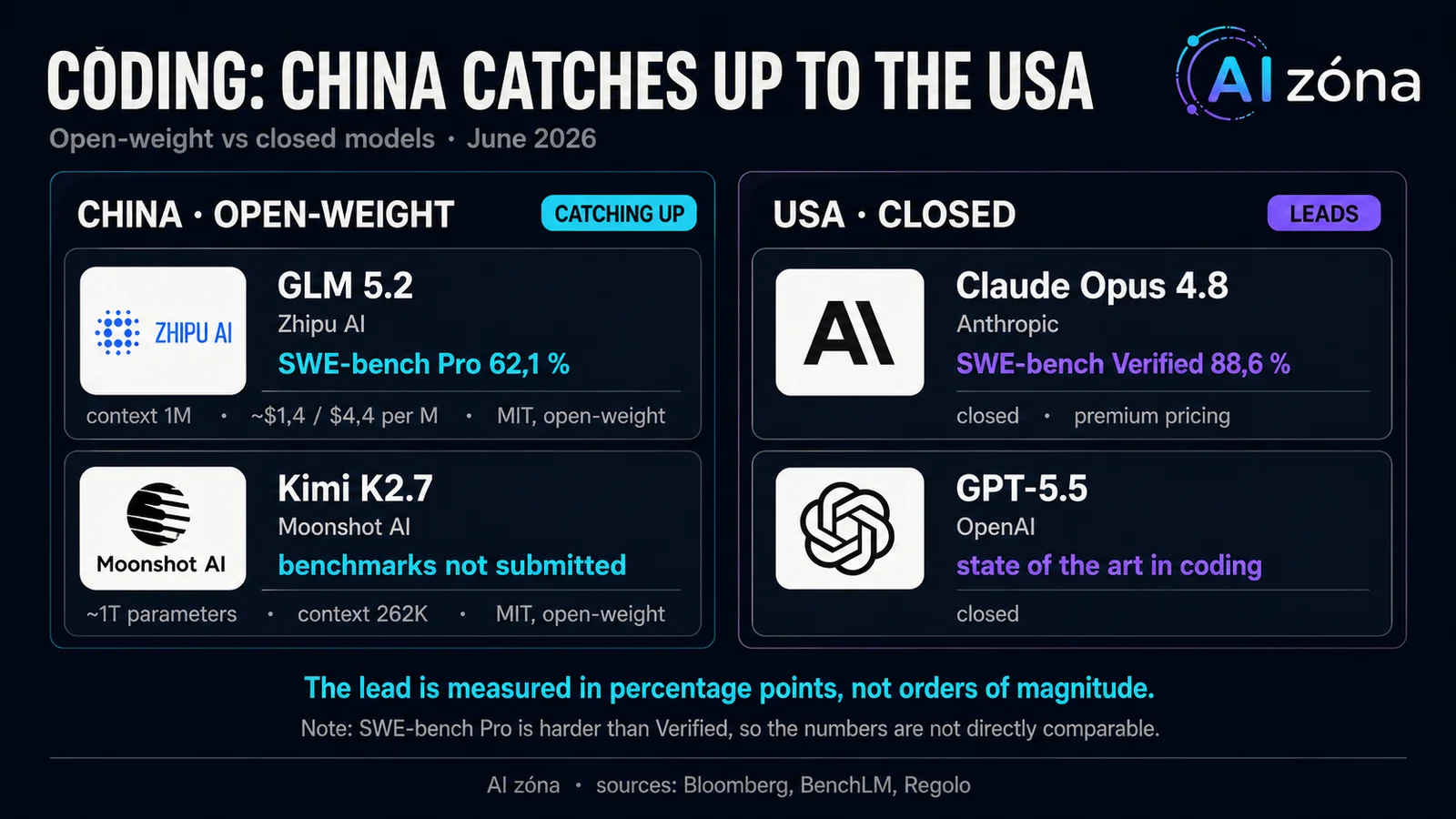
It is not just a plan on paper. Two Chinese open-weight models shipped alongside it, GLM 5.2 from Zhipu and Kimi K2.7 from Moonshot, and in coding they are catching up to the US frontier. Hardware independence and homegrown frontier models suddenly go hand in hand.
What you'll appreciate most
That you have gained a cheap, downloadable alternative. Chinese open-weight models mean you are no longer tied to just two or three American companies. You can download GLM 5.2 and Kimi K2.7, run them yourself, or use a far cheaper API.
And it is an alternative nobody can switch off by your passport or reprice overnight. Open weights mean the model is yours. Once you download it, no government or company can revoke your access. That is exactly the certainty missing from closed American models today.
Who it's for
It matters most to developers and companies paying for AI coding every month. For them the difference between the US frontier and a Chinese open-weight model is mainly a question of cost and control, not a dramatic gulf in capability.
Developer and coding team
- Coding
- Code review
- Agents
Cost-conscious company
- Costs
- Independence
- Operations
Creator watching the scene
- Trends
- Tools
- Choices
How to use it in practice
Start by trying a Chinese model once on a real task, not for play. Take a concrete coding task you normally run through Opus or GPT and run it through GLM 5.2. You will see the difference in quality and price with your own eyes.
01 · Test it
02 · Count the cost
03 · Keep a backup
A real-world example
A smaller studio's dev team paid for a closed API on every code review and the bill grew with each new project. They moved routine work, refactoring and test generation, onto GLM 5.2 through a cheap API. They kept the hardest architectural tasks on Opus 4.8. The result: the AI bill dropped by more than half, the quality of everyday work stayed comparable, and sensitive internal code now runs through an open-weight model they fully control.
Recommended tools
For everyday coding a Chinese open-weight model is plenty today, for the hardest tasks reach for the US frontier. This is a practical split, not politics. It is about which model is worth it for which job.
GLM 5.2
Zhipu AI
Best for
Developers who want strong coding at a fraction of the US frontier's price.
Kimi K2.7
Moonshot AI
Best for
Teams looking for a cheap agentic model with big reach.
Claude Opus 4.8
Anthropic
Best for
Anyone who needs the absolute top for the hardest programming.
Summary
The AI world is starting to split into two separate ecosystems. With a 2 trillion yuan plan China is clearly saying it does not want to depend on American hardware, and with its open-weight models it shows it has the frontier software too. Meanwhile the US lead in coding is measured in single-digit percentages, not orders of magnitude.
The good news for you is that you benefit from this contest. You have gained cheap, open, downloadable models nobody can switch off by your passport. Whether the world splits into an American and a Chinese AI bloc, or stays connected, remains to be seen. What you can do right now is test whether a Chinese open-weight model saves you most of your coding bill.
Sources
- Bloomberg: China preps $295 billion plan to fund nationwide AI buildout
- Tom's Hardware: China drafts $295 billion plan for a national AI grid running on 80% domestic chips
- Capacity: China plans state-directed AI buildout, moves to lock out Nvidia and AMD
- SWE-bench Verified leaderboard (as of 18 June 2026)
- Regolo: GLM 5.2 vs Kimi K2.7 Code coding comparison
Frequently asked questions
What people often ask
What is China's 2 trillion yuan plan?
A five-year state program to build national AI infrastructure. China reportedly plans to spend around 2 trillion yuan, roughly $295 billion, to connect data centers into a single computing grid by about 2028. The plan is coordinated by the National Development and Reform Commission (NDRC). The key part is a requirement that at least 80 percent of the technology, mainly AI chips, comes from domestic suppliers. Huawei and its Ascend line are set to be the main supplier, which effectively squeezes Nvidia and AMD out of Chinese data centers.
Why is China cutting out Nvidia and building on Huawei Ascend?
Sanctions and self-reliance. US export controls limited China's access to Nvidia's most powerful chips, so Beijing is betting on a domestic replacement. Huawei shipped around 812,000 AI chips last year and projects roughly $12 billion in processor revenue for 2026. The goal is an isolated, self-sufficient AI ecosystem that US sanctions cannot reach. The weak point is HBM memory, which is scarce domestically, so how many Ascend chips Huawei can actually build is the biggest question mark over the whole plan.
Are Chinese AI models better at coding than GPT-5.5 or Claude Opus 4.8?
Not better yet, but close. American closed models like Claude Opus 4.8 and GPT-5.5 hold the top, with Opus 4.8 around 88.6 percent on SWE-bench Verified. China's GLM 5.2 reports 62.1 percent on the harder SWE-bench Pro, which are not directly comparable numbers, but the gap is measured in single-digit percentages, not orders of magnitude. GLM 5.2 and Kimi K2.7 are also open-weight and several times cheaper. For everyday coding they often suffice, for the hardest tasks reach for the US frontier.
Can I run the Chinese open-weight models on my own hardware?
Yes, and that is the main advantage. GLM 5.2 and Kimi K2.7 shipped under an MIT license with open weights on Hugging Face, so you can download and run them yourself. The full versions are large (GLM 5.2 has 753 billion parameters, Kimi K2.7 around a trillion), so on a regular PC you need quantized variants or rented GPUs. The easiest path is the cloud API, which is far cheaper than the US frontier for both. The benefit of open-weight is that nobody can switch the model off or raise its price overnight.
Keep going
Related articles
More guides from the same area, topics and tools.
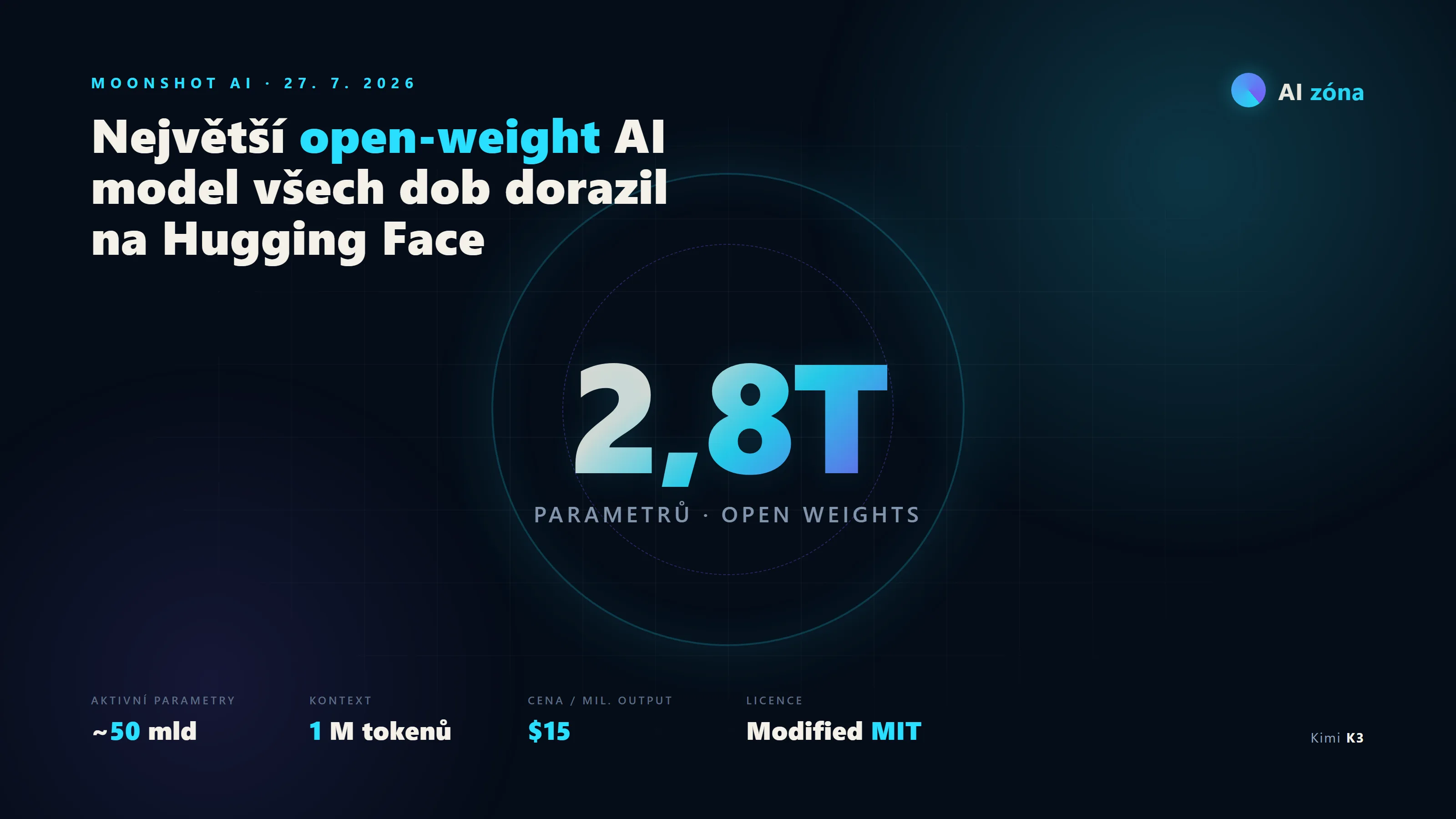
Kimi K3: 2.8 trillion parameters for free, but your home PC will not run it
Moonshot AI released Kimi K3 on July 27, 2026, the largest open-weight model in history. It has 2.8 trillion parameters, an MIT-modified license and, through a hosting cloud, costs roughly a third of Fable 5. Running it at home is a no-go.

GLM 5.2: New King of UI?
Chinese open-source model GLM 5.2 builds apps, games and components from a single prompt in ways that leave Claude Opus 4.8 behind. Is this the new leader in UI generation?

America just pulled Claude Fable 5 for all foreigners. Has the hybrid AI war begun?
On 12 June 2026 the US government ordered Anthropic to disable Claude Fable 5 and Mythos 5 for all foreign nationals. What does it mean for Europe and what can you do about it?