
GLM 5.2: New King of UI?
Chinese open-source model GLM 5.2 builds apps, games and components from a single prompt in ways that leave Claude Opus 4.8 behind. Is this the new leader in UI generation?
News analysis
GLM 5.2 + Claude Opus 4.8
On June 13, 2026, Zhipu AI quietly rolled GLM 5.2 out across every tier of its Z.ai Coding API. No big press conference, no benchmarks. Within 48 hours, a wave of side-by-side videos hit X anyway: developers feeding the same prompt to GLM 5.2, Claude and Kimi and putting the results next to each other. In the UI category, GLM 5.2 came out ahead. Clearly enough that the whisper started spreading: a Chinese open-source model just rewrote the UI generation leaderboard.
What's New
GLM 5.2 is Zhipu AI's new coding flagship, released June 13, 2026 under an MIT license with a 1-million-token context window.
The model has 744 billion parameters in a Mixture-of-Experts architecture, activating only 40 billion per token. The 1M context is five times larger than its predecessor and it's context the model actually uses productively, not just technically measures. From day one it was picked up as a model by Claude Code, Cline, Roo Code and Kilo Code.
What You'll Appreciate Most
It saves time on UI prototyping. From one prompt you get a working component, not just a skeleton. In the first user tests, GLM 5.2 output needed fewer follow-up prompts than comparable attempts with Opus 4.8 on the same task.
Concrete outputs from Z.ai's demo:
- 925-line SVG mechanical clock with animated hands, generated from a single prompt
- 3D football game in Three.js and Cannon.js with CPU opponent, passing and game state
- In-browser spreadsheet with formula engine, undo/redo and CSV import
Users report the model has stronger intuition for client-side architecture: message streaming, persistent state, mobile interactions and local state management. The resulting components feel like code written by a frontend developer who lives in this stuff, not just translated from a description.
Who It's For
Frontend developers and designers looking for a model to quickly prototype components, apps and games from a prompt.
Frontend Developer
You want a working component from a prompt, not just a structure. GLM 5.2 generates correct client-side logic on the first attempt.
- React/Vue prototypes
- UI components
- simple games
Startup or small company
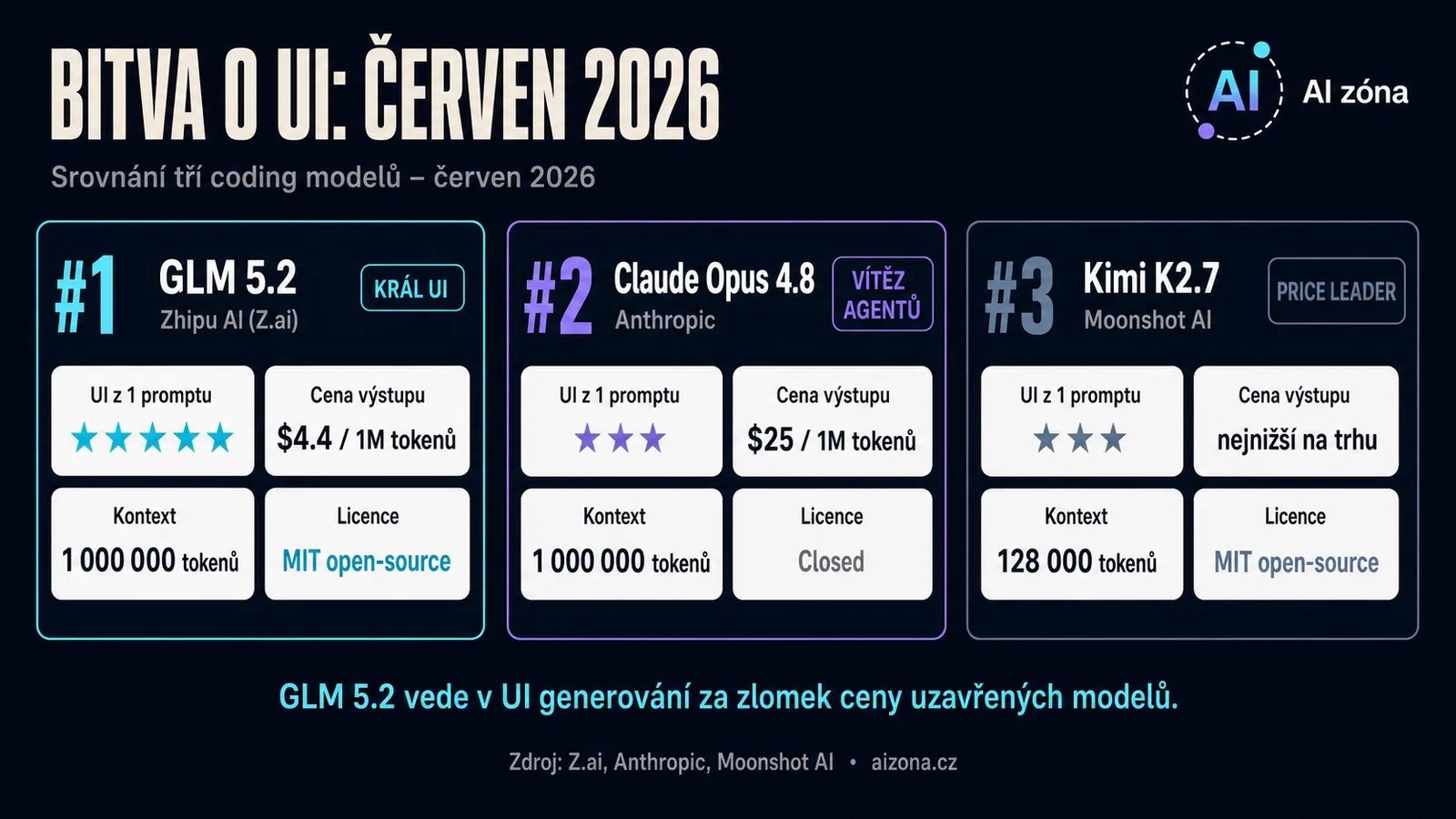
MIT license and open weights let you deploy the model on your own infrastructure. A million output tokens costs $4.4 instead of $25 with Opus 4.8.
- Self-hosting
- open-source stack
- predictable costs
Designer or product team
No time to wait on a developer for every experiment. GLM 5.2 takes a description and returns a working page you can show to clients or leadership.
- Text-to-wireframe
- interactive prototypes
- quick visual experiments
For agentic tasks, complex refactors in existing codebases and tool-use scenarios, Claude Opus 4.8 still leads. GLM 5.2 isn't unambiguously the better model. It's the better model for specific UI scenarios at a significantly lower price.
How to Use It in Practice
The fastest start is through the Z.ai API or the Vercel AI Gateway playground, where you can try the model without registration. If you already use Claude Code or Cline, just switch to glm-5.2 in your configuration. The model is available as an OpenAI-compatible endpoint, so no special integration work needed.
Try it live:
- Z.ai Developer Portal — docs, API keys, playground
- Vercel AI SDK Playground — switch model to GLM 5.2, no signup needed
- Z.ai Kilo Code demo — video: building a 3D football game from a single prompt
Real-World Example
Z.ai demonstrated building a 3D football game step by step at launch: starting as a simple 2D top-down view and evolving into a full 3D Brazil vs. Argentina match with player controls, passing and a CPU opponent. The whole build ran inside Kilocode connected to the Z.ai API.
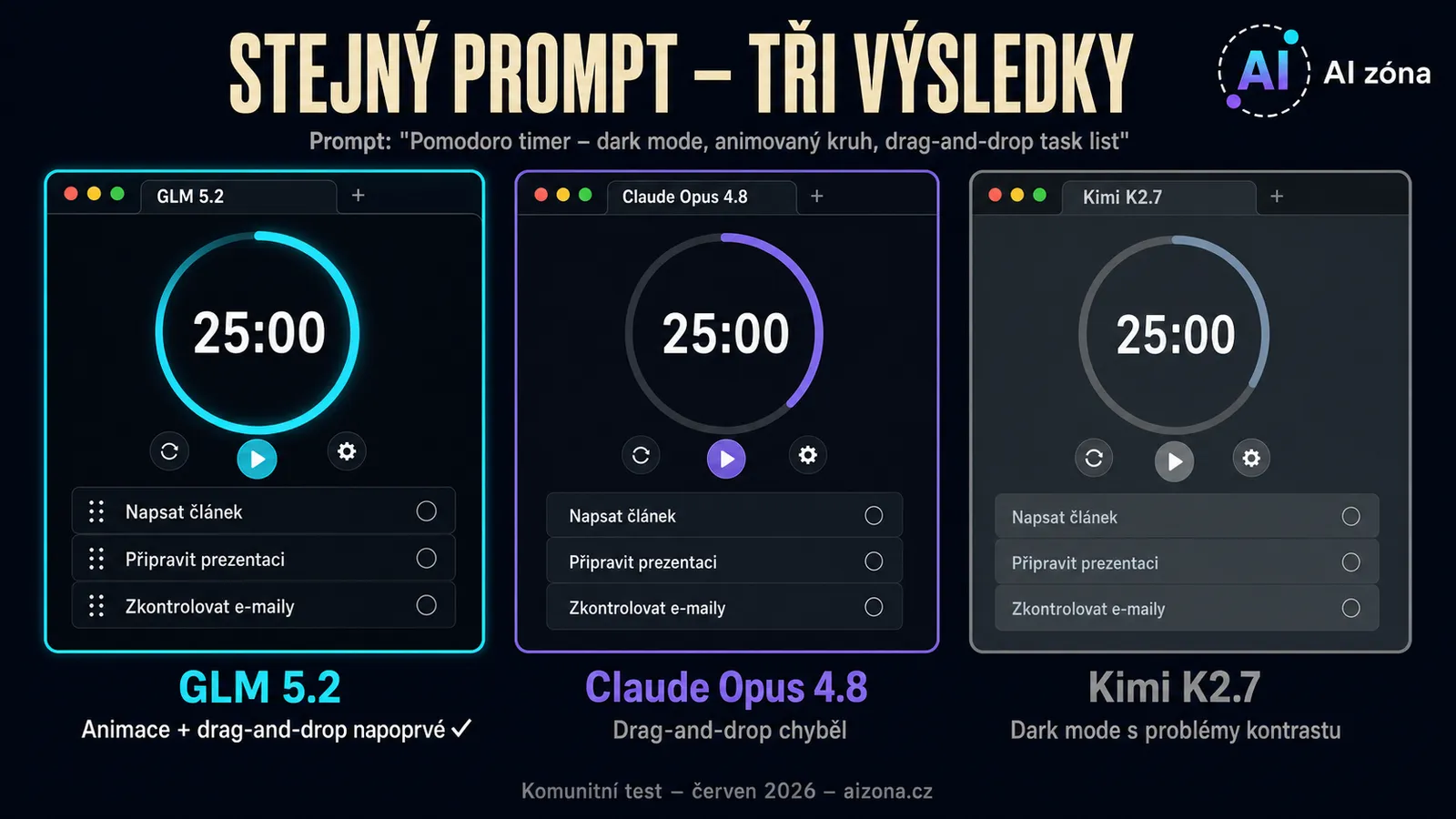
The community followed with their own tests: the same prompt for a Pomodoro timer with dark mode, an animated circular progress ring and a drag-and-drop task list. Outputs from Claude Opus 4.8 and Kimi K2.7 worked, but the animation and drag-and-drop needed a follow-up prompt. GLM 5.2 got them right on the first attempt, including dark mode with system preference detection built into the code automatically.
Model Comparison: June 2026
GLM 5.2
Zhipu AI (Z.ai)
Strongest open-source choice for UI generation. $1.4/$4.4 per 1M tokens, MIT license, 1M context. Stands out in components and single-prompt outputs.
Best for
developers, self-hosting teams
Claude Opus 4.8
Anthropic
Still leads on complex benchmarks, tool-use and multi-step planning. $5/$25 per 1M tokens. Best for agents and complex software projects.
Best for
agentic tasks, SWE, long-horizon
Kimi K2.7-Code
Moonshot AI
KimiCodeBench v2: 62.0 (Opus 4.8: 67.4). Cheap metered tokens and open weights available from launch. Strong on frontend, GLM 5.2 holds an edge in UI fidelity.
Best for
price-sensitive, metered tokens
Summary
GLM 5.2 didn't knock Opus 4.8 off the top of general leaderboards. It wasn't designed to, and Zhipu AI doesn't claim otherwise. But it's a genuine contender for the top spot in one specific discipline: generating UI components, games and apps from a single prompt, where the output looks like it was written by a frontend developer with real client-side experience.
At a fraction of the price, with an MIT license and open weights, that's an argument developer teams can't ignore.
UI from one prompt
3D games, spreadsheet apps, animated SVG. GLM 5.2 generates working output where others need follow-up.
5x cheaper output
$4.4 vs $25 per million output tokens. With the long outputs typical of UI generation, the savings add up fast.
No official numbers
Zhipu AI published no standardized benchmarks. Strong impression from demo videos, but lab numbers are still missing.
Open-source MIT
Self-hosting, your own infrastructure, no license headaches. Weights available from the week after launch.
Sources
- Zhipu AI / Z.ai developer docs — docs.z.ai/guides/llm/glm-5.2
- DataCamp: GLM-5.2 Features, Setup, and Model Switching Guide
- Codersera: GLM 5.2 vs Claude Opus 4.8: Should You Switch Your Coding Stack?
- buildfastwithai.com: Best AI Models for Frontend UI Development 2026
- ThePlanetTools.ai: GLM 5.2 vs Kimi K2.7-Code
- AIWeekly: Zhipu Deploys GLM 5.2 to All GLM Coding Plan Tiers
Frequently asked questions
What people often ask
Is GLM 5.2 better than Claude Opus 4.8?
Depends on the task. For UI generation and frontend prototypes, many developers rate GLM 5.2 higher, especially on single-prompt builds. For complex agents, long-horizon software engineering and tool-use, Claude Opus 4.8 still leads. GLM 5.2 also costs 3.5 to 5.7 times less and can be self-hosted.
How do I try GLM 5.2?
Via the Z.ai API (docs.z.ai), Vercel AI Gateway playground, or directly in Claude Code, Cline, Roo Code and Kilo Code where it has been supported since launch. For self-hosting, MIT weights were announced for the week after launch.
Is GLM 5.2 genuinely open-source?
Yes, MIT license. At launch on June 13, 2026 it was available via the Z.ai API and open weights were confirmed for the following week. That means you can deploy it on your own infrastructure with no licensing restrictions.
How does GLM 5.2 differ from Kimi K2.7?
Both are Chinese open-source coding flagships that shipped in June 2026. Kimi K2.7-Code leads on KimiCodeBench v2 and offers cheaper metered tokens. GLM 5.2 holds an edge in UI fidelity from a first prompt and has a 1M context window with MIT weights for self-hosting.
How much does the GLM 5.2 API cost?
Input tokens $1.4 per million, output tokens $4.4 per million. Claude Opus 4.8 runs $5 input and $25 output. On output tokens, which tend to be long in UI generation, GLM 5.2 saves you roughly 5.7 times the cost.
Keep going
Related articles
More guides from the same area, topics and tools.
OpenAI's Astra solved ten open math problems. For 2,000 dollars in API tokens
OpenAI announced a new model family called Astra on August 2, 2026. An internal version cracked ten mathematical problems that had been stuck for a decade or longer, and published the proofs as machine-verifiable Lean 4 certificates.

Claude Science: can Anthropic take over scientific research now that it grabbed a Nobel laureate too?
On June 30, 2026, Anthropic launched Claude Science, a standalone application for scientific research. Ten days earlier, Nobel laureate and AlphaFold co-creator John Jumper defected to them. What does that mean for biotech, pharma and academia?

China is betting 2 trillion yuan on AI without Nvidia. Will it build its own world?
China is preparing a five-year plan worth 2 trillion yuan (~$295bn) to build a national AI grid that runs 80% on domestic Huawei chips. What does it mean for the models you use?