
Can NVIDIA Spark take on Apple's M5? The new AI chip brings petaflop power straight to a laptop
NVIDIA has shown off RTX Spark, the laptop version of its Grace Blackwell chip. It promises up to a petaflop of AI performance and 128 GB of shared memory. Here is what it does and how Apple's M5 Max stacks up.
News analysis
NVIDIA RTX Spark + NVIDIA DGX Spark
What's new
At Computex 2026 NVIDIA unveiled RTX Spark, a Grace Blackwell chip for Windows laptops and mini-PCs. It is essentially the same silicon that has powered the desktop DGX Spark AI computer since last year, just placed into a portable form. NVIDIA developed it together with MediaTek and refers to it internally as N1X.
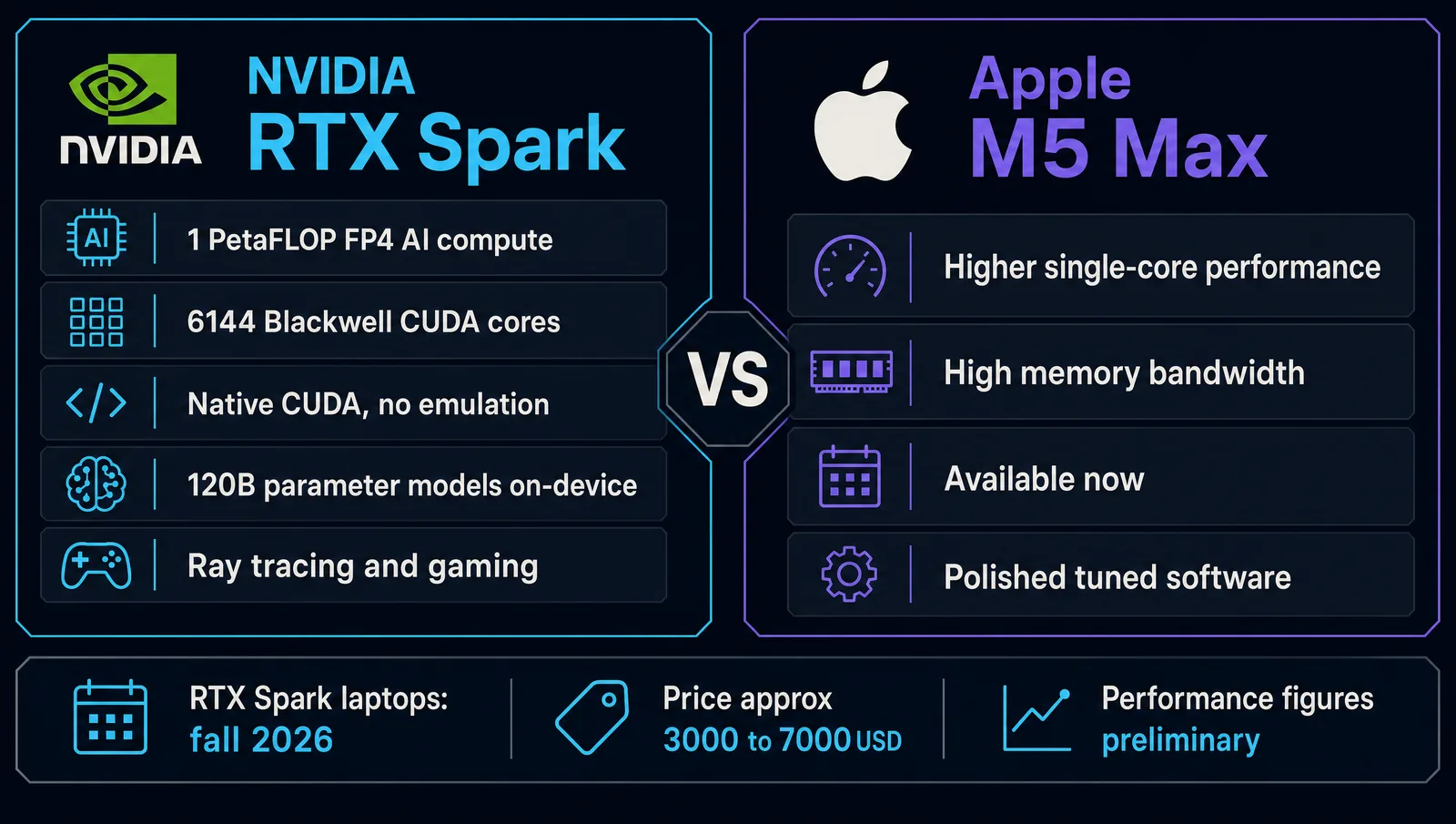
In a single package you get 20 Arm cores, a Blackwell GPU with 6,144 CUDA cores and up to 128 GB of shared memory. That memory lets the chip fit AI models that would not load onto a typical laptop GPU. NVIDIA talks about up to a petaflop of performance in the FP4 format.
The first machines from ASUS, Dell, HP, Lenovo, Microsoft and MSI are due in fall 2026. That puts RTX Spark in a direct fight with Apple's M5 Max, the reference point for AI work on a laptop.
What you'll appreciate most
Large models will run locally. The shared 128 GB memory is the whole trick of the chip. The CPU and the GPU reach into the same memory, so there is no copying data back and forth, and the device fits a model that a regular GPU could not handle.
In practice that means you do much of your AI work right in the laptop, without the cloud and without waiting for a remote GPU. Your data stays with you and you do not pay for every hour of compute separately.
AI models
3D and render
Video and games
Who it's for
For people who work with AI or creation full time and want the power with them, not in the cloud. For ordinary writing, web and office work a petaflop is overkill and a far cheaper laptop is enough.
AI developer
- Local inference
- fine-tuning
- agent prototypes
3D and video creator
- Render
- 12K editing
- visualization
Privacy-focused company
- Sensitive data
- on-device AI
- no cloud
How to use it in practice
For now, mostly watch and plan. The laptops only arrive in fall 2026, so the task today is deciding whether to wait or reach for another solution already. If you need the power now and do not mind a Linux desktop, the DGX Spark with the same chip already exists.
The key question is where you do most of your AI work. If the cloud and a subscription are enough, you do not need to wait for an expensive chip. But if you want your data with you and expect to run models daily, RTX Spark can repay those cloud bills quickly.
A real-world example
A data scientist today tunes a 70-billion-parameter model on a remote GPU. They pay for every hour of compute and wait for a machine to free up. With a laptop on RTX Spark they would run the same model, and its larger 120-billion version, locally, with a million-token context and no monthly cloud bill. And the data would never leave their desk.
Recommended tools
Pick by what you do and which ecosystem you are in. RTX Spark aims at AI and CUDA, Apple at polished software and battery life, Qualcomm at price and battery. Here is a quick comparison of the main players.
NVIDIA RTX Spark
NVIDIA + MediaTek
Best for
AI developers, data scientists, 3D and video creators.
Apple M5 Max
Apple
Best for
Mac users, creatives, anyone wanting a finished solution.
Snapdragon X2 Elite
Qualcomm
Best for
Anyone watching price, battery and everyday work.
Summary
RTX Spark moves the kind of power that used to live only in a desktop AI computer into a laptop. For developers and creators it is a serious alternative to Apple's M5 Max, mainly thanks to shared memory and native CUDA. An ordinary user does not need it and can wait until fall 2026 for confirmed prices and benchmarks too. But the fight over the laptop AI chip has just begun, and Apple finally has a real rival.
Sources
Frequently asked questions
What people often ask
Is it worth waiting for NVIDIA RTX Spark?
If you work with AI models, 3D or video and want it all running locally, waiting makes sense. RTX Spark promises up to a petaflop of AI performance and 128 GB of shared memory, so it can run models around 120 billion parameters right inside a laptop. For an ordinary user doing work, web and gaming a petaflop is useless and a cheaper laptop does the same. The first machines also only ship in fall 2026, and the estimated 3,000 to 7,000 dollar price aims squarely at professionals.
What is the difference between NVIDIA DGX Spark and RTX Spark?
It is almost the same chip in two boxes. DGX Spark is a desktop AI mini-computer that already sells for about 4,699 dollars and runs Linux. RTX Spark is the same Grace Blackwell chip placed into Windows laptops and mini-PCs that are still coming. NVIDIA uses the codename N1X for it, but technically it is the same as the GB10 in DGX Spark. The main practical difference is the operating system and the form factor: a Linux desktop versus a portable Windows device.
Is RTX Spark better than Apple M5 Max?
It depends on the workload, and we only have preliminary numbers so far. In an early test set Apple M5 Max leads on single-core performance, where NVIDIA trails by roughly 30 percent. In heavy developer workloads RTX Spark turns it around: in code compilation it was reportedly 54 percent faster than the base M5. NVIDIA's big advantage is native CUDA, so AI and 3D tools run without emulation, plus ray tracing and gaming. Apple still offers polished software and higher memory bandwidth.
What is NVIDIA Spark good for?
Mainly for running large AI models locally and for heavy creative work. NVIDIA cites rendering 3D scenes up to 90 GB, editing 12K video and running models with 120 billion parameters and a context up to a million tokens, all on the device. Thanks to 128 GB of shared memory the chip fits models that would not load onto a regular GPU. It makes sense for AI developers, data scientists and 3D and video creators who want to work without the cloud and without waiting for remote GPUs.
How much will NVIDIA RTX Spark cost and when does it launch?
The first laptops and mini-PCs with RTX Spark are expected, per NVIDIA, in fall 2026 from ASUS, Dell, HP, Lenovo, Microsoft and MSI. Exact prices are not confirmed yet, with estimates ranging roughly from 3,000 to 7,000 dollars depending on configuration. For comparison, the desktop DGX Spark with the same chip currently sells for around 4,699 dollars. So expect a premium price. This is not hardware for every home, but a work tool for people who take AI and creation seriously.
Keep going
Related articles
More guides from the same area, topics and tools.

China is betting 2 trillion yuan on AI without Nvidia. Will it build its own world?
China is preparing a five-year plan worth 2 trillion yuan (~$295bn) to build a national AI grid that runs 80% on domestic Huawei chips. What does it mean for the models you use?

Kimi K3: 2.8 trillion parameters for free, but your home PC will not run it
Moonshot AI released Kimi K3 on July 27, 2026, the largest open-weight model in history. It has 2.8 trillion parameters, an MIT-modified license and, through a hosting cloud, costs roughly a third of Fable 5. Running it at home is a no-go.

America just pulled Claude Fable 5 for all foreigners. Has the hybrid AI war begun?
On 12 June 2026 the US government ordered Anthropic to disable Claude Fable 5 and Mythos 5 for all foreign nationals. What does it mean for Europe and what can you do about it?