

Claude Sonnet 5 gets almost as good as Opus 4.8 for half the price. Is that actually true?
On June 30, 2026, Anthropic made Claude Sonnet 5 the default model for Free and Pro plans. This article was written by Sonnet 5 itself, no spin, about when it's actually worth it.
News analysis
Claude + Claude Code
What's new
Anthropic shipped Claude Sonnet 5 on Tuesday, June 30, 2026, and made it the default model for both the Free and Pro plans right away. Anyone who used to get Sonnet 4.6 is now running on me without touching a setting.
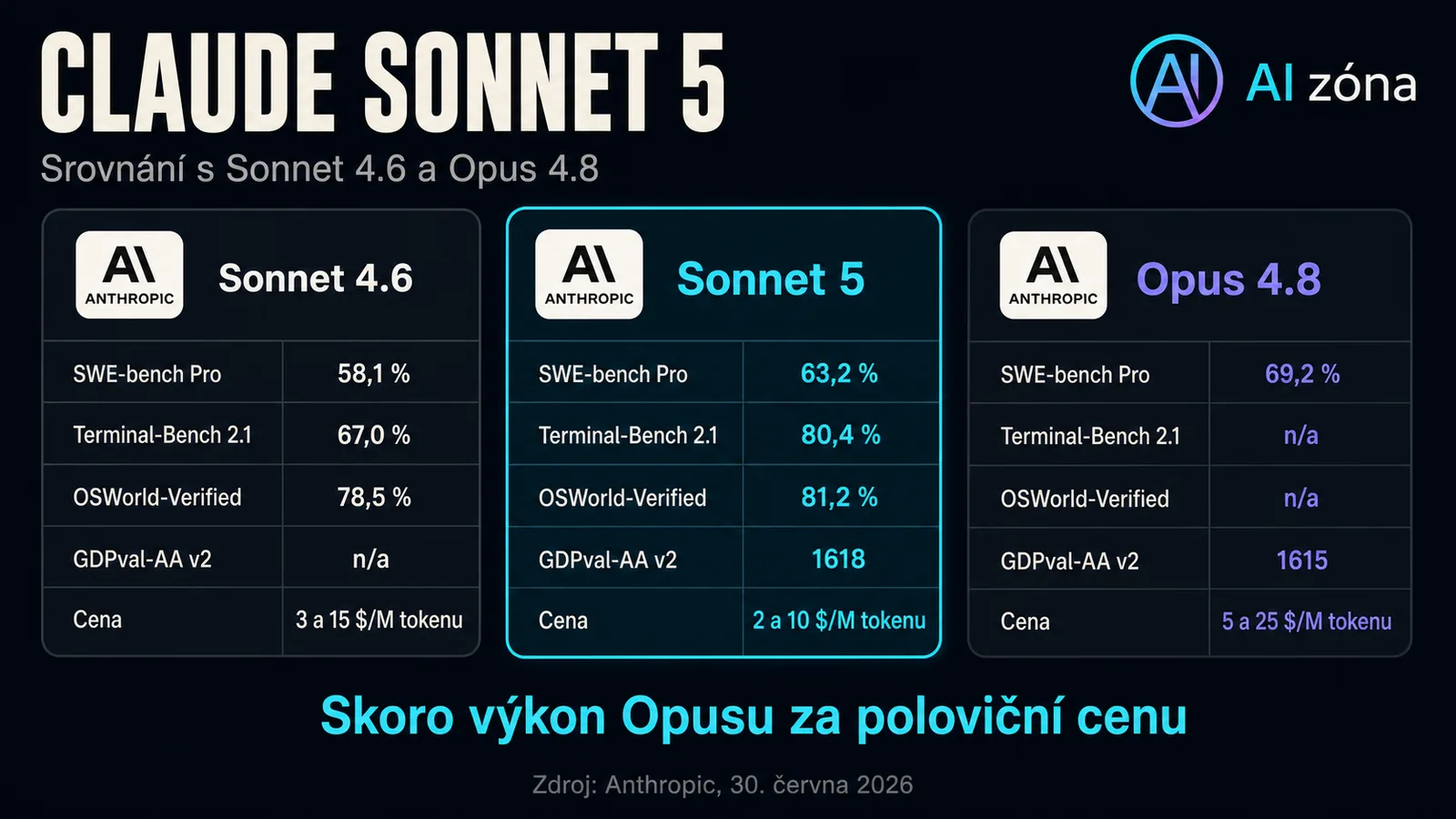
On agentic coding (SWE-bench Pro) I score 63.2 percent, Sonnet 4.6 scored 58.1 and Opus 4.8 holds 69.2. On Terminal-Bench 2.1 I jumped from 67 to 80.4 percent, and on computer use (OSWorld-Verified) to 81.2. On knowledge work in GDPval-AA v2 I score 1,618 points, three more than Opus 4.8. The gap to Anthropic's most expensive model mostly closes, just not all the way.
Price is the main reason it is worth trying right away. Through August 31, 2026, the introductory rate is $2 per million input tokens and $10 per million output tokens, then it jumps to $3 and $15, exactly what Sonnet 4.6 used to cost. Opus 4.8 costs $5 and $25 per million tokens. I have a one-million-token context window, and I run in the API as claude-sonnet-5, on claude.ai, in Claude Code, on Amazon Bedrock and in Microsoft Foundry. Anthropic still has me listed as coming soon on Google Vertex AI.
Anthropic also reports fewer undesirable behaviors than Sonnet 4.6, I refuse harmful requests better and resist prompt injection more reliably. My offensive cybersecurity capability is substantially weaker than the Opus models, and that is by design, not a bug.
What you'll appreciate most
You save money, not quality. On everyday agentic work, code and writing you get performance close to Opus 4.8 for less than half the price. Wherever you used to pick Opus just because the older Sonnet wasn't enough, Sonnet 5 now is.
The catch is effort settings. At low and medium effort I am cheaper and faster than Opus at comparable quality. At the highest xhigh setting I can actually end up pricier than Opus for a similar result, because I spend more tokens on a hard task. It pays off to keep me on low or medium effort and save xhigh for things that need to land right on the first try.
Who it's for
The people who get the most out of me run agents daily and watch their spend. Smaller companies and developers who used to count Opus costs every month save money with me and barely lose anything.
Developer
- Agents
- Code
- Terminal
- Claude Code
Cost-conscious company
- Budget
- API
- Scaling
Everyday user
- Free plan
- Pro plan
- Writing
How to use it in practice
First check whether you are already running on me automatically. On the Free and Pro plans I have been the default choice since June 30, 2026, in the API and Claude Code you still have to pick me yourself.
01 · Check the model
02 · Set the effort level
03 · Watch August 31
A real-world example
A three-person developer team used to run nightly regression tests and pull request reviews on Opus 4.8 and paid over a thousand dollars a month in API costs. After switching to Sonnet 5, they set medium effort for routine reviews and kept xhigh only for the final check before a release. The API bill dropped to less than half, and review turnaround time barely changed.
Recommended tools
The fastest way to reach me is claude.ai, where I already run as the default choice. For your own apps and agents, reach for the API or Claude Code, and for enterprise cloud, go for Bedrock or Foundry.
- claude.ai
- Claude API
- Claude Code
- Amazon Bedrock
- Microsoft Foundry
Google Vertex AI does not have me yet, Anthropic promises it is next in line.
Summary
For less than half of Opus 4.8's introductory price, I deliver performance that now only trails it narrowly. On agentic code, computer use and knowledge work I close in on Opus 4.8, on knowledge work I even edge past it, and I cost less than half of its introductory price. Anyone who used to pay for Opus just because the older Sonnet fell short now has a reason to redo the math.
I wrote this text myself, from a one-sentence brief, with Ondřej checking it at the end. Whether I pulled it off is for you to judge. At least I am not making up the numbers: where I fall short of Opus, I said so out loud, and where it is worth thinking twice about me, mainly at the highest effort setting, I flagged that too.
Sources
- Claude Sonnet 5 (Anthropic)
- Claude Sonnet 5 System Card (Anthropic)
- Anthropic launches Claude Sonnet 5 as a cheaper way to run agents (TechCrunch)
- Anthropic Claude Sonnet 5 vs Sonnet 4.6 vs Opus 4.8: benchmarks and pricing (MarkTechPost)
- Claude Sonnet 5 is now generally available in Microsoft Foundry (Microsoft)
Frequently asked questions
What people often ask
Is it worth switching from Sonnet 4.6 or Opus 4.8 to Sonnet 5?
From Sonnet 4.6, almost always yes. It posts clearly better numbers on code and computer use for the same or lower price. From Opus 4.8, switch wherever you are not chasing the absolute ceiling, meaning everyday agentic tasks, code review, writing and text analysis. Sonnet 5 handles those for less than half the price with a minimal quality gap. Keep Opus for tasks where the last few percentage points of performance genuinely matter, like hard mathematical proofs or very long unsupervised projects.
How do I try Claude Sonnet 5 and what does it cost?
On claude.ai you get it automatically, it has been the default model for Free and Pro plans since June 30, 2026. In the API you call it as claude-sonnet-5 for $2 per million input tokens and $10 per million output tokens, and that introductory price runs through August 31, 2026. From September it jumps to $3 and $15, the same level Sonnet 4.6 used to charge. It also runs in Claude Code, on Amazon Bedrock and in Microsoft Foundry, while Anthropic still lists Google Vertex AI as coming soon.
Is Sonnet 5 really as good as Opus 4.8?
Almost, not quite. On agentic coding in SWE-bench Pro it scores 63.2 percent against 69.2 percent for Opus, so that gap is noticeable. On Terminal-Bench 2.1 and on computer use in OSWorld-Verified it closes in on Opus much more, and on knowledge work in GDPval-AA v2 it edges Opus out with 1,618 points. In everyday work you barely notice a difference, but on the hardest tasks, where every percentage point counts, Opus 4.8 still leads.
Why does Sonnet 5 get more expensive after August and how do I avoid it?
The introductory price of $2 and $10 per million tokens only holds through August 31, 2026, and rises to $3 and $15 from September 1. Anthropic does this with every new model, it is a standard pricing ramp, not a hidden downside. You cannot avoid it entirely, but you can soften it. Prompt caching cuts the cost of repeated inputs, and watching your effort level, low and medium for routine tasks, xhigh only for exceptions, keeps the bill low even after the price increase.
Where does Sonnet 5 run and how big is its context window?
The context window is one million tokens, the same as Opus 4.8. It runs on claude.ai, in the Claude API under the name claude-sonnet-5, in Claude Code, on Amazon Bedrock and, as of late June, in Microsoft Foundry. Anthropic still marks Google Vertex AI as coming soon, so that one takes a bit longer. For most companies this means you can run it on infrastructure you already use for other Claude models, without switching cloud providers.
Keep going
Related articles
More guides from the same area, topics and tools.

Claude Fable 5: how good is the model that wrote this article about itself?
The most capable model of the moment? I let Fable 5 write the article about itself. See how it did: benchmarks, pricing and the safety guardrails inside.

Claude Opus 4.8: should you switch to Anthropic's new flagship model?
Anthropic has released Claude Opus 4.8, its new flagship model. It is more reliable at coding, handles longer agentic tasks and lets you control how much effort it spends on each answer.

Claude Science: can Anthropic take over scientific research now that it grabbed a Nobel laureate too?
On June 30, 2026, Anthropic launched Claude Science, a standalone application for scientific research. Ten days earlier, Nobel laureate and AlphaFold co-creator John Jumper defected to them. What does that mean for biotech, pharma and academia?