
OpenAI launched Daybreak Red. GPT-5.6-Cyber already found a hole in Chrome
OpenAI opened access to a new model called GPT-5.6-Cyber through the gated Daybreak Red program. It already surfaced a Chrome bug patched as CVE-2026-15903, but the key goes only to vetted defenders.
News analysis
GPT-5.6-Cyber + Daybreak Red
On Wednesday, August 10, 2026, OpenAI announced two things at once: a new specialized model called GPT-5.6-Cyber and an expansion of the gated Daybreak program that vetted defenders can use to access it. The model does what other frontier models openly refuse to do. It writes exploit chains, probes zero-day flaws, and rides along with red teams on pentests. The program has been running since spring, but the new model is the first one for which OpenAI has publicly acknowledged a real finding in a third-party product. Chrome took the first hit.
What OpenAI announced
On Wednesday August 10, 2026, OpenAI announced two things at once: the new cyber model GPT-5.6-Cyber and an expansion of the gated Daybreak program through which vetted defenders can access it. The model does what other frontier models openly refuse to do. It writes exploit chains, probes zero-day flaws, and rides along with red teams on pentests.
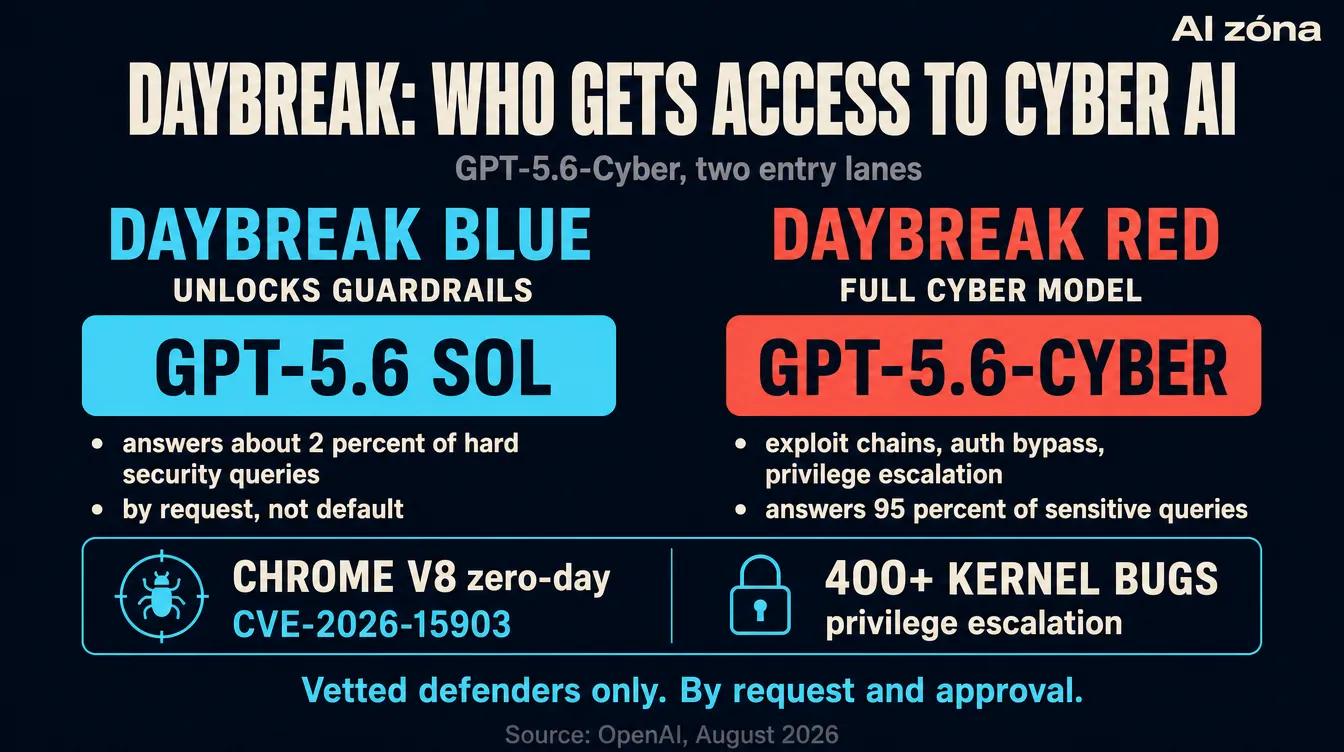
In testing, GPT-5.6-Cyber found two bugs in the V8 engine (the JavaScript engine in Chrome) that Google patched under CVE-2026-15903. It was high severity, because the optimizing compiler skipped a safety check when converting values to integers and undefined returned an unexpectedly large number. It was chainable into memory corruption and an escape from the V8 heap sandbox.
Beyond Chrome, OpenAI reports more than 400 vulnerabilities that the model surfaced in Linux kernels, mostly around privilege escalation. An internal benchmark shows that GPT-5.6-Cyber answers 95 percent of the sensitive security queries the base model refuses.
Access is handed out in two lanes. Daybreak Blue allows more security queries against the base GPT-5.6 Sol, which by itself only answers roughly 2 percent of the hardest security prompts. Daybreak Red opens the door to the new GPT-5.6-Cyber with a mandate covering exploit chains, authentication bypass, and privilege escalation. Both lanes are by request and approval, neither is default.
Why this finding carries different weight
It shows that AI vulnerability hunting has outgrown the demo phase. Chrome V8 is one of the sharpest training grounds in the world. One of Google's best teams builds it, professional security firms test it, and every other bug bounty on Zerodium hunts through it. When a language model finds a real chainable bug there in a few hours, the bar for what AI can do sits somewhere different from where it was last year.
The one bug does not matter, it will be patched. What matters is that this kind of research is reproducible. OpenAI shipped it as a product, not as a paper. Anthropic did the same with Claude Mythos through Project Glasswing back in May 2026. The trend is the same, cyber is the first domain where a specialized model has caught up with public frontier models and is starting to overtake them on a specific production task.
Honestly, when I first read the announcement, I expected more marketing than substance. The detail about CVE-2026-15903 convinced me that this case does not just stand on benchmark screenshots. The Chrome team fixed the bug and credited the AI origin, which is a different level of credibility than "our model scored 90 percent on a test".
Who actually gets into Daybreak Red
Vetted security teams with a documented work context. Bug bounty hunters whose profile OpenAI can verify through their public history of CVEs and reports. University labs of security research with publications. Government CERT teams in countries that OpenAI cooperates with under export rules. The rest of the world watches from behind the fence.
Security researcher inside a company
You have a documented work context on a product security or AppSec team, access to a representative sample of your code, and a clear responsible disclosure policy. Daybreak Red is a realistic path to testing before the product reaches the customer.
- Bug hunting in your own code
- exploit validation
- code review
- threat modeling
Bug bounty hunter with a profile
A track record on HackerOne or Bugcrowd, years of published findings, and a clean disclosure workflow. OpenAI verifies you through your history of CVEs and public reports, not through a form.
- Zero-day hunting
- HackerOne / Bugcrowd
- coordinated disclosure
Academic researcher
University labs with publications in academic security venues have access for reproducible research. OpenAI requires ethical review and a clear scope, no blanket key for anything.
- Weakness analysis in open source libraries
- publications in WOOT / USENIX
- CERT collaboration
Who does not get access: a freelance developer curious whether the model will find a bug in their own app, a regular pentester with no company affiliation, a student who wants to try CTFs, or people in countries where OpenAI is not allowed to sell under export rules. The form exists, but rejection is more the rule than the exception.
How to actually use it in defense
If OpenAI does let you into Daybreak Red, the workflow looks different from regular ChatGPT. The model has systemic authorization to probe exploit chains, but everything is logged at OpenAI and at the partner. It is not a tool for quiet work on your own. The expectation is that you find a bug, call the vendor, and wait for a patch in coordinated mode, not that you drop the exploit on Twitter.
Example from practice
A fintech firm with its own payments API gets Daybreak Red access for its AppSec team (five people). They deploy GPT-5.6-Cyber against their own codebase and ask the model to go through the authentication layer and hunt for chainable bugs that grant unauthorized access to a transaction endpoint. In a week the model produces twelve candidates. Seven of them prove real after verification (rate-limit bypass, race condition in refresh token, IDOR on one subresource). The remaining five are false positives. The team patches them internally, awards bounties to three external hunters who found the same in parallel through public tools. Speed: what used to take a quarterly audit now takes three weeks.
Two things are critical. The model is not a replacement for a human reviewer, the false positive rate of 40 percent is still high and every finding has to be verified by a person. And the second thing is coordination with legal, because whatever the model finds in a third-party library falls under responsible disclosure to the vendor, not into an internal ticket.
The blue team at a mid-sized SaaS company runs GPT-5.6-Cyber against its authentication flow. The model finds a bypass in the refresh token (a race condition under parallel requests). The company patches it within two days, informs enterprise customers through a security bulletin, and writes a post-mortem. Without a cyber model, an external pentester would have caught this in the yearly audit, seven months later.
What to do when you have no Daybreak access
It sounds like good news for defenders. Until you realize that the same kind of tool will soon reach an attacker who does not go through OpenAI's approval. Freely available open weight models (Kimi K3, Qwen 3.6, Llama, DeepSeek) will pick up exactly this kind of research over time, with no guardrails. You have a year, maybe two.
A practical answer for a team without a Daybreak Red key that still wants to use AI in defense:
- Automated scanning plus AI explanation. Semgrep, CodeQL, Trivy, or Snyk produce a list of findings. Claude Fable 5, Claude Opus 4.8, or GPT-5.6 Sol adds context, ranks severity, and suggests fixes. A deterministic tool plus a reasonable LLM is still the best combo for a team without special access.
- Threat modeling through an LLM. Describe the architecture and the model produces the attack surface, priorities, and test steps. No guardrails will trip on that kind of prompt.
- Code review of your own code. Frontier models can safely evaluate your repository. They lack a mandate to design an exploit in a third-party product, but they will find a race condition, a poorly validated input, or a bad token storage pattern.
- Watching the Daybreak roadmap. OpenAI hinted that access will expand to a broader circle once the disclosure loop is tuned. A bug bounty program and public CVE work will help build the profile OpenAI checks during approval.
Summary
GPT-5.6-Cyber is the first publicly acknowledged AI model that found a zero-day bug in a production tool with a finding the vendor accepted. It is not a demo, it is a shift in the bar. Daybreak Red hands this capability only to vetted defenders, but the balance will shift. What a gated OpenAI model can do today, a freely available open source model will do in a year. For your team it means cutting the time between finding a bug and patching it and not counting on old unmaintained dependencies staying out of reach.
Next step for you: audit what is running in production on a version older than twelve months and put it in the backlog with the priority of a net-new feature. When Daybreak Blue opens to the public, try to request access. And do not count on the guardrails of public models holding forever.
Sources
- OpenAI: Expanding Daybreak as the Cyber Defense Window Narrows, August 10, 2026.
- Yahoo Tech: OpenAI Ships GPT-5.6-Cyber Through Gated Daybreak Red Access Tier, August 11, 2026.
- TechTimes: GPT-5.6-Cyber Uncovered Chrome Zero-Days Standard AI Won't Touch, August 11, 2026.
- CybersecurityNews: OpenAI Expands Daybreak Cyber with GPT-5.6, August 2026.
- Developers Digest: OpenAI Ships GPT-5.6-Cyber Through Daybreak Red: The Numbers, the Chrome CVE, and What Access Looks Like, August 2026.
Frequently asked questions
What people often ask
Can I order GPT-5.6-Cyber on my regular OpenAI account?
Not yet. OpenAI hands it out only through Daybreak Red, a gated program for vetted defenders and security researchers. You have to go through approval, prove intent, and have a work context, typically a red team at a company, a bug bounty with a track record, or academic research. A regular ChatGPT Plus or API plan does not unlock it. The looser Daybreak Blue allows more security queries against the base GPT-5.6 Sol, but that too is by request, not default.
What do I do if I have no Daybreak access but still want to use AI for defense?
Reach for the public models that handle security work within normal guardrails. Claude Fable 5 and Claude Opus 4.8 can audit your own code, review PRs, draft a threat model, and interpret SAST findings. Combine that with Semgrep, CodeQL, Trivy, or Snyk so you get a deterministic output that the LLM annotates. For real zero-day hunting in third-party software, wait until OpenAI expands Daybreak, or hire a pentesting firm.
How is GPT-5.6-Cyber different from Anthropic's Claude Mythos?
Anthropic released Claude Mythos through Project Glasswing back in May 2026, also gated, also for select partners. GPT-5.6-Cyber goes one step further, because a publicly acknowledged zero-day discovery in a third-party product (Chrome V8, CVE-2026-15903) has so far been done by it alone. OpenAI gave it more autonomy and a broader mandate on exploit chain development, authentication bypass, and privilege escalation. Mythos is more defensive in framing, GPT-5.6-Cyber is more open to offensive research, but it ships to the same audience of vetted defenders.
Does this mean AI will start hacking me?
Not directly, because OpenAI is not giving GPT-5.6-Cyber access to just anyone yet. Indirectly yes, because every capability a defender has, an attacker gets equivalently. Open weight models like Qwen 3.6, Llama, or Kimi K3 will learn to do this kind of research over time without any approval process. The practical consequence: old dependencies, unpatched libraries, and legacy services with deferred updates will stop giving you a comfortable time buffer. What you deferred for half a year, someone may find in an afternoon.
What exactly did GPT-5.6-Cyber find in Chrome?
Two bugs in the V8 engine that could be chained to memory corruption and an escape from the V8 heap sandbox. Google fixed them under CVE-2026-15903. It was high severity, because the optimizing compiler skipped a safety check when converting values to integers and undefined returned an unexpectedly large number. Alongside that, the model surfaced more than 400 vulnerabilities in Linux kernels tied to privilege escalation. Internal benchmarks put GPT-5.6-Cyber at answering 95 percent of the sensitive security queries the base model refuses.
Keep going
Related articles
More guides from the same area, topics and tools.

OpenAI just shipped three new GPT-5.6 models. Why won't the US government let anyone near them yet?
OpenAI unveiled GPT-5.6 in three tiers, Sol, Terra and Luna. Because of a Trump administration intervention, only a handful of vetted companies can touch them so far.

America just pulled Claude Fable 5 for all foreigners. Has the hybrid AI war begun?
On 12 June 2026 the US government ordered Anthropic to disable Claude Fable 5 and Mythos 5 for all foreign nationals. What does it mean for Europe and what can you do about it?

OpenAI's Astra solved ten open math problems. For 2,000 dollars in API tokens
OpenAI announced a new model family called Astra on August 2, 2026. An internal version cracked ten mathematical problems that had been stuck for a decade or longer, and published the proofs as machine-verifiable Lean 4 certificates.