OpenAI's Astra solved ten open math problems. For 2,000 dollars in API tokens
OpenAI announced a new model family called Astra on August 2, 2026. An internal version cracked ten mathematical problems that had been stuck for a decade or longer, and published the proofs as machine-verifiable Lean 4 certificates.
News analysis
OpenAI Astra + Lean 4
OpenAI announced a new model generation under the working name Astra on August 2, 2026. Instead of the usual press release with benchmarks, it published a 249-page collection of mathematical proofs where its internal version cracked ten problems that mathematicians had left open for decades. Total compute cost: roughly 2,000 dollars in API tokens. You cannot buy it yet, but it is the most concrete look at where AI in scientific research is heading.
What OpenAI announced
Astra is the working name for OpenAI's next major model family. The company has not shipped it in ChatGPT or through the API, and has not said whether it will run as GPT-6 or as another variant of the five family. Instead of a blog post with marketing numbers, OpenAI released a report and an accompanying manuscript on August 2, 2026, where the internal Astra solved ten open problems in mathematics and theoretical computer science.
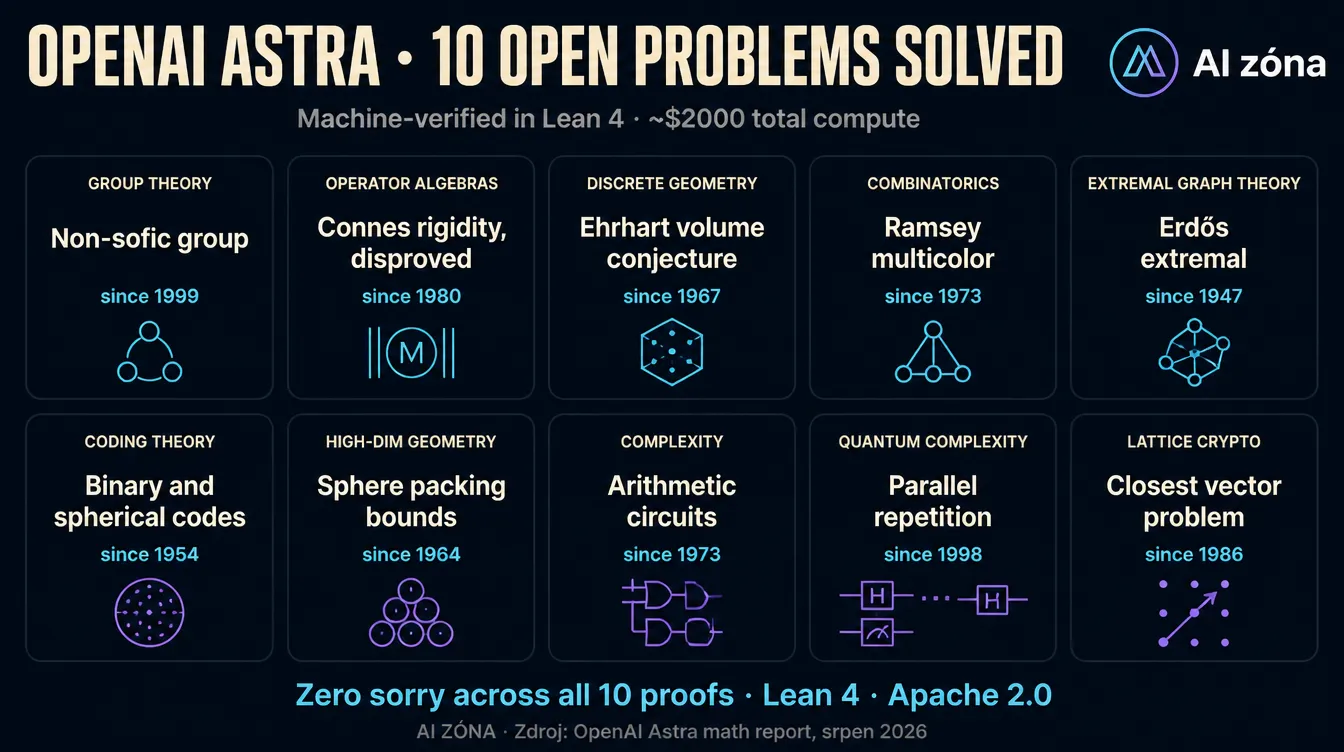
The full list: an explicit construction of a non-sofic group (a question left open since 1999, when Mikhail Gromov introduced the concept of soficity), disproving Connes' rigidity conjecture, Ehrhart's volume conjecture, three Erdős problems from multicolor Ramsey numbers and extremal graph theory, sphere packing bounds, binary and spherical codes, arithmetic circuit complexity, quantum parallel repetition, and the closest vector problem in lattice cryptography. Each proof is formalized in Lean 4, with certificates on GitHub under Apache 2.0. The repository reports zero unproven steps (Lean calls them sorry), meaning the type system sees every deduction from axioms to conclusion. Total compute across all ten solutions came to roughly 2,000 dollars at GPT-5.6 Sol API rates.
Why should you care about a model you cannot buy yet
Short answer: Astra will not speed up your daily work, but it changes how you plan a year ahead. For the first time, you have a scientific output from a major lab that no marketing team has to sell you. You can have it verified by a machine.
Lean 4 is a type system that itself checks every step of a proof for logical consistency. If the compiler passes without sorry, the proof holds. There is nothing to argue about, a laptop verifies it in minutes. That is a different situation from last October's announcement that GPT-5 had solved Erdős problems. A week later it turned out the model had retrieved existing solutions with no original contribution. With Astra the manipulation is off the table, because anyone can download the repository and run Lean locally.
The second thing worth remembering is the price. Two thousand dollars in API tokens for ten decade-old results is a fraction of what a single article in Nature or Annals of Mathematics costs. Scientific research is no longer tied only to human time. Compute is something you can buy, and Noam Brown of OpenAI himself admits the team did not throw unlimited resources at individual problems. Pushing test-time compute further is an open option.
Who actually gets something out of this
Short-term, nobody who uses ChatGPT regularly. Astra is not in any product you can click into. But three groups should already be thinking about what it means.
Scientists and mathematicians come first. Anyone who supervises PhD students or postdocs at a university has to reckon with AI that formalizes a proof into Lean 4 for a few hundred dollars. The economics of what we today call an open problem will change. When you can pay compute and get a proof, the labels 'unreachable' and 'open' problem will be reshuffled within one to two years.
The second group is teams doing formal software verification. Anyone working with Lean, Coq or F* on verifying cryptography, compilers or security protocols will get, within a year, a tool that writes invariant proofs on its own. Astra is not in public API yet, but the capability is there. Once OpenAI opens it up, formal verification will stop being a discipline for two hundred people in Cambridge, Paris and Boston.
The third group is developers and analysts watching where test-time compute is headed. If 2,000 dollars today buys ten PhD-level proofs, in a year it will cost an order of magnitude less. Anyone building an AI pipeline or working with agents should assume that tasks which look out of reach today will be routinely solvable through standard APIs this year or next.
How to verify a proof actually holds
You do not have to trust OpenAI or the model. The Astra proofs are public, and anyone with Linux or macOS can verify them in an afternoon. The steps:
1. Install Lean 4
Use elan (a one-line unix installer) or the official Windows setup. It takes five minutes, no Python or C++ toolchain required. Lean pulls in its own compiler version.
2. Clone the Astra repository
git clone downloads all ten proofs plus mathlib as a dependency. Size is a few hundred megabytes. The repo is Apache 2.0, so you can lift lemmas into your own research.
3. Run lake build
Compilation walks every proof. If it finishes without errors and grep sorry returns zero, the proofs formally hold. It takes tens of minutes on a regular laptop, under an hour on Apple M-series.
This is the key to why the Astra announcement lands differently from earlier "AI solved X" claims. Lean cannot hallucinate. Either the proof passes or it does not. If it passes, there is nothing left to argue about the model's capability. It can do it.
Example from practice
A cryptography team working on lattice-based algorithms for a post-quantum standard got a tip from a colleague about one of the published Astra proofs, specifically the result on the closest vector problem. Instead of a long wait for peer review in a journal, they cloned the repository, ran the Lean compiler and had certainty in an hour that the proof holds. They then pulled a lemma from it and used it in the security analysis of their own design. Cost to verify was zero dollars, because OpenAI released the result under an open license and the team already owned the hardware.
Bottom line
You cannot buy Astra yet, but it is the most concrete evidence that AI handles original scientific work with a machine-verifiable output. Ten open math problems, Lean 4 certificates with zero sorry, total cost 2,000 dollars in API. First step for you: open the Astra repository on GitHub, pick one proof and run it locally. You will see with your own eyes what kind of output every paying customer will get through a regular API a year from now.
Sources
- SiliconANGLE: OpenAI's Astra solves 10 long-open math problems and publishes the proofs, August 2, 2026.
- The Decoder: OpenAI announces its "next major model" Astra by dropping ten previously unsolved math solutions, August 2026.
- DataCamp: OpenAI's New Model, Astra, Has Solved Ten Open Math Problems, August 2026.
- Quartz: OpenAI Astra model solves 10 open math problems for $2,000, August 3, 2026.
- Forbes: OpenAI's Astra Solved Decades-Old Math Problems For $2,000, August 3, 2026.
Frequently asked questions
What people often ask
Can I try Astra in ChatGPT?
Not yet. OpenAI keeps Astra internal and has published no release plan. It has not said whether it will ship as GPT-6 or as another variant of the five family. The only concrete demo of the capability is the published math proofs and the accompanying 249-page report. For everyday use, expect the next flagship OpenAI model to arrive late 2026 at the earliest, and likely through API before ChatGPT. If you want to know where OpenAI is heading, read the research paper, not the press release.
Why is Astra different from earlier AI 'breakthroughs' in math?
The difference is Lean 4 verification. Last October OpenAI announced that GPT-5 had solved Erdős problems. It turned out to be retrieval of existing solutions, not new proofs. For each of the ten Astra results, the company published a Lean 4 certificate with zero unproven steps (Lean calls them sorry). That means the type system itself confirms every logical step. If the compile passes, the proof holds. There is no need to trust the model or OpenAI, you just run Lean locally.
What did the compute actually cost, and is that a lot?
OpenAI puts the cost at roughly 2,000 dollars at GPT-5.6 Sol API rates for all ten solutions combined. That is about 200 dollars per proof on questions that had made no progress in years. For comparison, a single math paper costs a university tens of thousands of dollars in direct researcher time and takes months to years. Test-time compute will keep falling. Noam Brown of OpenAI admits the team did not throw unlimited resources at each problem, so further optimizations are on the table.
What does this mean for me if I do not work in math?
It is a signal for year-ahead planning. If AI today solves PhD-level problems for a few hundred dollars with a verifiable output, in a year it will do it for tens of dollars. For you, that means tasks you file today under 'we do not have the capacity' will become accessible through standard APIs this year or next. It applies concretely to formal verification of software, legal analysis, market research and anywhere a human expert eats most of the time budget. Anyone planning a pipeline or automation should count on model capability being an order of magnitude different a year out.
What does 'zero sorry' mean in a Lean 4 proof?
Sorry is the keyword a mathematician uses in Lean 4 to mark a spot where a step is not yet filled in. The compiler still accepts such a proof as a well-typed file, but flags that one or more steps are missing. When a repository ships a proof with zero sorry across the whole tree, no step is left for later. The type system sees every deduction from axioms to conclusion. It does not guarantee the problem was formalized exactly the way mathematicians think about it. But it is the hardest available guarantee of proof correctness you can get in 2026.
Keep going
Related articles
More guides from the same area, topics and tools.

Claude Science: can Anthropic take over scientific research now that it grabbed a Nobel laureate too?
On June 30, 2026, Anthropic launched Claude Science, a standalone application for scientific research. Ten days earlier, Nobel laureate and AlphaFold co-creator John Jumper defected to them. What does that mean for biotech, pharma and academia?
GLM 5.2: New King of UI?
Chinese open-source model GLM 5.2 builds apps, games and components from a single prompt in ways that leave Claude Opus 4.8 behind. Is this the new leader in UI generation?
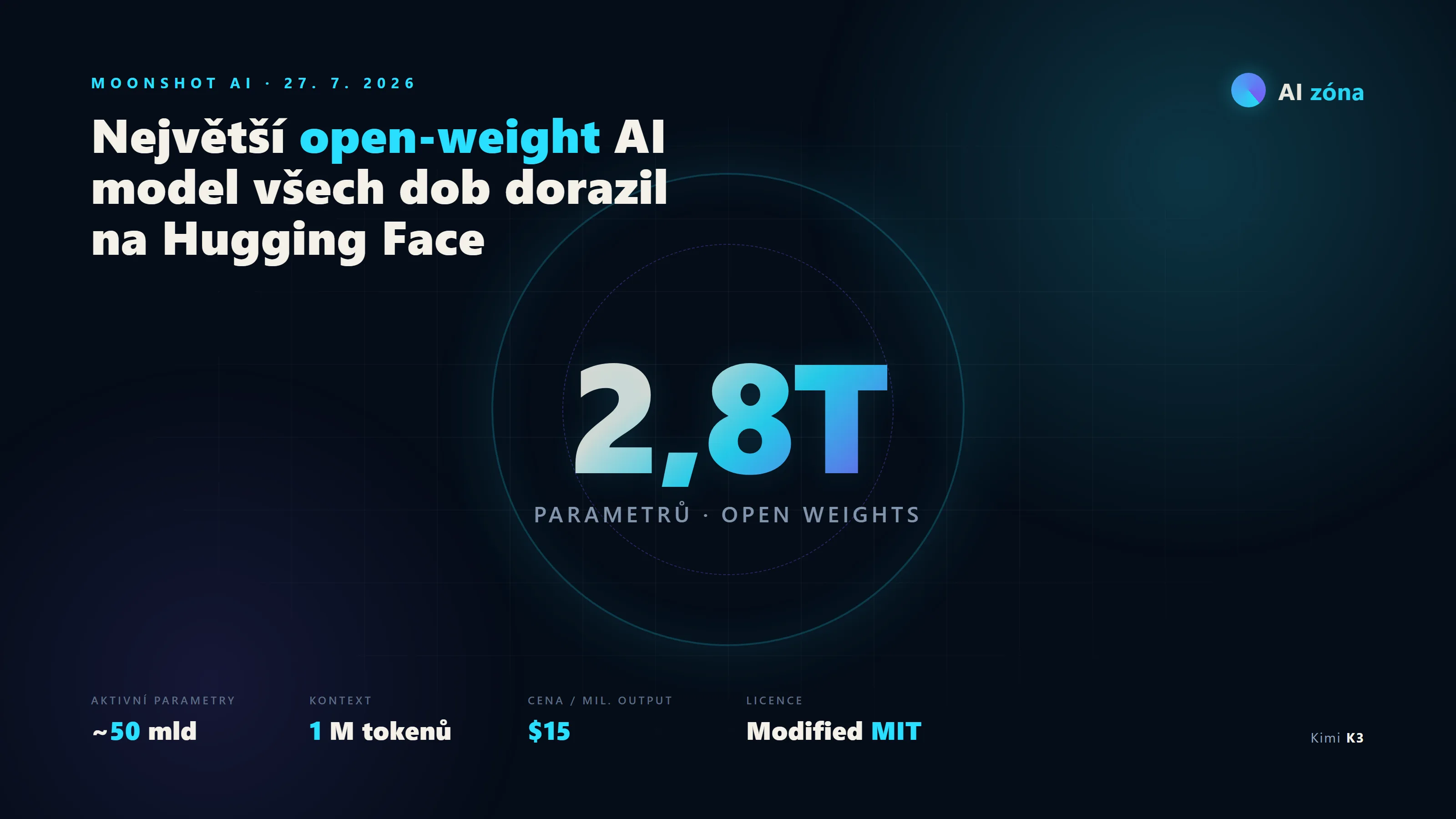
Kimi K3: 2.8 trillion parameters for free, but your home PC will not run it
Moonshot AI released Kimi K3 on July 27, 2026, the largest open-weight model in history. It has 2.8 trillion parameters, an MIT-modified license and, through a hosting cloud, costs roughly a third of Fable 5. Running it at home is a no-go.