
Seedance 2.5 turns a prompt into a film studio. Will Hollywood sue again?
ByteDance unveiled Seedance 2.5: native 30-second video, 50 references, 4K and a 3D scene preview. AI video jumps a level. Will the Hollywood lawsuits come back?
Novinka + rozbor
Seedance 2.5 + Veo 3.1
Picture a production team that builds no sets and hires no gear. They sit at a screen, write a prompt, and a few minutes later they have a 30-second scene in 4K, assembled from fifty of their own references. That is exactly what Seedance 2.5 promises, the model ByteDance showed at its Volcano Engine conference. And it is exactly why phones are ringing in Hollywood law offices again.
What's new
ByteDance unveiled Seedance 2.5 on the Volcano Engine conference stage, not through a leaked document. Leaks and speculation did circulate before the event, but the real reveal happened publicly during the keynote. A full launch is expected in early July 2026, and for now the model is in closed enterprise testing.
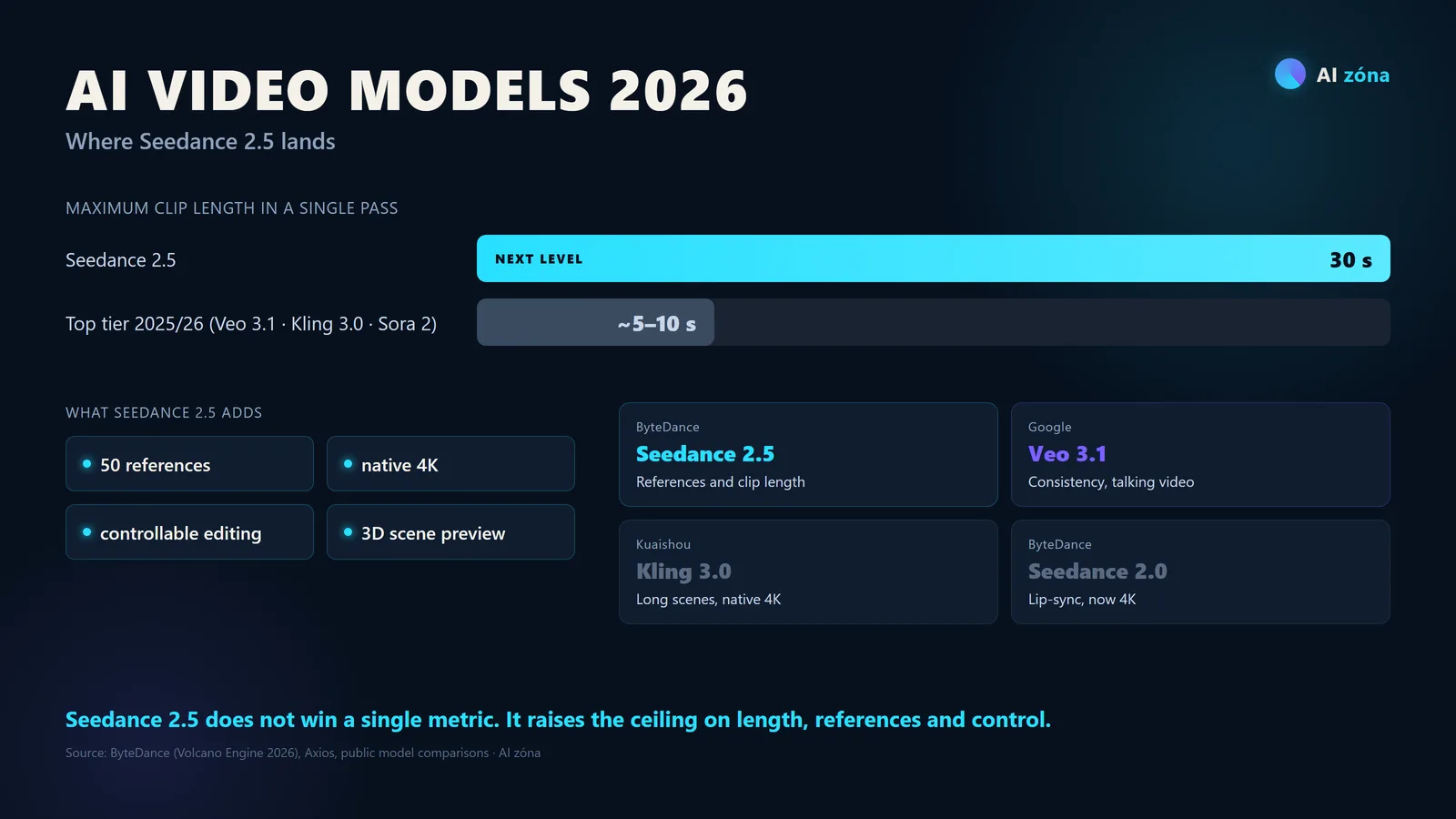
The big jump is in length and control. The model handles native 30-second video in a single pass, which ByteDance calls the longest continuous clip on the market. It accepts up to 50 references at once, not just images but video and audio too, so you hold the reins over the scene much more firmly. On top of that it adds native 4K, controllable editing of a finished shot and a 3D scene preview before generating. In parallel, the older Seedance 2.0 gained 4K output.
This power has another side. It was the previous version that put ByteDance under pressure from studios, and the better the model gets, the more concern it raises. So ByteDance is also going the other way and launched a licensing platform where derivative works are created from protected content with permission. Among the first partners is Hong Kong director Stephen Chow, whose classic films users can legally remix.
The best way to see how it looks in practice is on video. In this demo you can watch Seedance 2.5 hold motion, camera and scene continuity across a full thirty-second clip.
What you'll appreciate most
That you take on the role of director, not slot-machine player. Fifty references and 30 seconds in a single pass mean the result stops being a matter of chance. Upload your own character, environment, camera style and audio, and the model keeps them together instead of handing you a slightly different scene every time you generate.
The second thing is time. You used to assemble a longer sequence from short clips and handle cuts and continuity by hand. With a native thirty-second output you get a continuous scene right away, and the 3D preview hints at how it will look before you even start generating. That cuts out the loops that used to burn through most of your credits and nerves.
Who it's for
It is most useful to creators and teams that already produce a lot of short video. For them the difference between a few seconds and a continuous 30 seconds is decisive, because most ads, Reels and product demos play out in exactly this length.
Marketer and social team
- Reels
- Ads
- Product video
Creator and filmmaker
- Storyboard
- Mood film
- Clip
Agency and studio
- Campaigns
- Pitch
- Costs
How to use it in practice
Start by uploading your own references, not by writing a long prompt. The strength of Seedance 2.5 is in the source material. Give the model your character, environment and a sample of movement and you get a consistent scene. Rely on text alone and you are back to guessing.
01 · Gather references
02 · Check the 3D preview
03 · Edit, do not regenerate
A real-world example
A small agency needed a 30-second ad for a shoe store. Instead of filming, it uploaded product photos, a reference video with camera movement and the brand palette as a visual style into Seedance 2.5. It had the first continuous clip in a few minutes, fine-tuned the shot of the shoe through the 3D preview, and used controllable editing to swap the background without losing scene consistency. It sent the finished 4K ad to the client the same day. The whole thing ran on its own and licensed material, no other brands and no music.
Recommended tools
For work from your own references reach for Seedance today, for talking video and scene consistency reach for Veo, for long shots reach for Kling. The AI video market is not about one winner. It pays to know which model is strongest for which job.
Seedance 2.5
ByteDance
Best for
Creators who build video from their own images, video and audio.
Veo 3.1
Best for
Those who need realistic talking video and a stable scene.
Kling 3.0
Kuaishou
Best for
Those who make long, multi-shot, cinematic sequences.
Summary
Seedance 2.5 raises the ceiling on what you can pull out of a prompt: a longer clip, more references and more control. It is not a win in a single metric, it is a leap in how close a creator gets to the work of a whole crew. Thirty seconds, fifty references and 4K turn generating video into directing.
The second half of the story is legal. The same power that helps creators frightens studios, and Disney already struck once over the previous version. Whether Hollywood reaches for a lawsuit over 2.5 as well remains to be seen, and a lot will depend on how far ByteDance takes its licensing route. For your work the takeaway is simple: use the model's power in full, but build on your own and licensed material, not on other brands.
Sources
- ByteDance Seed: official Seedance page
- Seedance 2.5 in action: a capability demo (YouTube)
- BigGo Finance: ByteDance launches Seedance 2.5 with native 30-second video, July start
- AIbase: Seedance 2.5 launches in July, 50 materials and reimagining Stephen Chow's films
- Axios: Disney sends ByteDance a cease and desist over Seedance 2.0
- Variety: OpenAI shuts down Sora video, Disney drops its billion-dollar investment
- Vermillio: Disney vs. Sora 2 and the AI copyright crisis
Frequently asked questions
What people often ask
What is Seedance 2.5 and how does it differ from Seedance 2.0?
Seedance 2.5 is the new version of ByteDance's AI video model, unveiled at the Volcano Engine conference. There are three main differences from version 2.0. It can generate a native 30-second video in a single pass, while older models managed only a few seconds. It works with up to 50 references at once, including images, video and audio, so you get far more control over the scene. And it adds native 4K, controllable editing of a finished clip and a 3D scene preview before generating. For creators that means less randomness and more directing.
When will Seedance 2.5 be available and how much will it cost?
Based on information from the conference, a full launch is expected in early July 2026, and the model is currently in closed enterprise testing. ByteDance has not officially confirmed an exact date or pricing. Seedance is usually sold through an API and partner platforms, so pricing will likely be per generated second or clip, similar to version 2.0. In parallel, Seedance 2.0 gained native 4K, so if you want to try the model right now, you have something to start with before 2.5 opens up fully.
Is Seedance 2.5 better than Veo 3.1 or Kling 3.0?
It depends on the task, the market is not settled the way it is with language models. Google's Veo 3.1 leads in scene consistency and realistic talking video. Kling 3.0 scores with long multi-shot scenes and native 4K. Seedance has always been strong at working with references and lip-sync. Version 2.5 mainly pushes clip length, the number of references and control over the result, which makes it a strong choice when you build video from your own material. The best results today come from combining models, not from one winner.
Will ByteDance run into copyright trouble over Seedance?
The risk is real and not new. Over Seedance 2.0, Disney already sent ByteDance a cease and desist and accused it of shipping the service with a library of protected characters. Threats came from other studios too. Disney, NBCUniversal and Warner Bros are also suing other AI firms. With Seedance 2.5 ByteDance is going the other way and launched a licensing platform with creators. For your own work the rule is simple: do not use other brands, film characters or likenesses of real people without permission.
Keep going
Related articles
More guides from the same area, topics and tools.

America just pulled Claude Fable 5 for all foreigners. Has the hybrid AI war begun?
On 12 June 2026 the US government ordered Anthropic to disable Claude Fable 5 and Mythos 5 for all foreign nationals. What does it mean for Europe and what can you do about it?

Astra draws a yellow circle and turns it into a 3D game. Is this the start of AGI?
OpenAI shipped GPT-6 Astra on September 3 and Greg Brockman added: welcome to the AGI era. In the video the model turns a yellow circle into a game while booking a tennis court. How much of it holds up?

China is betting 2 trillion yuan on AI without Nvidia. Will it build its own world?
China is preparing a five-year plan worth 2 trillion yuan (~$295bn) to build a national AI grid that runs 80% on domestic Huawei chips. What does it mean for the models you use?