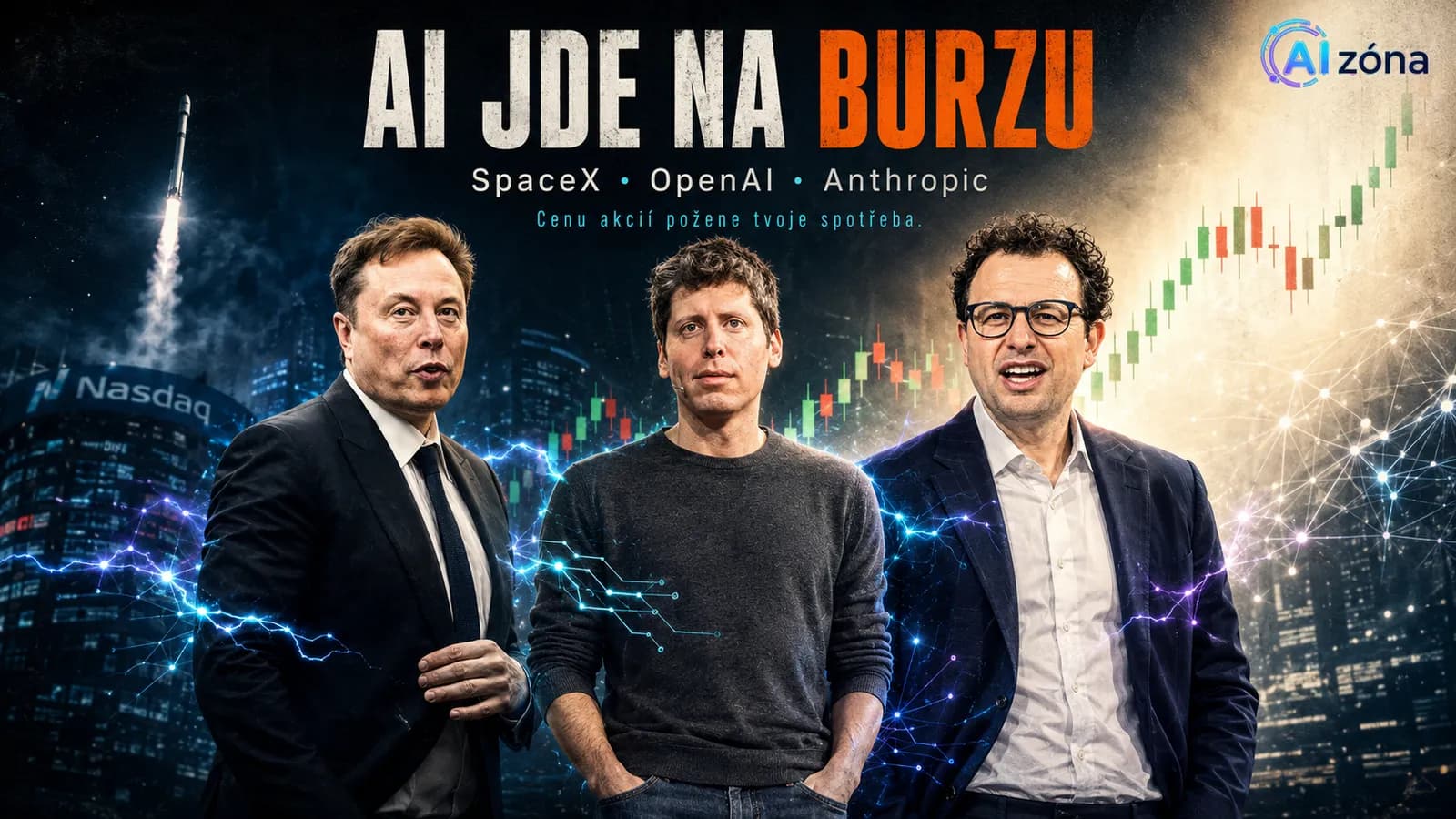
SpaceX is already public, OpenAI and Anthropic are next in line. Will your AI usage drive their stock?
SpaceX just pulled off the largest IPO in history, with OpenAI and Anthropic queuing for trillion-dollar valuations. Will the share price come down to how much AI we actually use?
News analysis
Claude + ChatGPT
In eight days in June, the three most valuable private companies on the planet either filed to go public or landed on the market outright. SpaceX did it first, and with the largest IPO in history. OpenAI and Anthropic are queued right behind it. And here is the unexpected part: whether their stock pays off for you will not be decided by the price per token. It will be decided by how much AI the world ends up consuming. Maybe you in particular.
What's new
Three AI giants are going public almost at once. On Friday 12 June 2026, SpaceX shares began trading on the Nasdaq under the ticker SPCX. And it was no ordinary debut.
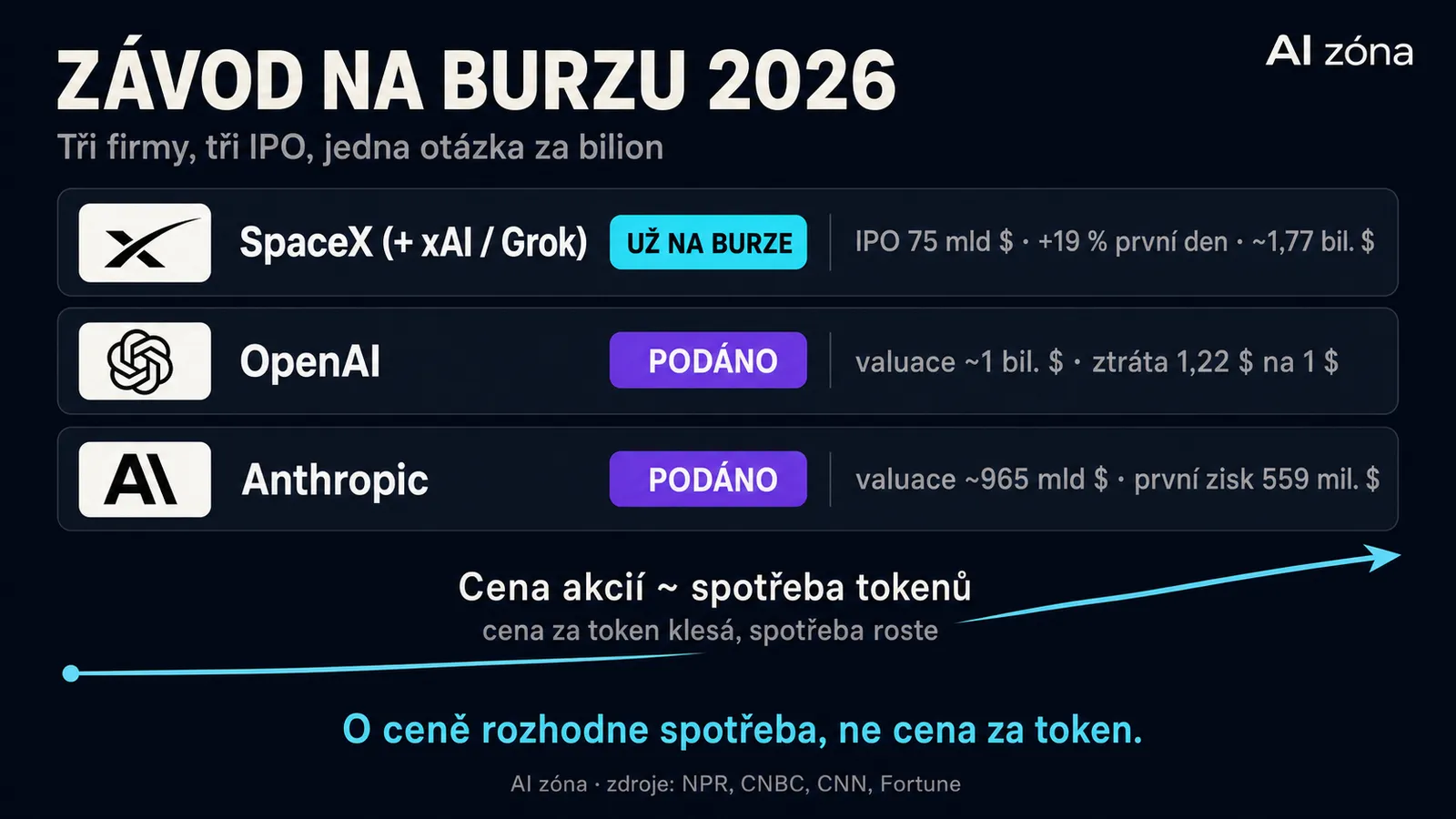
SpaceX priced its shares at $135, raised around $75 billion and beat even the legendary Saudi Aramco IPO of 2019. It closed day one at $160.95, up 19 percent, sending the company to a value of around $1.77 trillion. An important detail for us: back in February SpaceX absorbed Musk's xAI along with the Grok chatbot, so today it is not just a rocket company but a serious bet on AI too.
And it is not alone. Anthropic filed for its IPO on 1 June, OpenAI a week later on 8 June. Both are heading public by the end of 2026, and both are talked about near a trillion-dollar valuation. For the first time in history, a pure AI lab could reach the market valued at a trillion.
What you'll like most about it
That the companies are not milking you through the price per token, quite the opposite. You would expect them to raise prices before going public, to look profitable. The reality is reversed, model prices are falling.
Claude Opus cost $15 and $75 per million tokens only recently. Today's Opus 4.8 runs at $5 and $25, a 67 percent cut. ChatGPT and Grok push prices in the same direction. So where is the trick? In the fact that you are counting the wrong thing.
A newer model is cheaper per token, but it burns far more of them. Agents that work on a task for a full hour, and thinking mode that writes its own notes under the hood, chew through piles of tokens. The price per unit drops, your monthly bill rises. On top of that came premium tiers like Claude Max at $100 to $200. So the companies are not raising prices. They earn more because you consume more and more tokens. And you are the one growing that volume.
Who it's for
You care most if you build work on AI or write about it and want to understand where this is heading. This wave of IPOs will decide who sets the prices and the rules for years to come.
Company reliant on AI
- Costs
- Operations
- Plan
Curious investor
- SPCX
- IPO
- Risk
Creator and freelancer
- Subscription
- Tools
- Bill
How to use it in practice
Do not read these stocks through hype, but through one number: the ratio between how much AI people consume and how much that compute costs to run. When consumption grows faster than the compute bill, the stock has fuel. When it flips, the hangover comes.
You can build a rough forecast on this logic. It is not investment advice, it is a way to read the story. Depending on how model usage develops, three scenarios make sense.
Bull case
Base case
Bear case
A real-world example
Imagine your company paid twenty dollars a month last year for a single ChatGPT seat. This year you have an agent that goes through emails on its own, drafts replies and searches documents, and the bill is suddenly a few hundred dollars a month. The price per token has dropped in the meantime. This exact math, multiplied by millions of users, is why Anthropic and OpenAI are not afraid to go public with loss-making or barely profitable economics. You are not just a customer, you are a line in their investor prospectus.
Tools worth a look
When consumption decides the share price, the smartest thing you can do is understand your own. These three things give you an edge, whether you just want to save money or grasp what the market is really betting on.
Your own usage
Anthropic Console, OpenAI Usage
Best for
Anyone who pays for AI and wants to know where the money goes.
OpenRouter
OpenRouter
Best for
Curious users who want to see which models the world really uses.
Model per task
Haiku, Sonnet, Opus
Best for
Companies and individuals who do not want to overpay.
Summary
The market just got three new ways to bet on AI, and you are hidden inside that bet. SpaceX has launched, OpenAI and Anthropic are up next, and their value will climb in the same rhythm the world gets used to running the models.
The price per token will likely keep falling, so beware the instinct that these companies grow rich by raising prices. They grow rich on volume. The trillion-dollar question is whether consumption keeps its lead over the compute bill that lands at the turn of the year. Until then a simple rule applies: understand your own consumption before someone else cashes in on it. And treat this reading as analysis, not as a signal for where to send your money.
Sources
- NPR: SpaceX IPO is the largest in history, stock jumped 19% on day one (12 June 2026)
- CNBC: SpaceX IPO, billions in losses and Musk's massive ownership (May 2026)
- CNBC: xAI and SpaceX merger is the biggest ever, valued at $1.25 trillion (February 2026)
- CNN: Anthropic files for IPO, debut could approach a trillion dollars (1 June 2026)
- Fortune: Anthropic confidentially files for IPO at a $965 billion valuation (1 June 2026)
- Cryptobriefing: OpenAI files for IPO with a potential trillion-dollar valuation (June 2026)
- CloudZero: Claude Opus 4.8 pricing and benchmarks in 2026
- MindStudio: Why Anthropic's 70% inference margins change your API costs
Frequently asked questions
What people often ask
Can I buy SpaceX stock?
Yes. SpaceX has traded on the Nasdaq since 12 June 2026 under the ticker SPCX. The shares went into the IPO at $135 and closed day one at $160.95. You can buy them through any broker that offers US equities. OpenAI and Anthropic cannot be bought publicly yet, both have only filed and are heading public by the end of 2026. This is analysis, not investment advice, and freshly listed stocks tend to swing hard.
When are OpenAI and Anthropic going public?
Both filed in June 2026, Anthropic on 1 June and OpenAI on 8 June, and both are targeting a listing by the end of 2026, possibly as early as the autumn. Both are talked about near a trillion-dollar valuation, which could make Anthropic the first AI lab to debut at a trillion. Exact dates are not fixed yet, and IPO timelines routinely slip.
Why is the price of AI falling while the companies are worth a trillion?
Because two different things are being measured. The price per token is dropping, Claude Opus fell from $75 to $25 per million output tokens. But newer models burn far more tokens, especially agents and thinking mode. Revenue grows on volume, not on price. A trillion-dollar valuation is a bet that consumption keeps rising for years. OpenAI is still losing money, in the first quarter of 2026 it lost $1.22 for every dollar it earned.
Do OpenAI and Anthropic actually make money?
Not really yet, but it is turning. Anthropic reported its first operating profit of around $559 million in the second quarter of 2026, and its inference margins jumped from 38 to 70 percent in a year. OpenAI, by contrast, keeps losing money. Watch the timing, though: large committed compute deals are expected to eat those fragile margins again at the turn of 2026 and 2027. The first profit is more of a window than a certainty.
What should I watch to guess where the stock is heading?
One number above the rest: the ratio between how fast token consumption grows and how much that compute costs to run. When consumption outpaces costs, the stock has fuel. Track quarterly reports on revenue and margins, the pace of agent rollouts in companies, and public model-usage rankings such as OpenRouter. And keep an eye on the turn of 2026 and 2027, when the bill for committed compute arrives.
Keep going
Related articles
More guides from the same area, topics and tools.

Claude Science: can Anthropic take over scientific research now that it grabbed a Nobel laureate too?
On June 30, 2026, Anthropic launched Claude Science, a standalone application for scientific research. Ten days earlier, Nobel laureate and AlphaFold co-creator John Jumper defected to them. What does that mean for biotech, pharma and academia?

America just pulled Claude Fable 5 for all foreigners. Has the hybrid AI war begun?
On 12 June 2026 the US government ordered Anthropic to disable Claude Fable 5 and Mythos 5 for all foreign nationals. What does it mean for Europe and what can you do about it?
OpenAI's Astra solved ten open math problems. For 2,000 dollars in API tokens
OpenAI announced a new model family called Astra on August 2, 2026. An internal version cracked ten mathematical problems that had been stuck for a decade or longer, and published the proofs as machine-verifiable Lean 4 certificates.