How to build an AI copywriting workflow that saves hours without damaging the brand
AI copywriting in 2026 depends on an editorial system with brand voice, claim guidelines, a curatorial filter and a human signature. Here is how to build it step by step.
Practical guide
ChatGPT + Claude
What is new
In 2026, marketing teams can work with three mature AI models, ChatGPT, Claude and Gemini, as well as an open skills standard that keeps a consistent process across tools. The shift is that AI copywriting has stopped being a one-off request such as "write ten headlines" and is becoming a repeatable working system that a team runs every day with documented inputs and controlled outputs.
The practical difference between a marketer using AI ad hoc and one using an AI copywriting workflow is similar to the difference between making graphics in PowerPoint and working inside a design system. Both produce a visual. One starts over every time; the other has a system that handles many of the details.
The second development, discussed less openly, is greater risk. When AI scales production tenfold, it also scales mistakes. An invented supplement benefit, a false product specification or an off-brand tone in a sensitive campaign can spread quickly. Most marketers have now encountered some kind of AI incident, while regulators are watching more actively than they did in 2024.
- ChatGPT
- Claude
- Gemini
- NotebookLM
- Anthropic Skills
What will you appreciate most?
- It saves hours every week. Instead of reconstructing brand voice, claim guidelines and tone for each brief, you document the system once and let it handle the details.
- It maintains a consistent brand voice. Five copywriters can create five different tones. One skill with a brand voice document keeps one tone across channels.
- It scales without losing quality. A person may write five Google Ads variations in an hour. An AI workflow creates 50 in ten minutes, after which a human selects five based on strategic angles.
- It helps repurpose content. One 1,500-word article becomes a LinkedIn post, newsletter, Instagram carousel, short video script and FAQ. Without a workflow, a distribution editor may spend half a day on the same work.
- It prepares A/B tests. AI generates alternative angles faster than you can brief a copywriter, so a test launches this week rather than in three weeks.
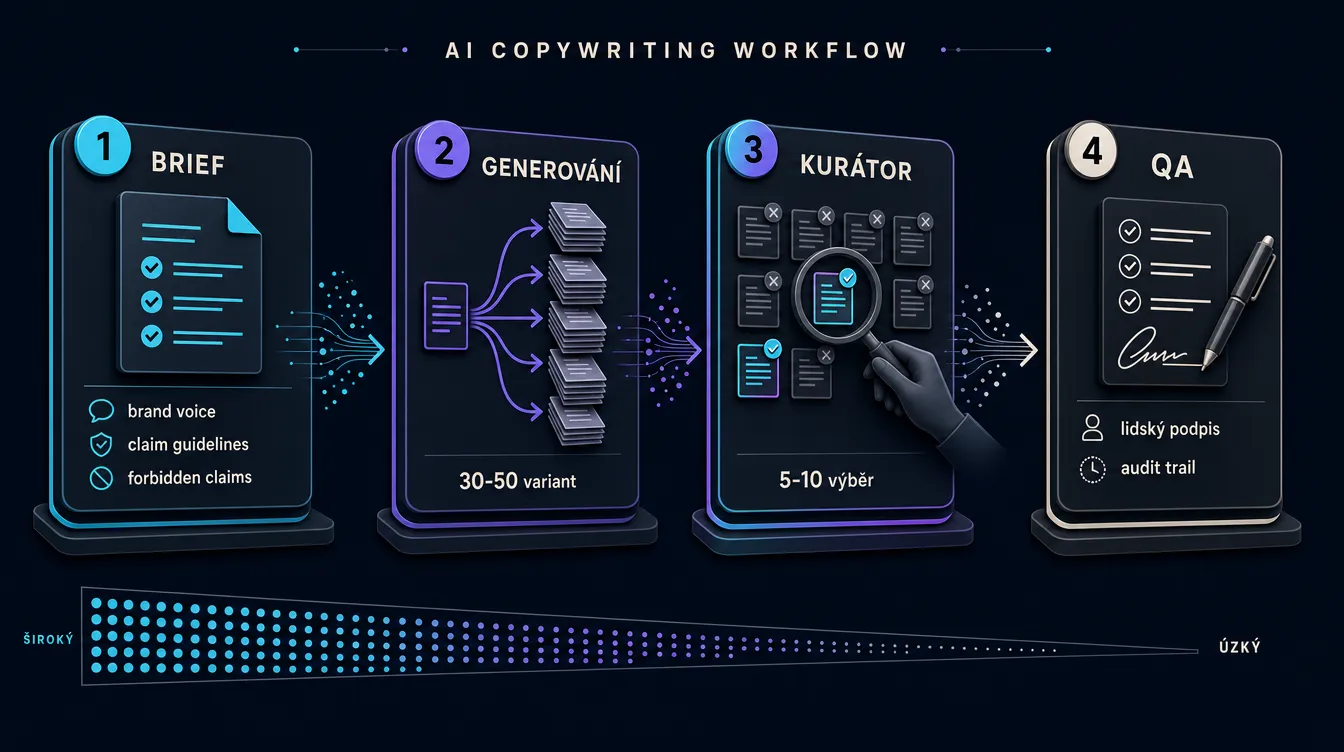
The workflow has four technical stages, with each stage applying a stricter filter to what reaches publication:
01 · Brief
02 · Generation
03 · Curator
04 · Pre-publication QA
Who it is for
PPC specialists, content marketers, brand strategists and freelancers need the same discipline for different outputs. PPC teams produce advertising variations at volume, content marketers adapt long-form material across channels, brand strategists maintain a consistent voice and freelancers save hours on repeated work for several clients.
PPC specialist
- Google Ads
- Meta copy
- RSA variations
- A/B tests
Content marketer
- Articles
- Newsletter
- Carousels
- Video scripts
Brand strategist
- Brand voice
- Claim guidelines
- Governance
Freelancer
- Client onboarding
- Briefing
- Repurposing
- Reports
A useful rule: if you write copy more than twice for the same category of task, such as Google Ads, product FAQs or email campaigns, you have a candidate for an AI workflow.
How to use it in practice
Begin with a brief. Not an instruction for AI, but a team document containing the product, audience, brand voice, claim guidelines and forbidden statements. Without it, the workflow collapses on the first campaign because every team member explains something different to the AI.
Describe brand voice concretely. Instead of "modern and friendly," write rules such as "address the reader directly, use short sentences, explain technical terms rather than removing them, and include examples of strong and weak phrasing from previous work." Without specific examples, AI invents a different brand voice every time.
Claim guidelines and forbidden statements are the most important part of a brief in sensitive sectors such as cosmetics, supplements, finance and healthcare. List the claims you may use and those you must never make. Without that filter, AI creates copy that sounds good but damages trust the first time a customer uses the product.
Use AI to generate broadly. For Google Ads copy, request 30 to 50 options at the beginning, not five or ten. The goal is not to save tokens, but to explore a broad range of benefit-led, problem-aware, social-proof, urgency and comparison angles. Then curate the best five to ten.
Curatorial selection determines whether the workflow helps or harms. Never publish all 50 variations. Choose five to ten using two criteria: claim accuracy, with no invented benefits, and strategic angle, so each option tests something different. Publishing 50 at once forces the algorithm to spend weeks reaching a meaningful result and fragments the budget.
Pre-publication QA is the final safeguard. Run claim, brand and legal checks for sensitive sectors. Require a human signature in the ticket and preserve an audit trail showing what AI generated versus what was published. This is not bureaucracy. It is the difference between AI saving time and AI creating a regulatory penalty.
Practical example
Consider a marketing agency that repurposes a 1,500-word article into social formats for five e-commerce clients. Inputs are the article in Google Docs, the client's brand voice document and claim guidelines. The pipeline runs through Claude Code using a content-repurpose skill. Outputs go to Notion, never directly to the CMS.
The skill first splits the article into five conceptual blocks and evaluates each one for a channel. A LinkedIn post needs an insight-led hook and personal experience, so it takes the data block and gives it a more personal frame. A newsletter needs a conversational introduction and practical takeaway, so it uses the actionable tips. A carousel needs six to eight slides with short statements, so it turns the main arguments into visual points. A short video script needs a hook in the first second and payoff by the seventh, so it rewrites the opening for spoken delivery.
Outputs arrive in Notion tagged draft-for-review. A distribution editor adds the CTA manually, checks that no output violates the brand's claim guidelines and sends the work to the client for sign-off. Only approved material is published. The pipeline saves three hours per article, and the client pays for the result rather than manually written variations.
An AI copywriting skill using the Anthropic standard. Inputs: product, audience, insight, brand voice and claim guidelines. Outputs: 20 advertising hooks across strategic angles, 10 primary-text variations, a QA table with claim and brand checks, and recommendations for which options to test first. The pipeline keeps consistent quality for ten clients. The skill lives at ~/.claude/skills/ad-copy-sprint/, while its frontmatter description tells Claude when to run it. The team activates it with /ad-copy-sprint in chat.
What must remain human
Four decisions cannot be delegated to AI, however persuasive the prompt: editorial point of view, claim accuracy, prioritisation against a business goal and sensitive-sector judgement. They belong to an editor because their quality depends on context and accountability, not on generating more variations.
Editorial point of view
Claim accuracy
Business prioritisation
Sensitive sectors
A useful rule: if you could not explain to your manager why a decision was made that way, do not let AI make it without review. AI decides only as well as the inputs allow. A poor brief produces a poor output without exception.
Recommended tools
- ChatGPT. Best for fast headline variations, short formats and one-off tasks. It has the broadest plugin and Custom GPT ecosystem. Use it for a PPC sprint requiring 50 variations in ten minutes.
- Claude. Best for long strategic copy, sensitive brand voice and repeated workflows through Agent Skills. It handles long context well, including an article, brand voice and claim guidelines together, and follows instructions precisely.
- Gemini. Best for briefs grounded in Google Ads, Search Console, YouTube and Analytics data. Its multimodal input works well for creative audits involving screenshots, video and images.
- NotebookLM. Best for client memory. Upload brand guidelines, campaigns and customer interviews as sources. It answers with citations, reducing the risk of inventing what a product does.
- Anthropic Skills + Claude Code. Best for repeated workflows. A skill is a saved process the team can run consistently instead of explaining the client's Google Ads rules every time.
Summary
AI copywriting in 2026 is won by teams with an editorial system. Brand voice, claim guidelines, a curatorial filter and human sign-off matter more than the best prompt. Without the system, teams risk invented claims and brand damage. With it, they save hours every week while keeping quality consistent across channels.
The key is a clear division of work. AI generates variations, maps formats and writes the first draft. A person owns the editorial point of view, claim accuracy and prioritisation against business goals. When that boundary disappears, the workflow scales mistakes instead of quality.
A practical start is to write brand voice on one page and claim guidelines on another. Package them into a skill or Custom GPT. Begin with one repeated task, such as Google Ads copy for one product or repurposing one article into social formats, and refine the workflow there. Scale only after it works.
ChatGPT, Claude, Gemini and NotebookLM have stopped competing only for the title of best general-purpose AI. Each now excels at different work. Professionals know when to use each one. Amateurs mix all of them into one task and wonder why the outputs are inconsistent.
What must stay with you is the decision about what gets published. AI does not hallucinate deliberately, but it hallucinates whenever you allow it to.
The brief is the foundation
Curator > generator
3 tools, 3 purposes
Human sign-off
Sources
Frequently asked questions
What people often ask
Is an AI workflow worth it for a small marketing team?
Yes, but for the opposite reason you might expect. A small team benefits most because a workflow covers roles it cannot afford separately, such as a junior copywriter, distribution editor and QA reviewer. Apply it to repeated work: Google Ads variations, repurposing articles into social formats and drafting product FAQs. Keep one-off tasks such as a major creative concept under direct human control. The return usually becomes clear in the second month, once the brand voice is documented and the team understands when to use AI and when not to.
How do I make AI write consistently in our brand voice?
Brand voice has to live in a document, not in someone's head. Use one or two pages to define the tone, forbidden words, preferred phrasing and examples of strong and weak copy from the past. Add that document to every prompt as context or save it as a skill in Claude Code so it activates automatically. Without a written brand voice, AI will invent a different one each time and the team will keep correcting the same problems.
Which AI copywriting tool should I choose in 2026?
Choose based on the task. Use ChatGPT for fast headline variations and short formats, Claude for long strategic copy and sensitive brand voice, and Gemini for briefs grounded in Google Ads, Search Console and YouTube data. For repeated workflows, use Claude Code or Codex with a skill that packages the entire process. Do not mix all three in one task, because the result will be inconsistent. Pick one primary tool and two secondary tools for specific cases.
Who is responsible when AI copy contains a false claim: the agency or the client?
Contracts often place responsibility on the agency, but in practice it belongs to whoever publishes the text. If you publish an AI-generated claim a product cannot support, particularly in supplements, cosmetics or finance, you risk regulatory penalties and the loss of the client. Use a claim checklist before every publication, require a named person's approval in the ticket and keep an audit trail comparing the AI output with the final version. 'The AI wrote it' is not a viable defence.
How many Google Ads variations should AI generate?
Ask for 30 to 50 variations of one headline and description set as the starting pool. Manually select the best 5 to 10 across strategic angles such as benefit-led, problem-aware, social proof, urgency and competitor comparison. Uploading all 50 makes little sense. The algorithm would need weeks to reach a statistically relevant decision and the budget would fragment. Test two or three strategic directions rather than 50 linguistic versions of the same message.
Keep going
Related articles
More guides from the same area, topics and tools.

How to build an AI creative system that keeps the brand consistent across every format
Modern banner production is not a workflow inside one tool. It is a system: a master layout, brand rules, format rules and an AI skill that applies them repeatedly. Here is how to produce eight formats every week without chaos.

How to get your content cited in AI answers: GEO in 2026
Google AI Overviews appears in 48% of searches and ChatGPT handles a billion queries a week. GEO is a new discipline alongside SEO. Learn how to earn AI citations and measure AI traffic in GA4.

Claude for small businesses: 15 workflows plus Claude Code for everything else
On May 13, 2026, Anthropic launched Claude for Small Business: 15 ready-made AI workflows connected to QuickBooks, PayPal, HubSpot, Canva, DocuSign, Google Workspace and Microsoft 365. Here is what they do, how much time they save and where Claude Code fills the gaps.