
How to get your content cited in AI answers: GEO in 2026
Google AI Overviews appears in 48% of searches and ChatGPT handles a billion queries a week. GEO is a new discipline alongside SEO. Learn how to earn AI citations and measure AI traffic in GA4.
Practical guide
ChatGPT Search + Perplexity
What is new
Generative Engine Optimization, usually shortened to GEO and sometimes called AEO for Answer Engine Optimization or LLMO for LLM Optimization, is the practice of optimising content for search engines that return an answer instead of a list of links. These include Google AI Overviews, ChatGPT Search, Perplexity, Claude and Microsoft Copilot. The goal is not to rank first. It is to appear in the citation panel attached to the AI answer.
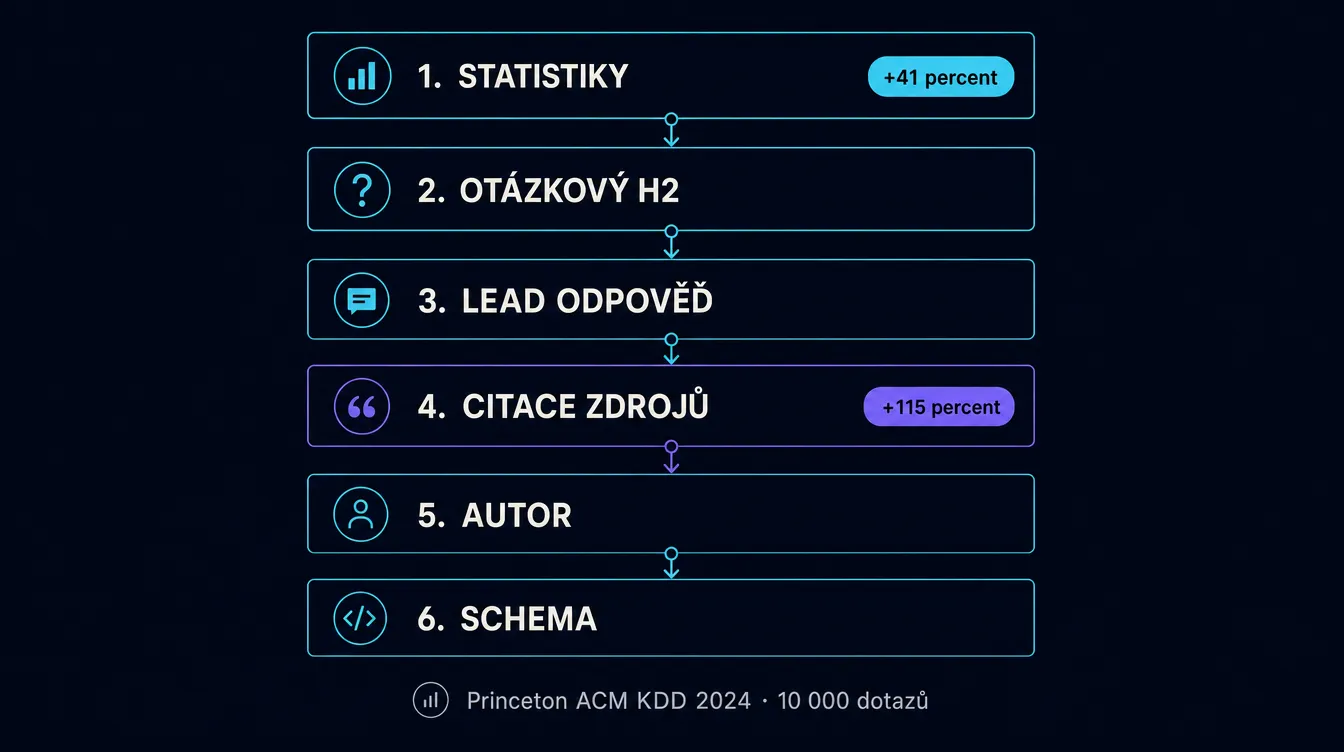
The first academic paper to name GEO and test specific techniques came from Princeton University together with Georgia Tech, IIT Delhi and the Allen Institute for AI. Published at ACM KDD 2024, it tested nine optimisation methods across 10,000 queries. Three techniques performed particularly well: adding statistics, which improved citation visibility by 41%; citing external sources, which improved it by 28%; and adding authoritative citations to lower-ranked pages, which improved it by 115%.
By 2026, this no longer concerns a niche group of users. Google AI Overviews appears in 47–48% of searches. ChatGPT handles more than a billion queries a week. Perplexity has 150 million monthly active users. If your content depends on organic traffic, GEO is no longer optional.
- Google AI Overviews
- ChatGPT Search
- Perplexity
- Claude
- Microsoft Copilot
- Gemini
What will you appreciate most?
It creates an opportunity for smaller sites. The Princeton study found that adding citations to external sources increased citation visibility by 115% for lower-ranked pages, typically smaller sites with low domain authority. Conventional SEO can require years of backlink work. An AI engine judges the content it can use now, rather than last year's link-building effort.
The second advantage is faster feedback. Conventional SEO changes may take three to six months to affect rankings. AI Overviews and Perplexity can begin citing new content within days. Add a concrete statistic to an article and Perplexity may use it as soon as the page is crawled again.
The third advantage is that GEO remains relatively unsaturated. Conventional SEO is dominated by long-established agencies with thousands of backlinks and mature optimisation tactics. GEO rewards content, data and structured answers, allowing a small site with specific evidence to stand beside a large publication. That window will begin to close in 2027 as major brands invest more heavily.
+41% citations
+115% for small sites
48% of searches
1bn queries/week
Who it is for
GEO matters to marketers who have relied exclusively on conventional SEO. If organic search drives acquisition, AI Overviews is already reducing click-through rates. Pew Research found that fewer than half as many users click onward when an AI summary appears. GEO provides a way to remain visible inside the AI answer even when the click never happens.
Marketer
- Content audits
- GEO sweeps
- GA4 AI traffic
- Schema
- FAQ optimisation
Business owner
- Brand visibility
- AI mentions
- Expert positioning
- Lead generation
Copywriter / SEO specialist
- Question headings
- Lead paragraphs
- Statistics
- Citation patterns
A useful rule: if content marketing contributes to conversions and organic search drives more than 20% of visits, you need to work on GEO. If all acquisition is paid, it can wait today, but probably not for another year.
How to use it in practice
Begin with the ten pages that receive the most organic traffic. Review each against the six citation signals highlighted by the Princeton study and subsequent research:
01 · Statistics
02 · Question-led H2
03 · Lead answer
04 · Source citations
05 · Author
06 · Schema
Consider an article titled Our e-commerce services. The chance that ChatGPT cites it in an answer to What is e-commerce optimisation? is close to zero. Change the heading to What is e-commerce optimisation, and how can it grow revenue? Begin the section with a direct answer: E-commerce optimisation is the systematic improvement of conversion rate and average order value through A/B testing, UX changes and personalisation. That is a complete sentence an AI engine can extract as a citation.
Then inspect the facts. If a sentence says Most online stores lose conversions in the checkout, AI has little reason to select it. If it says 70% of online-store visitors abandon the checkout, commonly because of delivery costs and registration, the sentence becomes citable. Statistic, number, context. That is the basic pattern.
Practical example
Imagine a company selling online courses for graphic designers. Its website contains 30 articles on typography, layout and colour, producing 8,000 organic visits every month. The company completes a GEO sweep over two weeks.
In every article, the author rewrites H2 headings as questions such as What is kerning?, How long should an optimal line of text be? and How do serif and sans-serif fonts differ? Each section gains a lead paragraph with a direct answer. The writer adds specific data from Nielsen Norman Group and Adobe Typography research, implements FAQPage schema based on real search questions and updates the author's profile with clear expertise and experience.
Six weeks later, AI Overviews begins citing the articles for typography questions. GA4 shows AI Assistant traffic rising from 4% to 17% of visits. Conventional Organic Search declines slightly from 65% to 61%, but total website traffic grows by 22%. AI citations introduce the company to people who previously received an answer from ChatGPT without ever seeing the site.
What that means in numbers. Article, FAQPage and Author markup took half a day. Rewriting headings and lead paragraphs took two weeks. Adding statistics took another week. The result was 22 working days, 22% traffic growth and new visibility in AI Overviews and Perplexity: a stronger return than three months of conventional link building.
What you can ignore for now
Do not implement every possible schema type at any cost. If the choice is between adding Article and FAQPage schema, which is useful and quick, or spending days on BreadcrumbList, Speakable and HowTo schema for marginal impact, choose the first option. An Ahrefs study of 1,885 pages that added JSON-LD between September 2025 and March 2026 found that citation visibility in Google AI Overviews actually declined by 4.6%. Google AI Mode rose 2.4% and ChatGPT 2.2%. Schema helps, but it is not a miracle.
You can also ignore conventional SEO tools that do not yet provide GEO features. Older versions of some rank-tracking tools cannot monitor AI citations. Ahrefs now offers AI Overviews tracking, Semrush has an AI Search Toolkit, Surfer SEO has a GEO module and Frase has repositioned itself around GEO.
How to measure AI traffic in GA4
On May 13, 2026, Google launched a new AI Assistant channel in GA4's Default Channel Group. It works automatically. When a user arrives from ChatGPT, Gemini, Perplexity, Claude or Microsoft Copilot with a clean referrer header, GA4 assigns the medium ai-assistant and places the session in the AI Assistant channel.
In Acquisition → Traffic acquisition, the new channel can be broken down by source to show how much traffic came from ChatGPT versus Perplexity. If event tracking covers engagement such as scrolling, time on page and key actions, you can also see whether AI-assisted traffic converts.
What will remain invisible is roughly 20–40% of real AI traffic. Referral-attribution studies suggest that only 60–80% of AI visits bring a clean referrer. The rest appears as Direct when a user types a URL from chat, or as Organic when they search for the company in Google afterward. AI influenced the journey, but GA4 cannot see it.
Combine GA4 data with a survey question during onboarding or on the thank-you page. A simple Where did you first hear about us? with options for ChatGPT, Perplexity, Claude and another AI assistant fills in the picture that analytics alone misses.
Recommended tools
- Ahrefs AI Search Tracking. Monitors where Google AI Overviews, ChatGPT and Perplexity cite you. It works like rank tracking, but reports citation visibility rather than position.
- Semrush AI Search Toolkit. A Semrush section covering AI citation tracking, GEO-focused content briefs and competitor analysis for AI Overviews. A natural choice for companies already paying for Semrush.
- Frase. A tool that has moved from conventional content briefs toward GEO. Its briefs include question-led headings, places for statistics and citation prompts, making it useful for content teams that want GEO inside the workflow.
- Schema.org Validator. A free official tool for confirming that JSON-LD is valid and structured as expected. Use it after every schema deployment.
- Google Search Console + GA4. Still the foundation. Search Console helps monitor pages appearing around AI Overviews, while GA4 measures AI Assistant traffic. Do not skip them for an expensive specialist tool.
- Perplexity Sources tab. Test important questions manually and inspect the sources Perplexity cites. If your site is missing for a query where it deserves inclusion, you have a concrete content-sweep brief.
Summary
GEO divides into techniques that clearly work, such as concrete statistics, question-led headings, a direct answer in the first 200 words, citations to authoritative sources and an identifiable author, and techniques that are frequently overstated, such as complicated schema, supposed AI Overviews tricks and expensive specialist tools without an actionable workflow.
Begin with the ten pages receiving the most traffic. Turn H2 headings into questions, make each section's first paragraph a direct answer, add concrete statistics and link to authoritative external sources. Implement Article, FAQPage and Organization schema and update author profiles. This can be completed in two weeks, with results visible within two months.
Measure through GA4's AI Assistant channel and supplement it with a survey question during onboarding or on the thank-you page, because GA4 sees only 60–80% of real AI traffic. If you have time, inspect the Perplexity Sources tab manually. No tool currently provides a more precise view of when and where Perplexity cites you.
GEO does not replace SEO. It is a new layer above it. Conventional SEO foundations such as technical health, strong content and domain authority also help in AI search. GEO adds signals that were not previously necessary. Teams that use the opportunity in 2026 receive a fair start. By 2027, the field will be more crowded and large brands with large teams will regain some of their advantage.
6 GEO layers
Measurement in GA4
Top tools
Opportunity window
Sources
- GEO: Generative Engine Optimization (Aggarwal et al., Princeton, ACM KDD 2024)
- Schema Markup Has No Meaningful Impact on AI Citations (Stan Ventures, Ahrefs study coverage)
- Schema Markup AI Citations Research (Analyzify)
- Google Analytics Now Tracks AI Traffic as Its Own Channel
- GA4 AI Assistant Channel official update (MarTech)
- How GA4 records traffic from Perplexity Comet and ChatGPT Atlas (MarTech)
- What is GEO? Frase.io 2026 Guide
- Generative Engine Optimization Statistics 2026 (Omnibound)
- How to plan for GEO in 2026 (Search Engine Land)
Frequently asked questions
What people often ask
What is GEO, and how is it different from conventional SEO?
GEO, or Generative Engine Optimization, optimises content for AI search engines that return an answer instead of a list of links. Conventional SEO helps a page rank in Google for a keyword. GEO helps it appear in the citation panel shown by ChatGPT, Perplexity or Google AI Overviews. The goal is different: SEO pursues position and clicks, while GEO pursues citations and mentions. In practice, the two disciplines overlap. Conventional SEO foundations such as technical quality, domain authority and strong content also support GEO.
Is GEO worth working on if AI Overviews does not show my site yet?
Yes, but not instead of SEO. In 2026, Google AI Overviews appears in 47–48% of searches. ChatGPT handles more than a billion queries every week and Perplexity has over 150 million monthly active users. Even if AI Overviews is not common in your niche yet, traffic from AI assistants is becoming measurable. Begin by adding concrete numbers, direct answers at the start of sections and cited sources to existing content. That takes a day and supports both SEO and GEO.
Does schema markup help AI cite my content?
It helps, but less than many agencies claim. Analyzify found a 38.5% citation rate for pages with JSON-LD compared with 32% without it, with BreadcrumbList, FAQPage and Organization schema performing well. Ahrefs examined 1,885 pages that added schema between August 2025 and March 2026 and found a 4.6% decline in Google AI Overviews citations, while Google AI Mode rose only 2.4%. The conclusion is to implement Article, FAQPage, Organization and Author schema, but not treat it as a silver bullet. Concrete facts in the text have greater impact.
How do I measure traffic from AI search engines?
Since May 13, 2026, GA4 has included a native AI Assistant channel in the Default Channel Group. It recognises ChatGPT, Gemini, Perplexity, Claude and Microsoft Copilot and assigns them the medium ai-assistant. To see individual assistants, create a segment where source contains chatgpt, perplexity, claude, gemini or copilot. GA4 sees roughly 60–80% of real AI traffic. The remainder appears as Direct when a user types the URL manually, or as Organic when they search for the company in Google afterward. Combine GA4 with a survey question such as 'How did you hear about us?' for the full picture.
Does GEO work for small sites, or only for large brands?
It works, and in some respects offers small sites more opportunity than conventional SEO. AI engines do not weigh backlinks as heavily as Google. The Princeton study found that for lower-ranked pages, often small sites, adding citations to external authoritative sources increased citation visibility by 115%. A small site does not need hundreds of backlinks to be cited. Specific data, trustworthy sources and an identifiable author can be enough for an AI engine to choose a focused small source over a large generic site.
Keep going
Related articles
More guides from the same area, topics and tools.

How to build an AI copywriting workflow that saves hours without damaging the brand
AI copywriting in 2026 depends on an editorial system with brand voice, claim guidelines, a curatorial filter and a human signature. Here is how to build it step by step.

Claude for small businesses: 15 workflows plus Claude Code for everything else
On May 13, 2026, Anthropic launched Claude for Small Business: 15 ready-made AI workflows connected to QuickBooks, PayPal, HubSpot, Canva, DocuSign, Google Workspace and Microsoft 365. Here is what they do, how much time they save and where Claude Code fills the gaps.
Can an AI agent prepare your marketing report every morning?
GA4 has added the AI Assistant channel, Google made Meridian MMM freely available and Looker gained agentic workflows. Here is the reporting stack you can build today, where governance belongs and where the tools still fall short.