

Can an AI agent prepare your marketing report every morning?
GA4 has added the AI Assistant channel, Google made Meridian MMM freely available and Looker gained agentic workflows. Here is the reporting stack you can build today, where governance belongs and where the tools still fall short.
Practical guide
Google Analytics 4 + Google Meridian
What is new
Marketing measurement has changed more in the past year than in the previous five. In February 2026, Google added Scenario Planner to its open-source Meridian MMM, making budget modelling possible without Python for the first time. In mid-May 2026, GA4 launched the native AI Assistant channel, which automatically captures visits from ChatGPT, Perplexity, Claude and Gemini. Looker gained preview agentic workflows that monitor metrics and send anomaly alerts to Slack.
Above all of them sits the Google Analytics MCP Server. It is official, open source under Apache 2.0 and exposes six core tools. Connect it to Claude Desktop or Gemini CLI and the AI gains direct access to live GA4 data without exports, dashboard clicking or waiting for an analyst.
Together, these four layers make it possible to build a reporting workflow that genuinely saves time. This is not a demo or keynote slide, but a daily routine. The GEO guide explains the AI Assistant channel in more detail; this article focuses on the complete reporting workflow.
- GA4 MCP Server
- Claude / Gemini
- Looker Conversational Analytics
- Google Meridian
What will you appreciate most?
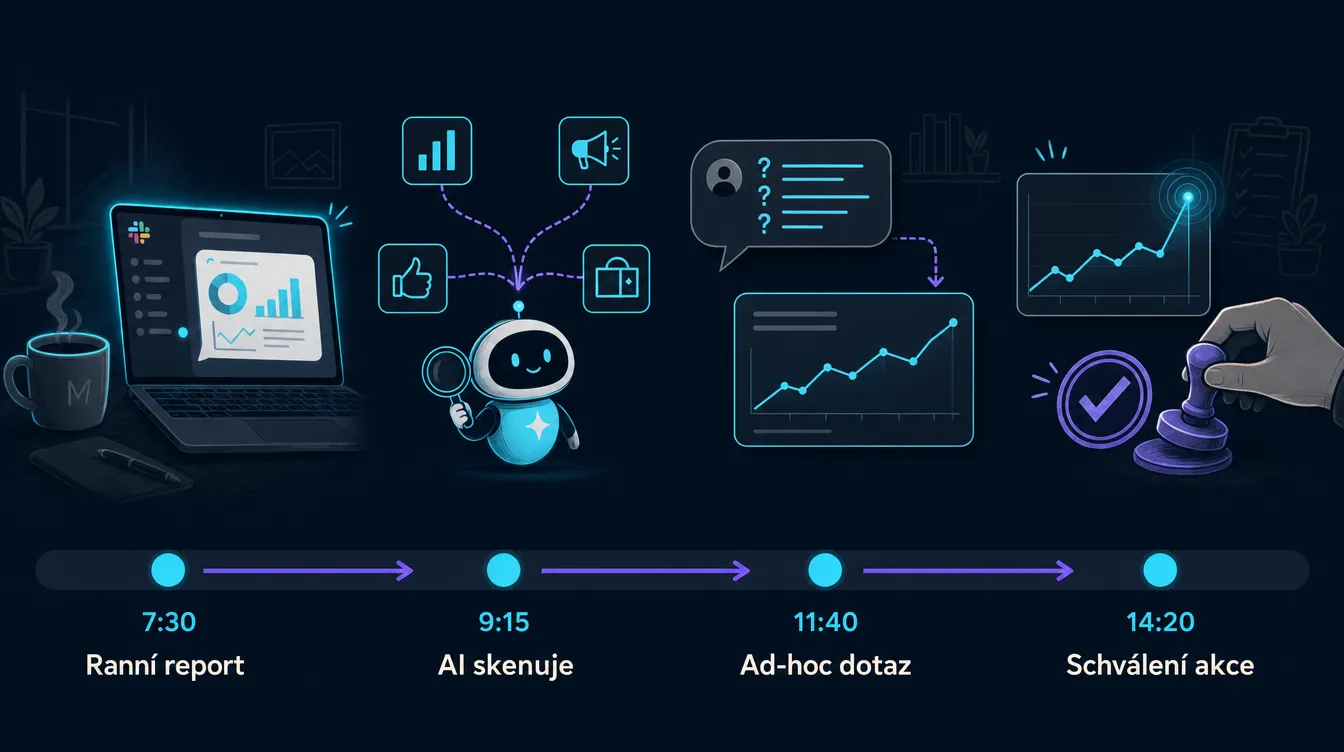
It gives your morning back. Instead of spending fifty minutes clicking through GA4, Ads and Meta Ads Manager, open one email or Slack message with the top five anomalies, their context and proposed actions. Begin the day with decisions rather than data compilation.
Names the anomaly
Consolidates sources
Sees AI traffic
Maintains governance
Then there is Meridian, which forces a different way of thinking about budget allocation. A Bayesian model may show that Meta Ads contributes 18% of total revenue incrementally even when GA4 reports only 7% through last-click attribution. It is privacy-durable, requiring no cookies or individual identifiers. Work that once meant a twelve-month agency MMM project can now be configured internally over a few weeks.
Who it is for
The first audience is a marketer managing two to five campaigns across Google Ads and Meta. A reporting agent makes sense anywhere data exceeds available time and the daily performance check takes more than thirty minutes.
Marketer
- Weekly reports
- Cost monitoring
- Creative fatigue
- A/B analysis
Account manager
- Client reports
- Morning health checks
- Escalations
- MMM discussions
Performance specialist
- Bidding strategy
- Meridian
- Attribution
- Anomalies
E-commerce owner
- Store integration
- Daily cost checks
- Multi-channel overview
It is not worthwhile for a freelancer with one client or a small company with one Google Ads account where a morning check takes five minutes. In that case, the setup is excessive and token costs exceed the time saved. It becomes valuable with more than two performance accounts and a repeated daily routine.
How to use it in practice
The process reflects what works in 2026. Begin with read-only reporting, add ad-hoc questions and only then move into MMM. Jumping straight to Meridian before reporting works is a common way to sink the project.
01 · GA4 MCP setup
02 · Morning reporting prompt
03 · Looker for ad-hoc questions
04 · Meridian for allocation
Step 1: Connect the GA4 MCP server
Download Google Analytics MCP Server from the official Google repository. It works with Claude Desktop, Gemini CLI and Gemini Code Assist. Setup involves creating OAuth credentials in Google Cloud Console and adding the GA4 property ID. Add the configuration to the MCP client, such as claude_desktop_config.json, restart it and Claude can read the GA4 data directly.
Six main tools cover account summaries, property details, standard reports such as page views and conversions, funnel reports, real-time reports and custom dimensions. That handles roughly 80% of common questions. For a fully automated Make or n8n run, the server remains the same and is called through Gemini CLI or another supported client.
Step 2: Write the morning reporting prompt
Without a good prompt, the agent is only a talkative dashboard. Do not write "make a report." Give it structure:
Save the prompt as a Claude skill or Make template. Run it with one click on Monday morning and have the agent send a Markdown report by email. Consistency matters more than creativity because the same format makes daily numbers comparable.
Useful parameters include an explicit time window, such as the last 24 hours against a seven-day average, a percentage or statistical threshold for anomalies, and business context such as a price change, seasonality or a new creative asset.
Step 3: Use Looker Conversational Analytics for ad-hoc questions
The morning report handles the routine, but at ten o'clock someone will ask how yesterday's new creative affected a particular email flow. Opening GA4, building a segment and finding conversions can consume fifteen minutes.
Looker Conversational Analytics answers in natural language. Ask it to show conversions from a specific email platform over the last 48 hours, segment by campaign and compare them with the seven-day average. Gemini builds the analysis in Looker. Multi-turn mode allows follow-ups such as "now show mobile only" or "export this to CSV." In 2026, Looker added Dashboard Agents, Insight Assistant and Agentic Workflows, which monitor LookML models and send Slack alerts when they find an anomaly.
Step 4: Use Meridian for budget allocation
Leave Meridian until last. It is the deepest tool in the stack and makes sense only after reporting works and the team knows what it expects from MMM. For a company spending more than roughly CZK 1 million each month, it can show the true contribution of each channel separately from the last-click illusion.
Meridian answers questions such as: "How much revenue does Meta Ads really create after accounting for cannibalisation from organic search?" Last-click may report 7%. Meridian may estimate an incremental contribution of 18% because Meta also lifts organic and direct traffic. That difference can change hundreds of thousands of koruna in budget.
Since Q1 2026, Meridian no longer requires Python for every use case. The new Scenario Planner provides a no-code interface for uploading historical weekly aggregates, setting channel-level priors and producing a budget mix with confidence intervals. That turns a month-long analytical project into a day's work for an analyst and makes MMM less of a black box for marketers.
Practical example
An e-commerce company spends CZK 800,000 each month across Google Ads, Meta Ads and a local search platform. Its long-term ad-cost ratio is 28%, with a target below 32%. The agency account manager handles five other clients and spends an hour a day on this account.
The morning-report setup connects GA4 MCP to Claude Sonnet, while Make runs it every day at 7:30. The prompt reviews the previous 24 hours across three platforms and returns the top anomalies, context and three proposed actions in Markdown.
On Thursday of the second week, the agent reports: "Ad cost rose from 28% to 41% in the Performance Max campaign for Outdoor. Conversion rate fell 22% and cost per conversion increased 60%. Possible cause: last weekend's sale ended but the campaign still uses creative with a 25% discount badge. Proposed actions: pause the current creative set, deploy the non-sale alternative and reduce daily budget by 30% until cost returns to target."
The account manager approves the first and third actions and sends the creative to the client for review. The ratio returns to 31% on Friday. Without the agent, the manager would have discovered in the Friday report that the company overspent CZK 18,000 during the week.
Monthly setup cost: a few hundred koruna in Claude tokens, roughly CZK 290 for Make Core and nothing for GA4 MCP. It paid for itself in the first week.
Measuring AI Assistant traffic in GA4
One reason the reporting agent deserves a place in the 2026 stack is GA4's new AI Assistant category. Since May 13, 2026, GA4's Default Channel Group has automatically recognised visits from ChatGPT, Gemini, Perplexity, Claude and Microsoft Copilot and assigned the medium ai-assistant. No setup is required.
This shows how much traffic arrives from AI search and how its conversion rate compares with organic search. Early observations from companies using the channel suggest that AI Assistant traffic often converts 20–40% better than organic search because the visitor arrives with specific intent shaped by the AI answer rather than an exploratory search query.
It does not show roughly 20–40% of real AI traffic. A user who types the URL manually from chat appears as Direct. Someone who searches for the company in Google appears as Organic. AI influenced the journey, but GA4 cannot see it. The GEO and AI citation guide explains how to combine the channel with a survey question.
Do not compare AI Assistant traffic with organic search only by absolute volume. It may represent 3–18% of total traffic but have a much stronger willingness to convert. Track it as a separate channel with separate goals.
Anti-pattern: AI that takes action without governance
The greatest temptation in 2026 is an autonomous agent that changes bids, budgets and creative assets by itself. Vendors sell the idea and teams discuss it at conferences, but nearly everyone who enables it without governance loses money or a client within months.
Examples of failure include a sudden conversion-rate decline caused by a technical website issue that the agent misreads as channel saturation and responds to by cutting budget; a new creative with weak first-day performance that the agent pauses before the audience response stabilises; and a seasonal decline interpreted as a long-term trend.
Agentic actions make sense for hard caps such as a daily budget ceiling, maximum CPA or maximum bid, because these are safeguards rather than strategic decisions. They also make sense for pausing a campaign that spent its entire daily budget in two hours, escalating alerts to Slack or a phone, and generating draft creative for approval. Everything else should be proposed rather than executed.
The practical boundary is clear: the agent can write an email but not send it. It can prepare an Ads Editor CSV but not upload it. It can identify creative assets to stop but not stop them. That line saves time while protecting the team from quiet failures.
Recommended tools
Four tools hold the reporting workflow together. Set them up from top to bottom rather than all at once. Begin with GA4 MCP and Claude, then add Meridian only when daily reporting works and the team wants to improve cross-channel budget allocation.
Google Analytics MCP Server
Best for
Marketers, performance specialists and account managers
Google Meridian
Best for
Performance specialists, growth marketers and e-commerce companies with substantial budgets
Looker Conversational Analytics
Google Cloud
Best for
In-house teams, analysts and decision makers
Add Make or n8n for orchestration. Without it, the workflow still needs to be started manually. Make or n8n keeps the reporting agent on a schedule, connects GA4 MCP to an LLM and delivers the report by email or Slack. Starting plans are inexpensive enough that orchestration is not the defining cost.
For a small e-commerce company or freelancer with one client, GA4 MCP plus Claude Desktop is enough without Looker or Meridian. For an agency managing more than five clients, the full stack with orchestration makes sense. A large company with an in-house BI team may use Looker Enterprise with Conversational Analytics as the main BI layer.
Summary
An AI reporting agent is practical in 2026 if you keep three rules. Use it for reading and proposing rather than acting inside performance accounts. Build the stack gradually instead of all at once. Measure the agent's return just as you measure campaigns, or it will become an expensive toy.
Begin with the GA4 MCP server and a morning prompt in Claude or Gemini. That provides most of the practical value after fifteen minutes of setup and a modest monthly cost. Add Looker Conversational Analytics when ad-hoc questions become a bottleneck. Meridian is a strategic tool for quarterly decisions, not a daily-reporting engine.
Avoid autonomous agents that change bids without approval. Performance Max already uses AI bidding; a second autonomous layer creates conflicts. Reporting agent: yes. Executing agent: no. That boundary separates a setup that saves an hour a day from one that wastes a month's budget.
Sources
- Meridian is now available to everyone (Google)
- Google Meridian GitHub repository
- Google expands capabilities of its open-source MMM program (MarTech)
- Looker Conversational Analytics now GA (Google Cloud Blog)
- Looker updates for agentic BI at Next '26 (Google Cloud Blog)
- Connecting to the Google Analytics MCP server with Claude (Two Octobers)
- Adding Context To Analytics Data Using The Official Google Analytics MCP Server (Medium)
- Marketing Anomaly Detection & Alerts Guide 2026 (Improvado)
- Google Analytics Now Tracks AI Traffic as Its Own Channel (Shashi)
- AI ROAS Optimization for Google Ads with Claude (Ryze)
Frequently asked questions
What people often ask
What is an AI reporting agent, and is it worth using?
A reporting agent is an AI workflow that automatically reviews GA4, Google Ads, Meta Ads and e-commerce data every morning, finds anomalies such as a sharp rise in ad cost or a fall in conversion rate, and sends a summary with proposed actions. It is worthwhile when you manage more than two performance accounts and daily data checks take more than thirty minutes. It is excessive for a freelancer with one client but can save an account manager with three to ten clients substantial time. The important rule is that the agent proposes and a person approves.
How do I connect the GA4 MCP server to Claude or Gemini?
Google released the official Google Analytics MCP Server under the Apache 2.0 licence in 2026. Connect it to Claude Desktop, Gemini CLI or Gemini Code Assist through a configuration file containing OAuth credentials and the GA4 property ID. The LLM then receives access to six core tools covering account summaries, property details, standard reports, funnel reports, real-time reports and custom dimensions. Setup takes roughly fifteen minutes if a Google Cloud project and OAuth configuration already exist.
Should I let an AI agent change bids and budgets by itself?
No, except for narrowly defined scenarios with hard limits. Performance Max already uses AI-powered Smart Bidding. Adding a second autonomous agent often creates conflicts and unexpected changes. For most companies, human-in-the-loop is the right approach: the agent finds a problem and proposes a change, then you approve it in Ads Editor. Hard caps such as a daily budget ceiling, maximum CPA or a pause when an entire daily budget disappears within an hour can be automated. Everything else should be proposed, not executed.
Is Meridian better than a conventional agency MMM?
Meridian is an open-source marketing mix modelling framework from Google using Bayesian causal inference without cookies or individual identifiers. It is durable under GDPR and iOS privacy restrictions. It is not automatically better than an agency model, but it is more accessible. An agency may spend 6 to 12 months building a custom MMM for a substantial fee. Meridian can be configured internally in weeks, but it still needs an analyst who understands Bayesian methods and Python, or the no-code Scenario Planner introduced in February 2026. It makes sense for companies spending more than roughly CZK 1 million a month; for smaller campaigns, MMM is excessive.
How much does a complete morning reporting-agent setup cost?
A small setup costs roughly CZK 600–2,500 per month. The GA4 MCP server and Meridian are free. Looker is an enterprise Google Cloud product with custom pricing, so it belongs later in the roadmap when an in-house BI team exists. The main small-setup cost is LLM usage for Claude or Gemini. A daily report may use 50,000 to 150,000 tokens, costing a few hundred koruna a month depending on the model, plus Make or n8n orchestration from roughly CZK 290 per month. For an account manager with five clients, the setup can pay for itself in the first week.
Keep going
Related articles
More guides from the same area, topics and tools.

Claude for small businesses: 15 workflows plus Claude Code for everything else
On May 13, 2026, Anthropic launched Claude for Small Business: 15 ready-made AI workflows connected to QuickBooks, PayPal, HubSpot, Canva, DocuSign, Google Workspace and Microsoft 365. Here is what they do, how much time they save and where Claude Code fills the gaps.

Atlas, Comet, Dia or Edge: which AI browser can really save you an hour a day?
Atlas, Comet, Dia, Edge Copilot and Brave Leo: five AI browsers, different philosophies and an interactive guide that finds the right one for you. Plus where AI overreaches and where it genuinely saves an hour a day.

NotebookLM: how to chat with company documents instead of searching forever
Google's NotebookLM turns company PDFs, manuals and procedures into an assistant you can question in natural language. Here is how to use it in practice and where its limits begin.