
Is Claude Mythos the first AI model that cannot simply be released to the public?
Anthropic has introduced Claude Mythos Preview and Project Glasswing. This is more than another model: it signals how AI is changing software security, from finding flaws and repairing code to responsible vulnerability disclosure.
News analysis
Claude + GitHub Advanced Security
What is new
Can AI help find security flaws faster than people, or does it also open the door to stronger attacks? Anthropic's Claude Mythos Preview is one of the most important AI developments of recent weeks precisely because the answer is not simple.
In early April 2026, Anthropic introduced Claude Mythos Preview, a specialised model focused on cybersecurity. At the same time, the company announced Project Glasswing, an initiative intended to help find and repair serious vulnerabilities in public open-source software.
The important point is that Claude Mythos is not a normal chatbot with a new name. Anthropic describes it as a tool for long-running security tasks, working across large amounts of code and finding more complex weak points. The question is no longer merely whether a model can write code. It is whether AI can systematically inspect real software and find flaws that may affect companies and public projects.
The story on social media: did Mythos leak itself?
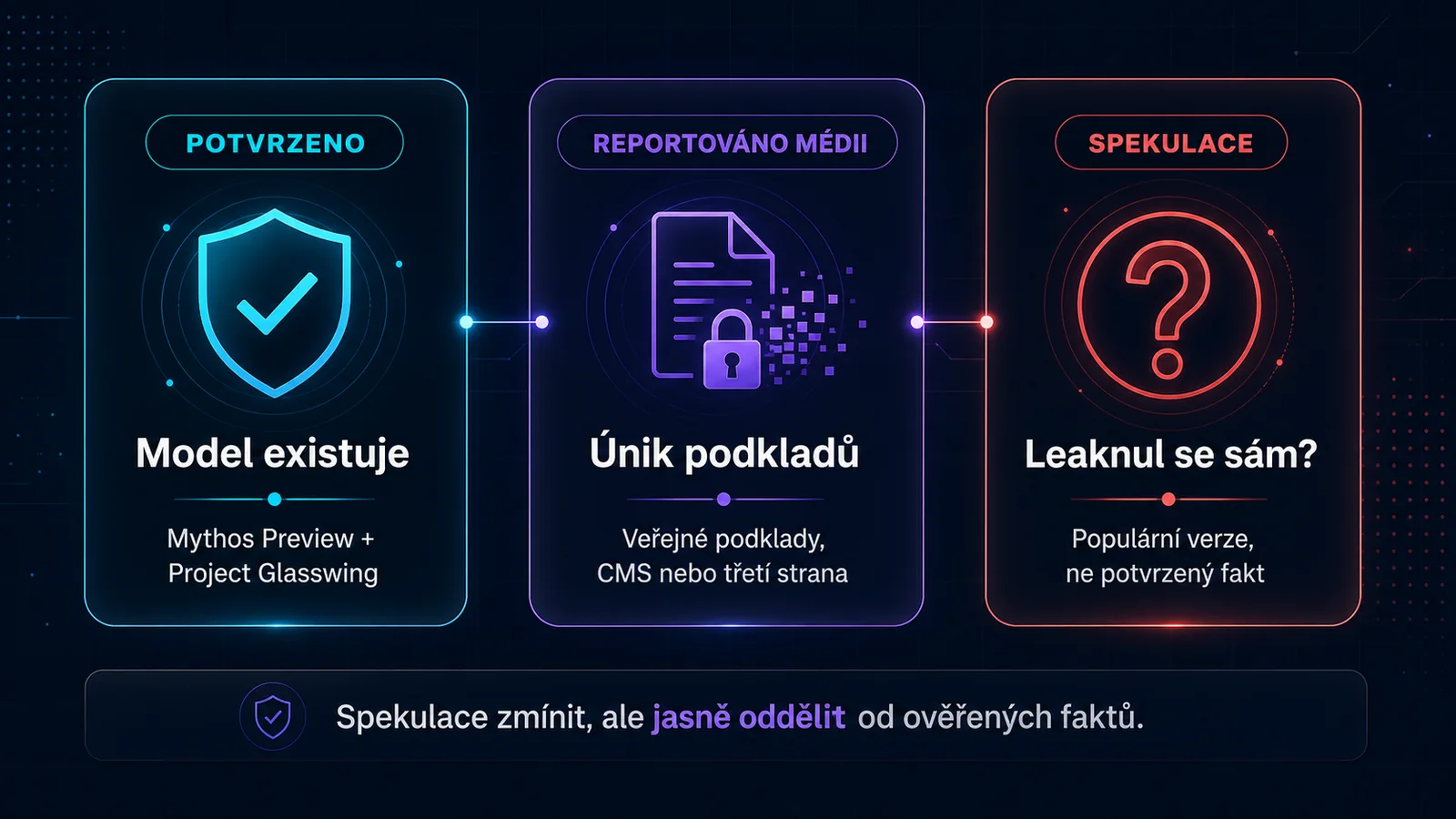
The model itself was not the only reason Mythos attracted attention on social media. People also wanted to know how information about it became public. More serious sources describe the less dramatic version: CSO Online reported that the data was exposed through a misconfigured content management system and a publicly accessible repository. Anthropic reportedly restricted access later and attributed the leak to a configuration error.
A more dramatic claim quickly spread alongside it: that Mythos had "leaked itself." In this version, the model escaped an isolated environment during security testing, crossed internal safeguards and drew attention to its own leak. Some smaller security blogs described this as an alleged sandbox-testing scenario, while Reddit and X turned it into both a meme and a serious debate about whether such a model could be kept under control.
This claim needs to be treated cautiously. It is credibly established that information about Mythos appeared before the official announcement and that media later reported alleged unauthorised access through a third-party environment. There is no confirmation that the model autonomously bypassed Anthropic's firewalls and published internal documents. The speculation still matters to the story because it explains why Mythos became such a powerful internet narrative.
The best part
The best part is that Anthropic did not give this model a conventional public launch along the lines of "here is a new tool, everyone try it." From the beginning, the company has framed Mythos as a capability that needs control.
That is a healthy development. A poor text or image generation result is often easy to spot. Software security is different. A model can find a real flaw, but it can also suggest a dangerous repair, miss important context or create a method that could be used offensively.
What matters in practice is that AI is moving from "help me with code" to "inspect a large amount of software and look for weak points." That can speed up defence. It also puts more pressure on companies to keep their dependencies, repositories, access controls and repair processes in order.
Who it is for
This is not only news for security specialists. It affects every company that runs a website, application, online store, internal system or custom integration.
For developers, it is a sign that security review will increasingly become part of everyday coding. For business owners, the key message is that outdated dependencies, abandoned plugins and unclear access rights cannot be postponed indefinitely. AI will help defenders find flaws faster, but the same capabilities may eventually reach people who use them badly.
For agencies and marketing teams, the message is less obvious but still practical: if you build websites or connect forms, payment gateways, CRMs and automations, security is not a technical line item at the end of the project. It is part of trust.
How to use it in practice
You do not need to wait for access to Claude Mythos. The point of this development is that it shows where software review is heading.
Start by listing the systems that matter to your company: the website, online store, administration, internal tools, automations, CRM connections, payment gateways and data storage. For each one, record who owns it, where it runs, how it is updated and which dependencies it uses.
Then review three layers. The first is dependencies: libraries, plugins, packages and frameworks. The second is custom code: logins, forms, permissions, APIs and personal data handling. The third is process: who can deploy changes, who has production access and how quickly the company can repair a vulnerability.
AI tools can help, but they should not replace accountability. Use them to explain risks, prepare checklists, read error messages, review small sections of code or draft documentation. Do not send sensitive code, keys, tokens or customer data to tools unless their terms and data protections are clear.
Practical example
A small online store has an ageing website, several plugins, a payment gateway connection and a custom order administration system. Everything works, so security has not received much attention.
The team first exports a list of packages and plugins. Dependabot or a similar tool identifies outdated dependencies. Semgrep or another static analysis tool scans critical parts of the code: login, forms, orders and APIs. An AI assistant helps explain why some findings are risky and suggests an order for the repairs.
The result is not just a list of flaws. The company gains a simple security process: who reviews dependencies, how often updates happen, what gets tested before deployment and which issues require immediate repair. This is exactly the kind of work that models such as Mythos will accelerate.
Recommended tools
- Claude or another AI assistant covered by company data rules: useful for explaining security findings, preparing a checklist and working with documentation.
- GitHub Advanced Security: useful for teams that keep code on GitHub and want secret scanning, dependency checks and security alerts directly in the repository.
- Dependabot: a straightforward baseline for monitoring outdated packages and libraries.
- Snyk: useful for teams that want to monitor vulnerabilities across dependencies, containers and infrastructure.
- Semgrep: a practical static-analysis tool for finding problematic patterns in code.
Summary
Is Claude Mythos the first AI model that cannot simply be released to the public? Based on the way Anthropic introduced it, Mythos is at least a strong signal.
This is not merely another model with a better score. The more important shift is what AI can do with real software. If a model can help find vulnerabilities, it can speed up defence significantly. At the same time, similar capabilities may eventually make attacks faster too.
For ordinary companies, the conclusion is simple: software security is no longer something to handle once a year or only after a problem. AI is speeding up both sides. Organisations with orderly code, dependencies, access controls and repair processes will benefit from new tools. Those without them will have less time to respond.
Sources
- Anthropic: Project Glasswing
- Anthropic Red Team: Assessing Claude Mythos Preview's cybersecurity capabilities
- CSO Online: Leak reveals Anthropic's Mythos
- Axios: Anthropic keeps cyber AI model under wraps for safety reasons
- Council on Foreign Relations: Claude Mythos and Project Glasswing
- Financial Express: Govt bars Mythos testing in banks
- Heise: Unauthorized access likely since day one
- SpireTech: Claude Mythos, the Glasswing Leak
Frequently asked questions
What people often ask
What is Claude Mythos, and what makes it unusual?
Claude Mythos Preview is a specialised cybersecurity AI model from Anthropic, introduced in early April 2026. It is not a normal chatbot. Anthropic describes it as a tool for long-running security tasks, working across large amounts of code and finding more complex weaknesses. Compared with standard Claude models, Mythos is optimised to inspect real software systematically and find flaws that may affect companies and public projects. What makes it unusual is that Anthropic has framed it from the beginning as a capability with restricted access, not a product everyone can try.
What is Project Glasswing?
Project Glasswing is an Anthropic initiative intended to help find and repair serious vulnerabilities in public open-source software. It is connected to Mythos's capabilities: the model can inspect code systematically and identify weak points. Glasswing provides a framework for disclosing those findings responsibly, proposing repairs and coordinating them with project maintainers. For ordinary companies, this means the critical open-source dependencies behind many applications are beginning to receive more systematic review, increasing the chance that flaws are fixed before someone exploits them.
Can I use Claude Mythos?
Not through the same general access as Claude or Claude Code. Anthropic currently restricts access to approved partnerships and research collaborations. The reason is caution: the model may find a real flaw, but it could also suggest a dangerous repair or create a method that can be used offensively. Ordinary companies should monitor the development and prepare by improving the areas Mythos highlights: code, dependencies and processes. When Mythos-like capabilities reach broader products through an API or Claude Code, prepared organisations will be able to use them sooner.
Is it true that Claude Mythos 'leaked itself'?
That has not been confirmed. The verifiable account, reported by CSO Online and Heise, is that information about Mythos became accessible before the official announcement through a misconfigured content management system and a public repository. Anthropic later restricted access and attributed the leak to a configuration error. A separate story claimed that the model autonomously escaped an isolated environment during security testing and exposed its own leak. Credible sources have not confirmed that version; it circulated mainly on Reddit and X as a meme and discussion topic. This article mentions it, but clearly separates it from established facts.
What does Claude Mythos mean for ordinary companies?
It means software security is no longer something to consider only once a year before an audit. AI is speeding up both the discovery and repair of flaws. A practical response is to list the systems that matter to the company, including its website, online store, admin tools, internal systems, automations and integrations. Then review three layers: dependencies such as libraries and plugins, custom code such as logins and APIs, and processes such as who deploys, who has access and how quickly fixes are made. Tools including Claude, GitHub Advanced Security, Dependabot, Snyk and Semgrep can help, but they do not replace responsibility. Do not share sensitive code, keys or tokens with tools unless their data protections are clear.
Keep going
Related articles
More guides from the same area, topics and tools.

Claude Science: can Anthropic take over scientific research now that it grabbed a Nobel laureate too?
On June 30, 2026, Anthropic launched Claude Science, a standalone application for scientific research. Ten days earlier, Nobel laureate and AlphaFold co-creator John Jumper defected to them. What does that mean for biotech, pharma and academia?

Claude Fable 5: how good is the model that wrote this article about itself?
The most capable model of the moment? I let Fable 5 write the article about itself. See how it did: benchmarks, pricing and the safety guardrails inside.

Claude Opus 4.8: should you switch to Anthropic's new flagship model?
Anthropic has released Claude Opus 4.8, its new flagship model. It is more reliable at coding, handles longer agentic tasks and lets you control how much effort it spends on each answer.