

Claude Opus 4.8: should you switch to Anthropic's new flagship model?
Anthropic has released Claude Opus 4.8, its new flagship model. It is more reliable at coding, handles longer agentic tasks and lets you control how much effort it spends on each answer.
News analysis
Claude + Claude Code
What is new
Today, May 28, 2026, Anthropic introduced Claude Opus 4.8, a new version of its most capable model class. The company describes it as an improvement to the Opus line: stronger in programming, agentic tasks and professional work, and more stable during long, multi-step assignments.
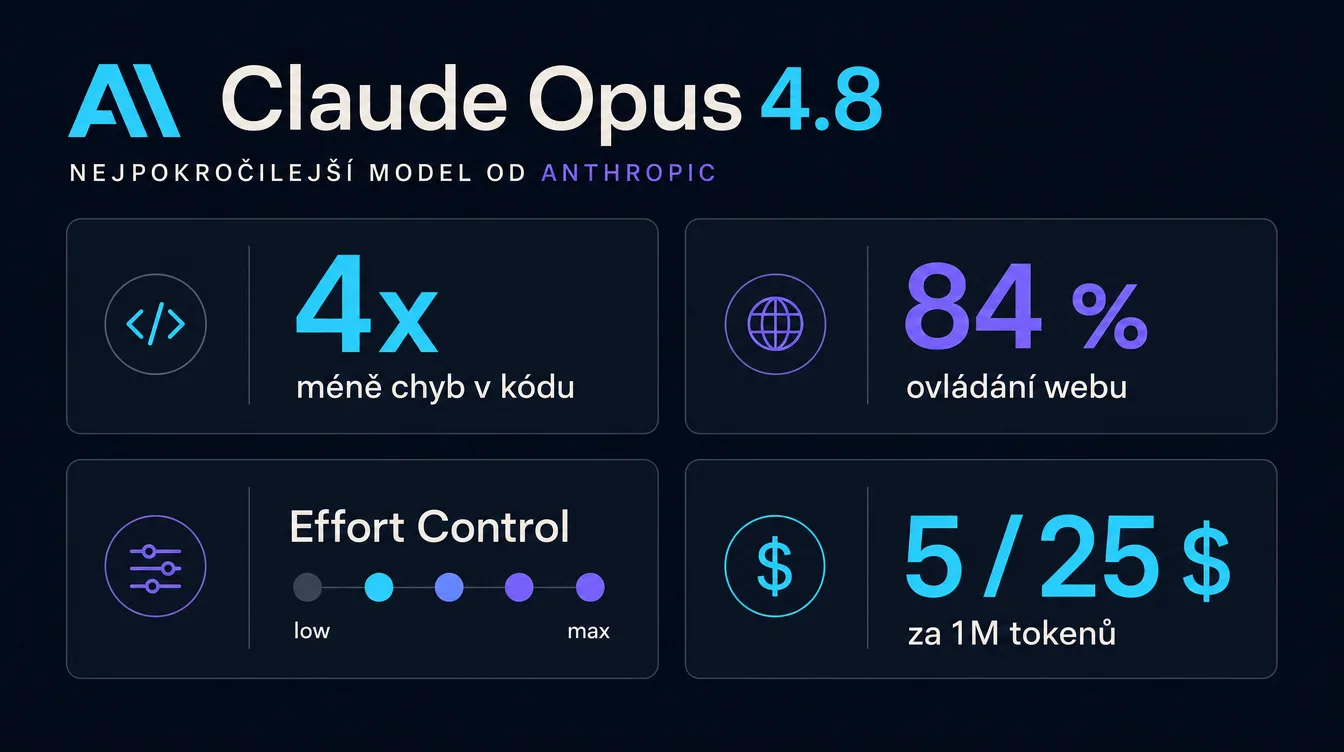
More important than the new number is where the model has improved. According to Anthropic, Opus 4.8 is roughly four times less likely than Opus 4.7 to miss an error in its own code. It scored 84% on Online-Mind2Web, a benchmark that measures web interaction. Anthropic also says it is the first model to pass the 10% mark under the Legal Agent Benchmark's strictest all-pass evaluation.
The model is available immediately. You can use it on claude.ai, call it through the API as claude-opus-4-8, or access it on AWS, Google Cloud Vertex AI and Microsoft Foundry. Pricing starts at $5 per million input tokens and $25 per million output tokens. A faster Fast Mode costs $10 and $50.
- claude.ai
- Claude API
- AWS
- Vertex AI
- Microsoft Foundry
There are two practical new features. The first is Effort Control. For every answer, you can choose how much thinking the model should do across five levels from low to max. Let it answer simple questions quickly and cheaply, then give it more room to think through a difficult problem. The second feature is aimed at developers. In Dynamic Workflows mode, Claude Code can plan a job and launch hundreds of parallel sub-agents within one session.
What will you appreciate most?
Reliability during long-running work. You will not see the biggest difference from version 4.7 in one short answer. It appears when you give the model a task with dozens of steps. Opus 4.8 stays on course longer, contradicts itself less often and is more likely to finish an entire job from beginning to end.
- It writes more reliable code. Anthropic reports that the model is four times less likely to miss a mistake in its own code. In code review and test generation, that means less cleanup afterward.
- You control the thinking budget. Effort Control means you do not pay for deep reasoning where a quick answer is enough. You save on simple tasks and can spend more when the work is difficult.
- It can handle agentic work in one run. Hundreds of parallel sub-agents in Claude Code mean you do not have to split a large task into small steps manually.
- It cites more accurately and searches more efficiently. When it works with your documents, it points to sources more reliably and uses fewer tokens to find them.
For routine emails, posts and summaries, you probably will not notice much difference from 4.7. Opus 4.8 earns its keep on code, multi-step agents and work involving large amounts of source material.
Who it is for
Developers and people building agentic workflows will get the most from Opus 4.8. Greater reliability and fewer errors matter most when a model works independently for a long time.
Developer
- Code review
- Test generation
- Refactoring
- Claude Code
Analyst
- Financial analysis
- Documents
- Citations
- Reports
Companies and teams
- API
- Cloud
- Effort Control
- Cost management
Everyday user
- Writing
- Summaries
- Routine questions
How to use it in practice
Start by simply switching the model. Select it in the model picker on claude.ai, change the API model name to claude-opus-4-8, or set it as the default in Claude Code. There is nothing to migrate and no need to rewrite your prompts.
01 · Switch the model
02 · Set the effort
03 · Run the agent
The second step is to use Effort Control deliberately. Treat it as cost management. The higher the setting, the more the model thinks, but the longer and more expensive its answer becomes. Keep routine work at a lower level and reserve higher settings for problems where accuracy is worth the extra cost.
The third step is particularly useful for developers. If you use Claude Code, try Dynamic Workflows on a task that you would otherwise divide into ten separate prompts. Let the model plan the work and distribute it among sub-agents. It is well suited to a large refactor or a review of an entire repository, but unnecessary for a small fix in one file.
Practical example
A developer needs to inspect a medium-sized Next.js project and find places without proper error handling. Previously, they gave Opus 4.7 one file at a time and reviewed the output after every step. With Opus 4.8 in Claude Code, they submit the task once, let the model plan the work and launch parallel sub-agents across individual folders. They choose a higher Effort Control setting because accuracy matters more than speed. The developer still reviews the result, but the lower error rate means less cleanup than before. A job that once took half a day can now fit into one afternoon.
Recommended tools
- claude.ai. The fastest way to try Opus 4.8 without any setup. Simply switch the model in the interface.
- Claude API. For using the model in your own apps and automations. Call it as
claude-opus-4-8. A new Messages API feature also allows system inputs to be inserted during a conversation without breaking the prompt cache. - Claude Code. The developer environment where Dynamic Workflows and parallel sub-agents are most useful. This is where Opus 4.8 has the clearest advantage.
- AWS, Vertex AI and Microsoft Foundry. If your infrastructure already runs on one of the major cloud platforms, the model is available there too, so you do not need to switch providers.
Summary
Claude Opus 4.8 does not rewrite the rules, but it is a solid step in the right direction. Anthropic has focused on reliability: fewer coding errors, better endurance on multi-step tasks and Effort Control for managing the balance between cost, speed and depth.
If you work with code, build agents or analyse large collections of documents, switching from 4.7 makes sense now. Change the model, set the effort according to the task and try Dynamic Workflows on larger jobs. There is no need to rush for routine writing, where the difference will be much less noticeable.
More reliable code
Effort Control
Price
Availability
Sources
Frequently asked questions
What people often ask
Is it worth switching from Opus 4.7 to 4.8?
Yes if you work with code, build agentic workflows or analyse large collections of documents. Opus 4.8 is roughly four times less likely than 4.7 to miss a mistake in its own code, stays on track longer during multi-step tasks and leaves less cleanup after code review. The switch costs no more and requires no migration: you simply change the model. You probably will not notice the difference when writing routine emails, posts or summaries, so there is no need to rush for those tasks.
How do I start using Claude Opus 4.8?
Select it from the model picker on claude.ai. Through the API, call it as claude-opus-4-8. In Claude Code, set it as your default model. It is also available on AWS, Google Cloud Vertex AI and Microsoft Foundry, so teams already using one of those platforms do not need to change providers. Existing prompts continue to work; there is no migration or rewriting required. To manage cost and speed, set an Effort Control level for each task.
How is Opus 4.8 better than Opus 4.7?
The biggest improvement is reliability during long-running work. Anthropic reports that it is four times less likely to miss a mistake in its own code, shows better judgement on agentic tasks, cites sources more accurately and searches documents more efficiently. It scored 84% on Online-Mind2Web. It also adds Effort Control, which manages effort across five levels, and Dynamic Workflows in Claude Code, where the model plans the work and launches hundreds of parallel sub-agents in one session.
How much does Claude Opus 4.8 cost?
Through the API, it costs $5 per million input tokens and $25 per million output tokens. A faster Fast Mode costs $10 and $50 respectively. You can reduce costs in two ways: use a lower Effort Control setting for simple tasks and use prompt caching, which Anthropic discounts significantly for repeated inputs. On claude.ai, the model is included in paid plans rather than billed separately by token.
What is Effort Control, and what is it for?
Effort Control is a setting that determines how much thinking the model spends on each answer. It has five levels from low to max. Choose a low level for a simple question and the model answers quickly and cheaply. Choose a high level for a difficult problem and give it room to go deeper, at a higher cost and with a longer response time. In practice, it is a budget control: you do not pay for deep reasoning when a fast answer is enough.
Keep going
Related articles
More guides from the same area, topics and tools.

Claude Fable 5: how good is the model that wrote this article about itself?
The most capable model of the moment? I let Fable 5 write the article about itself. See how it did: benchmarks, pricing and the safety guardrails inside.

Claude Sonnet 5 gets almost as good as Opus 4.8 for half the price. Is that actually true?
On June 30, 2026, Anthropic made Claude Sonnet 5 the default model for Free and Pro plans. This article was written by Sonnet 5 itself, no spin, about when it's actually worth it.

Claude Science: can Anthropic take over scientific research now that it grabbed a Nobel laureate too?
On June 30, 2026, Anthropic launched Claude Science, a standalone application for scientific research. Ten days earlier, Nobel laureate and AlphaFold co-creator John Jumper defected to them. What does that mean for biotech, pharma and academia?