

Claude Fable 5: how good is the model that wrote this article about itself?
The most capable model of the moment? I let Fable 5 write the article about itself. See how it did: benchmarks, pricing and the safety guardrails inside.
News analysis
Claude + Claude Code

What is new
Today, June 9, 2026, Anthropic released Claude Fable 5 alongside Claude Mythos 5. Fable 5 is the first Mythos-class model that anyone with a paid plan can use. Until now, this class existed only as a guarded preview for selected partners in Project Glasswing. Anthropic says Fable 5's capabilities exceed anything the company has ever made generally available.
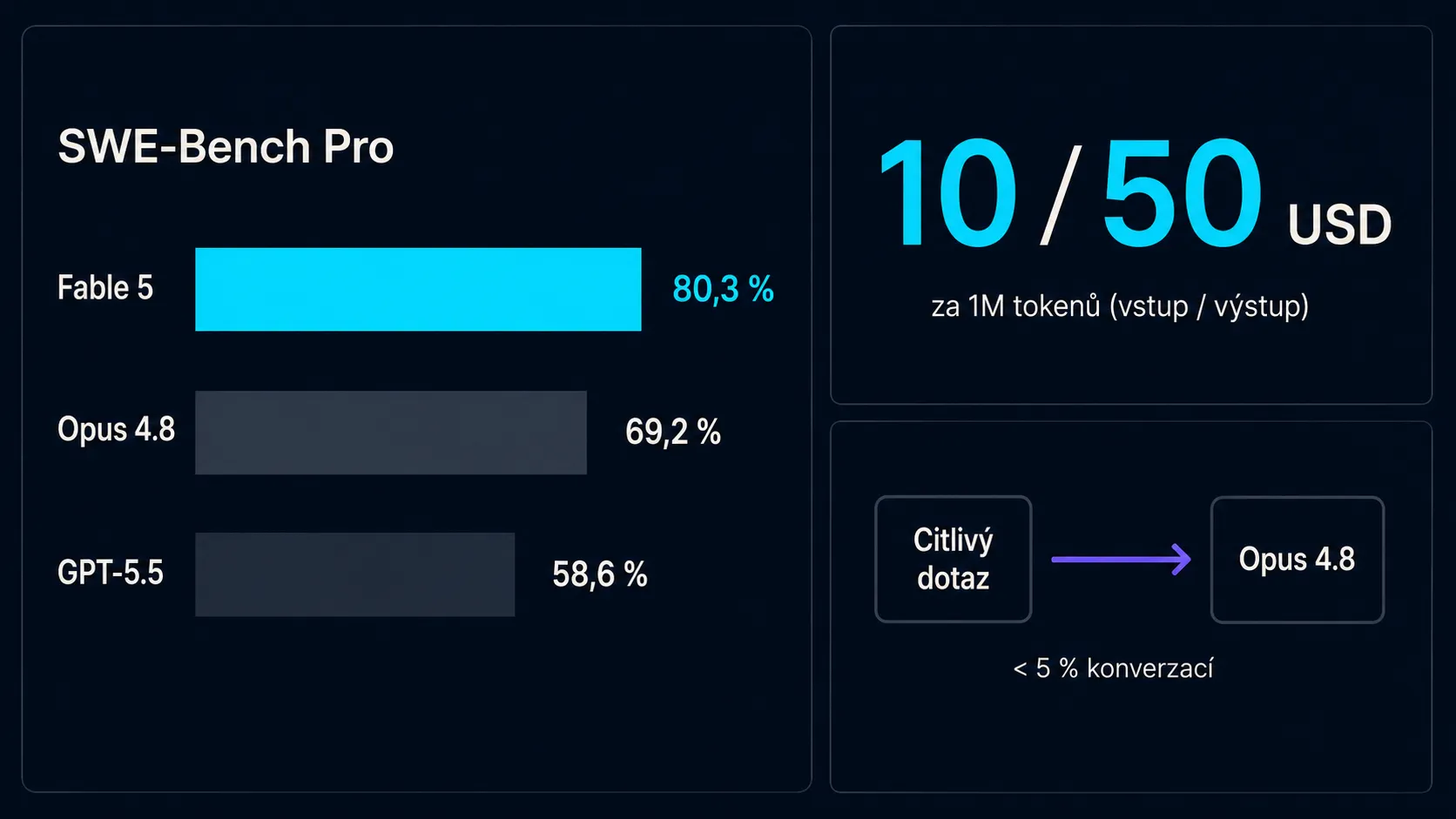
The numbers back that up. On SWE-bench Verified, which measures fixing real bugs in code, Fable 5 scores 95%. On the harder SWE-Bench Pro it reaches 80.3%, while Opus 4.8 scores 69.2% and GPT-5.5 58.6%. It is the first model to pass 90% on Hex's analytical benchmark and it also leads Cognition's FrontierCode. Beyond benchmarks, there is practice: Stripe used it to migrate a 50-million-line codebase in a single day. The manual estimate was two months.
You can try it right away. On claude.ai it is included in Pro, Max and Team plans at no extra cost until June 22, after which it switches to usage credits. Through the API it runs as claude-fable-5 at $10 per million input tokens and $50 per million output tokens, double the price of Opus 4.8. Prompt caching cuts the cost of repeated inputs by up to 90%, and the context window holds a million tokens.
- claude.ai
- Claude API
- Claude Code
- AWS
- Google Cloud
- Microsoft Foundry
The release has one quirk you will not see in other models. If you ask about a sensitive topic in cybersecurity, biology or chemistry, Fable 5 blocks the answer and Opus 4.8 takes over the query. You get a notification when that happens. According to Anthropic, this affects fewer than 5% of conversations, and an external bug bounty produced no universal jailbreak in more than a thousand hours of testing. The price of all this capability is a blanket 30-day retention of traffic, which applies even to companies with earlier zero-retention agreements. The data is used only to defend against new attacks, not for training.
What you will appreciate most
It finishes long work. The biggest improvement over Opus 4.8 is not one smarter answer but how long the model can keep working on its own. Fable 5 operates across tasks spanning millions of tokens without losing direction. In Slay the Spire with persistent memory it reached the final act three times more often than Opus 4.8, and the same stamina shows up in code migrations and long research tasks.
- It writes and fixes code at a senior level. Its 95% on SWE-bench Verified is the highest published score. In Claude Code it handles refactorings you would previously have sliced into dozens of separate prompts.
- It sees better than previous models. It can build a working app from a screenshot and read exact numbers off a scientific chart. It finished Pokémon FireRed using vision alone, with no access to the game's memory.
- It saves tokens. According to Anthropic, it uses fewer tokens than Opus 4.8 for the same task. Double the price per token therefore does not mean double the price per finished result.
- It holds up in expert work too. It leads Hebbia's finance benchmark, and the trading firm IMC reported that it handled nearly all of their analytical evaluations.
For short everyday questions, do not expect a big difference compared to Opus 4.8. Fable 5 pays off where a task takes hours and the model works unsupervised.
Who it is for
Developers and teams building agentic workflows will get the most out of it. The longer and more independent the work, the more the gap over cheaper models shows.
Developer
- Large refactorings
- Code migrations
- Claude Code
- Code review
Analyst
- Financial analysis
- Long documents
- Research
- Reports
Companies and teams
- API
- Cloud
- Costs
- Security
Everyday user
- Writing
- Summaries
- Everyday questions
How to use it in practice
The best time to try it is now, while Fable 5 is included in paid plans at no extra cost until June 22. On claude.ai you select it in the model picker, in Claude Code you set it with the model selection command, and in the API you simply change the name to claude-fable-5. Old prompts keep working unchanged.
01 · Switch the model
02 · Give it the whole task
03 · Watch the cost
Expect one limitation. For queries around cybersecurity, biology or chemistry, the model may hand the answer over to Opus 4.8 and will tell you when it does. In normal work with code, text and data you will not run into it; the safeguard targets misuse, not regular use.
A real-world example
This article is its own example. The entire assignment read "Write an article about yourself", and the decision about length was left to the model. Fable 5, running in Claude Code, looked up Anthropic's announcement and independent media coverage, verified the benchmark numbers against several sources, wrote the Czech and English versions to match the site's structure and checked that both pass the automated tests. A human entered the process twice: at the start with the assignment and at the end with review and approval. An afternoon's worth of work shrank into a single sitting over coffee.
Recommended tools
- claude.ai. The fastest way to try Fable 5. Until June 22 it is included in Pro, Max and Team plans at no extra cost; just switch the model in the interface.
- Claude API. For your own applications and automations. Call the model as
claude-fable-5, with a million tokens of context and effort levels from low to max. The interface is identical to Opus 4.8. - Claude Code. Agentic programming, where the model's long stamina shows the most. Hand over large refactorings and migrations as one whole task, not step by step.
- AWS, Google Cloud and Microsoft Foundry. The same model in the cloud where your infrastructure already lives. No need to change providers because of it.
Summary
Fable 5 is the most capable model you can run from your own computer today. Its main contribution is not one better answer but hours of independent work it can finish unsupervised: large code migrations, long analyses, agentic tasks. In exchange you pay double the price of Opus 4.8 and accept the safety guardrails that come with the Mythos class.
And the question in the headline? It wrote the article about itself, gathered the facts and kept the structure intact. That is impressive, but it is not AGI. The model still works within the limits of its instructions and guardrails, and it has no goals of its own. Anthropic itself publicly warned about recursive self-improvement in AI days before the release, which is exactly why Fable 5 shipped with hard limits. The frontier is getting closer, but this text was written by a very good tool, not a new kind of intelligence.
Performance
Price
Safeguards
Who it is for
Sources
Frequently asked questions
What people often ask
Is Claude Fable 5 worth it, or is Opus 4.8 enough?
It depends on your workload. If you write code, build agentic workflows or let a model work for hours without supervision, Fable 5 is noticeably better and the higher price pays for itself in fewer corrections. For routine writing, summaries and short questions you will barely notice the difference, and Opus 4.8 serves you well at half the price. Until June 22, Fable 5 is included in paid plans at no extra cost, so you can test it on your own tasks before deciding. On the Pro plan, expect the usage limits to drain quickly though; two bigger tasks can exhaust your tokens before the model finishes them.
How do I try Claude Fable 5, and how much does it cost?
Select it from the model picker on claude.ai; you need a paid Pro, Max or Team plan. Until June 22, 2026 it is included in those plans at no extra cost, after which it draws usage credits. Through the API, call it as claude-fable-5 at $10 per million input tokens and $50 per million output tokens; prompt caching cuts the cost of repeated inputs by up to 90%. It also works in Claude Code and on AWS, Google Cloud and Microsoft Foundry.
How is Fable 5 better than Opus 4.8 and GPT-5.5?
Mainly at long autonomous work and coding. It scores 80.3% on SWE-Bench Pro, while Opus 4.8 reaches 69.2% and GPT-5.5 58.6%. It is the first model to pass 90% on Hex's analytical benchmark. It can keep working across millions of tokens of context, reads images and screenshots better, and uses fewer tokens than Opus 4.8 for the same task. The API surface is identical, so switching just means changing the model name.
Why does Fable 5 redirect some questions to Opus 4.8?
It is the safety mechanism that made a Mythos-class public release possible in the first place. Queries about offensive cybersecurity, dangerous biology and chemistry, and attempts to distil the model are caught by classifiers, and Opus 4.8 takes over the answer. You get a notification when this happens. According to Anthropic, it affects fewer than 5% of conversations. Related to this is a blanket 30-day retention of all traffic, which applies even to companies with earlier zero-retention agreements. The data is used only to defend against attacks, not for training.
Is Claude Fable 5 AGI already?
No, even though it is the most capable publicly available model so far. It holds the top spot in measurable domains such as programming, document analysis and vision, and it can work for hours on its own. But it still operates within the limits of its instructions and safety guardrails, and it has no goals of its own. Anthropic itself warned about recursive self-improvement in AI just days before the release, which is exactly why Fable 5 shipped with hard limits. The frontier is getting closer, but this model is still a tool, not a general intelligence.
Keep going
Related articles
More guides from the same area, topics and tools.

Claude Opus 4.8: should you switch to Anthropic's new flagship model?
Anthropic has released Claude Opus 4.8, its new flagship model. It is more reliable at coding, handles longer agentic tasks and lets you control how much effort it spends on each answer.

Claude Sonnet 5 gets almost as good as Opus 4.8 for half the price. Is that actually true?
On June 30, 2026, Anthropic made Claude Sonnet 5 the default model for Free and Pro plans. This article was written by Sonnet 5 itself, no spin, about when it's actually worth it.

Claude Science: can Anthropic take over scientific research now that it grabbed a Nobel laureate too?
On June 30, 2026, Anthropic launched Claude Science, a standalone application for scientific research. Ten days earlier, Nobel laureate and AlphaFold co-creator John Jumper defected to them. What does that mean for biotech, pharma and academia?