

GPT-5.5: OpenAI's strongest model for complex work?
OpenAI introduced GPT-5.5 as its smartest model yet for complex work, coding and automation.
News analysis
ChatGPT + Codex
What is new
OpenAI introduced GPT-5.5, a model designed for more complex work, longer context and tasks where a quick answer is not enough. It holds the brief together more reliably, understands broader relationships and is suited to work, coding and automation.
Where the shift is
GPT-5.5 is not just a "smarter answer machine." It is a model for tasks where you need to keep context, process, rules and the final result in view at the same time.
In practical terms, it can complete several steps in sequence. It does not only write text. It understands the brief, reviews source material, proposes a process, chooses the best option and prepares the output. In code, that may mean analyzing a problem, proposing a fix, changing several files and checking the impact. In marketing, it may mean reviewing a campaign, creating new copy variants and recommending what to test next.
Who it is for
Developers, marketers, product teams, analysts and companies that already use AI for writing, research, coding, support or automation will get the most value from it.
How to use it in practice
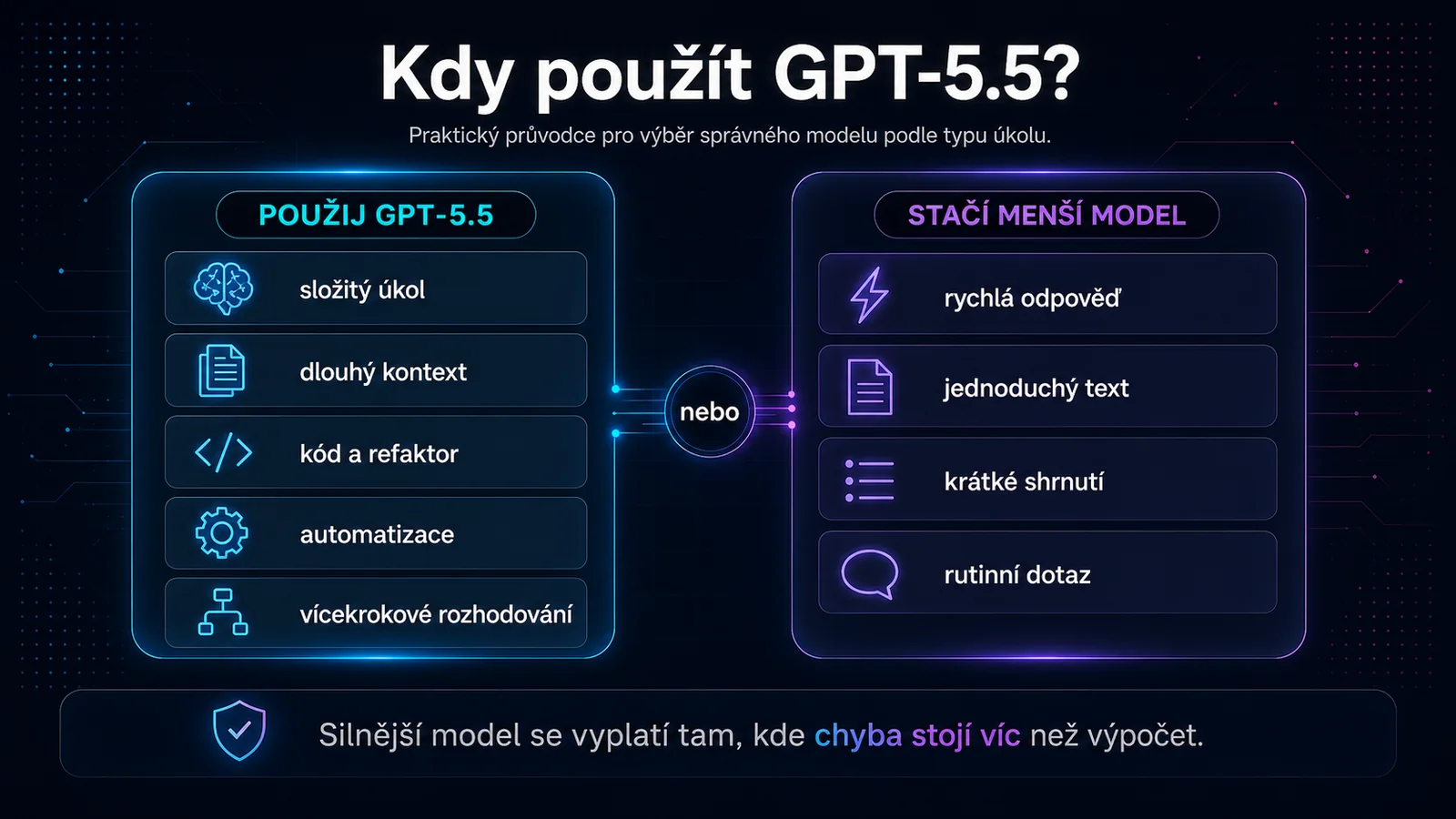
GPT-5.5 is useful when you need to connect several steps: understand the brief, review alternatives, propose an approach and only then finish the output. Examples include preparing a campaign, reviewing data, designing a workflow, refactoring code or writing content within a clear system.
A practical example
A marketing team can use GPT-5.5 to analyze campaigns, propose copy variants, review the results and prepare the next strategy. The task is not only to write text. It is a multi-step process: what happened, why it happened, what to try next and how to turn that into concrete ads.
Recommended tools
- ChatGPT for everyday AI work.
- Codex for development, refactoring and work inside a codebase.
- OpenAI API for companies that want to integrate the model into their own tools.
Summary
GPT-5.5 mainly moves AI closer to practical work on complex tasks. If you only use AI for quick drafts, you do not need to change anything immediately. If you build workflows or work with code, data or automation, it is worth watching closely.
Sources
Frequently asked questions
What people often ask
What is GPT-5.5, and how is it different from ordinary ChatGPT?
GPT-5.5 is OpenAI's latest model for more complex tasks, longer context and multi-step processes. The main difference from earlier versions is not that it answers faster, but that it can keep the brief, process, rules and result in view at the same time. Instead of giving one quick response, it can review the source material, propose an approach, choose a variant and then prepare the output. You may not notice much difference in a short chat, such as an email summary or a rewrite. The difference appears in tasks that combine analysis, decisions and production, such as a campaign review, code refactor or workflow design.
Who can make practical use of GPT-5.5?
It is most useful for developers, marketers, product teams, analysts and companies that already use AI systematically for research, coding, support or automation. If your workflow has several consecutive steps, such as campaign analysis followed by variants and ads, or code analysis followed by a proposed fix and file changes, GPT-5.5 can hold that chain together better than earlier models. It is overkill for people who mainly use AI for short tasks such as writing an email or summarizing an article. A cheaper model is enough for them.
Is it worth switching to GPT-5.5 if I only use regular ChatGPT?
If you use ChatGPT for short everyday tasks, there is no reason to switch immediately. The difference will not be dramatic for you, and the model will cost more in tokens. A stronger model becomes worthwhile when you build multi-step workflows, work with longer context such as documents or a codebase, or automate decisions. A practical rule is to use the stronger model where a mistake costs more than the compute: strategy, code, data and unattended automation.
What is the difference between GPT-5.5, Codex and the OpenAI API?
GPT-5.5 is the model, meaning the underlying capability. ChatGPT, Codex and the API are three different ways to use that model. ChatGPT is a web chat for writing, research and analysis. Codex is a coding agent that works directly in a project: it reads the repository, changes files, runs commands and performs refactors. The OpenAI API is the integration layer for companies and developers who want to use the model in their own applications, internal tools or automation. Choose according to whether you want an answer in chat, changed code or an integration in your own product.
Where does GPT-5.5 stand out most in practice?
It stands out where a task requires several consecutive steps and a lot of context. Practical examples include analyzing a marketing campaign, proposing new copy and recommending the next test; refactoring a larger piece of code across files while checking the impact; analyzing report data, proposing follow-up questions and preparing a presentation; or turning a brief into a content plan, structure and first drafts. The common factor is that one output is not enough. The task needs a process. The difference is much smaller for one-off requests such as rewriting a sentence or producing a short summary.
Keep going
Related articles
More guides from the same area, topics and tools.

Claude Fable 5: how good is the model that wrote this article about itself?
The most capable model of the moment? I let Fable 5 write the article about itself. See how it did: benchmarks, pricing and the safety guardrails inside.

Claude Opus 4.8: should you switch to Anthropic's new flagship model?
Anthropic has released Claude Opus 4.8, its new flagship model. It is more reliable at coding, handles longer agentic tasks and lets you control how much effort it spends on each answer.

What are AI skills, and why are they the future of work with AI agents?
Skills turn AI tools such as Claude Code, Codex and Cursor into repeatable systems that apply your know-how consistently. Learn the principle, see three strong GitHub repositories and inspect a real editorial skill that helped produce this article.