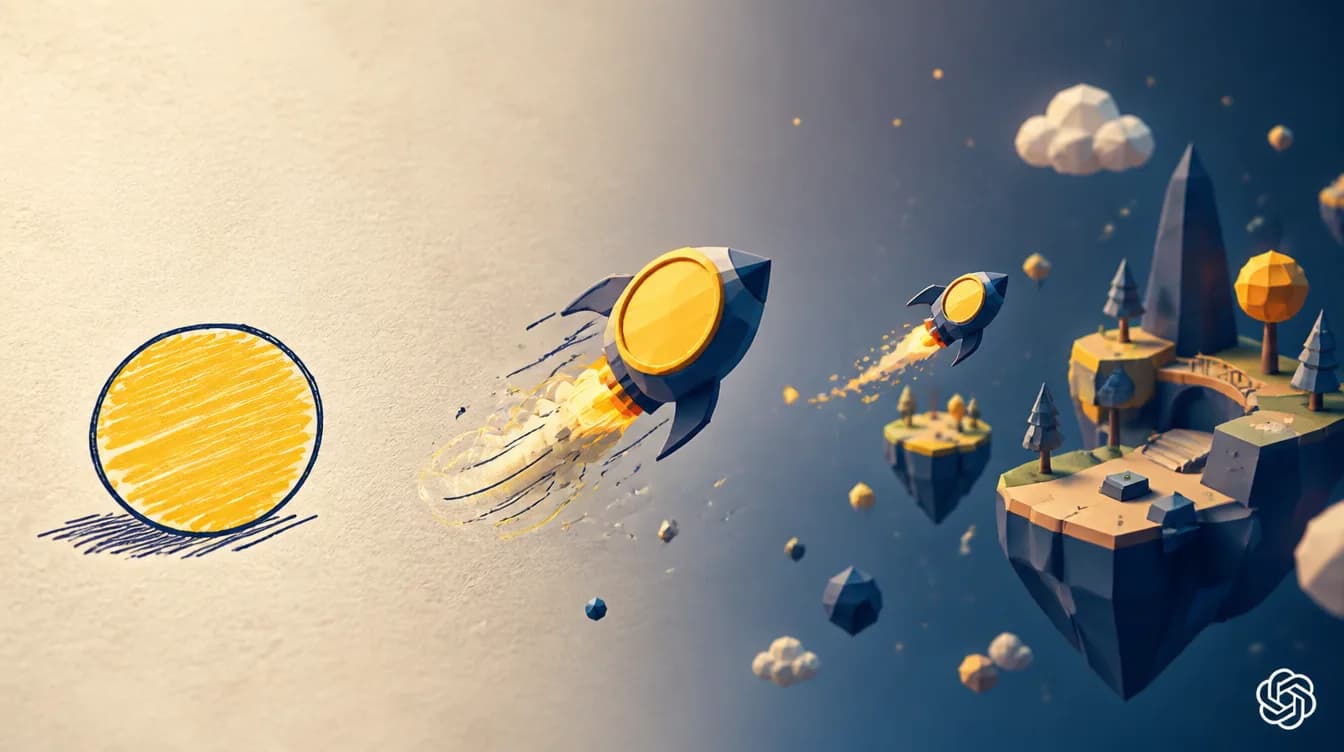
Astra draws a yellow circle and turns it into a 3D game. Is this the start of AGI?
OpenAI shipped GPT-6 Astra on September 3 and Greg Brockman added: welcome to the AGI era. In the video the model turns a yellow circle into a game while booking a tennis court. How much of it holds up?
Novinka + rozbor
GPT-6 Astra + ChatGPT
What happened and what is in the video
On September 3, 2026 OpenAI released GPT-6 Astra and called it the most intelligent and most aligned model in the world. Co-founder Greg Brockman added a line that half the internet quoted within the hour: welcome to the AGI era.
The launch video is cut with a sense of timing. It opens with archive footage from the eighties, where a person asks a computer to draw a yellow circle. The computer thinks for a moment and draws a yellow circle. Cut to today: OpenAI staff talk to Astra out loud, have the circle turned into a rocket and the rocket into a playable 3D game within minutes. In parallel the model lists an item on eBay, orders food and books a tennis court.
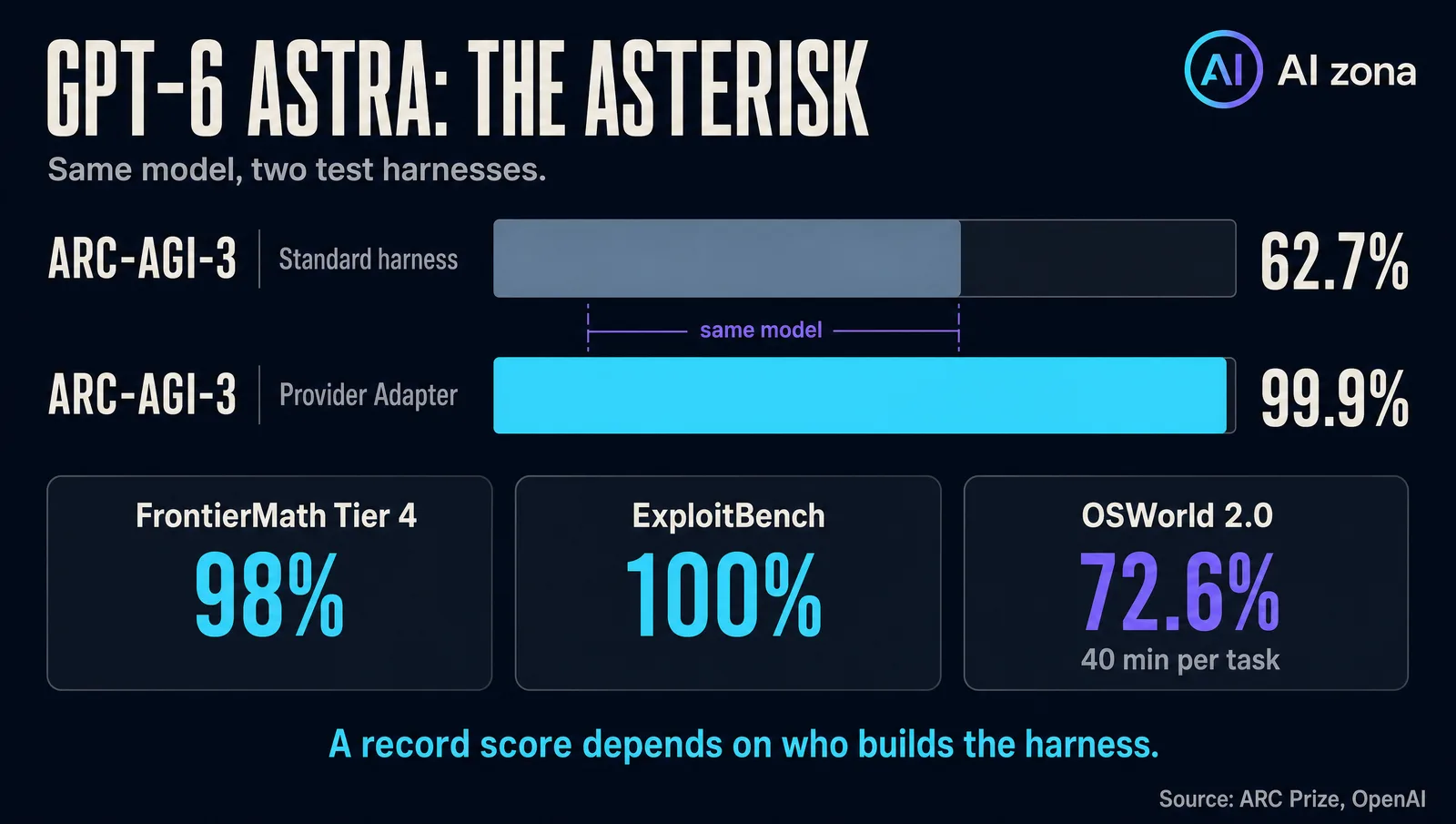
The headline technical change is computer use. Astra handles a browser, spreadsheets and ordinary applications without needing a prepared integration. On the OSWorld 2.0 benchmark it finished 72.6 percent of tasks in 40 minutes, while the previous generation managed 65.7 percent and needed 75 minutes.
You say it out loud
The model sits at the computer
A finished thing arrives
Is this AGI, or a very expensive circle?
On paper it looks like AGI. Astra reports 98 percent on FrontierMath Tier 4, a hundred percent on ExploitBench and 99.9 percent on ARC-AGI-3, the test that has been treated for years as the bar for general intelligence.
Then you open the write-up from the ARC Prize foundation and find the asterisk. That 99.9 percent came on the Provider Adapter harness, which uses OpenAI's own context management. On the standard harness Astra scored 62.7 percent. The gap between those two numbers is wider than the gap between whole model generations.
I have to admit the asterisk caught my attention more than the record did. ARC Prize itself writes that even a perfect score would not be proof of AGI, because the test has closed rules while the real world is open. Gary Marcus adds that early access went mainly to enthusiasts and not to sceptics, which he calls great marketing and poor evidence.
The second thing that does not quite fit the celebration: Astra is the first OpenAI model that crossed the critical cybersecurity threshold under the company's own safety framework. That is why subscribers were not first in line, organisations in the Daybreak security program were. Sam Altman said the release pace is now set by safety rather than by capability.
Who saves the most time
The biggest winners are people who spend their day clicking through someone else's interface: the accountant retyping invoices between two systems that refuse to talk to each other, the office manager placing the same order every single week, the marketer pulling numbers from four tools into one spreadsheet. None of it is hard, it just never ends.
For developers the more interesting change is in Codex. Instead of compressing older context into a summary it now keeps searchable notes, so it can go back to a requirement or a test result from the start of a long run. The mode is experimental for now and should become the default within weeks.
And then there is the group for whom almost nothing changes: if you use AI for writing, brainstorming and short questions, you will barely notice the difference. Astra is expensive precisely because it handles long tasks. For a two-sentence question it is like driving a truck to the corner shop.
How to get ready for it
Start by writing down the three most tedious clicking tasks from last week. For each one note how many steps it takes and where the mistakes happen. That list becomes your first test brief the moment Astra shows up, and it saves you an hour of wondering what to try.
Next, check who decides about switching it on. In Business and Enterprise accounts the model is off at launch and an admin has to enable it, so Astra may well be out while you still cannot reach it.
Count the budget per finished task. Input tokens cost 10 dollars per million, output tokens 50, and fast mode doubles both. OpenAI promises roughly 57 percent lower cost per finished task than the previous generation, because Astra needs fewer attempts. For short questions a smaller model still comes out cheaper.
A real-world example
A small e-commerce company goes through the same routine every Monday. Someone exports the orders from the admin panel, retypes them into the stock spreadsheet, generates the carrier paperwork and posts three clearance listings. It takes about two hours and once a month it produces an error the accountant then has to hunt down. With Astra it turns into a single brief: go through the weekend orders, add them to the spreadsheet, prepare the labels and post the listings from the template. The person only checks the result. Two hours of clicking shrink into ten minutes of checking.
Summary
Astra is a big jump, but not the end of the story. It is the best computer-use model publicly available, with results that would have sounded like science fiction a year ago. It is also a model whose nicest number rests on a harness built by its own maker, and whose release is being slowed by its own safety framework.
If you spend hours today moving data between tools, prepare that task list and try it the moment Astra reaches you. If the AGI question is what interests you, wait for independent measurements and for the first month of real use. The word can be said any time, proving it takes actual work.
Sources
Frequently asked questions
What people often ask
Can I run GPT-6 Astra today?
Probably not yet. OpenAI is rolling the model out in waves and organisations accepted into the Daybreak security program got it first. ChatGPT Plus, Pro, Business and Enterprise subscribers should get it within days, as should API users and customers on AWS. In company accounts Astra is switched off at launch and an admin has to enable it, so even if your organisation already has access, you may not see it in your own interface. Watch your admin, not just the changelog.
How much does GPT-6 Astra cost?
In the API you pay 10 dollars per million input tokens and 50 dollars per million output tokens. Fast mode costs double. OpenAI itself pushes a different measure, the price per finished task, and claims it comes out roughly 57 percent cheaper than the previous generation because Astra needs fewer attempts. In practice it comes down to how many steps your job takes. For short questions Astra is expensive for no reason, for long agent runs the cost per task is where the difference shows.
Is GPT-6 Astra really AGI?
Nobody outside OpenAI is saying so. Greg Brockman said it is not unreasonable to feel we are in the AGI era, which is more careful than the headlines it produced. The ARC Prize foundation, which runs the ARC-AGI-3 benchmark, writes explicitly that even saturating the test would not be proof of AGI, because the test has closed rules and does not cover the open-endedness of the real world. Gary Marcus adds that early access went mostly to enthusiasts, not sceptics. So Astra is a big capability jump that nobody independent has yet confirmed as AGI.
What good is Astra if I do not code?
Think of the last time you spent twenty minutes clicking through someone else's system. That is exactly where Astra helps most. It operates a browser, spreadsheets, websites and desktop applications much like a person does, so it needs no prepared integration or API. In practice that means filling forms in systems with no export, moving data between tools, preparing documents and presentations, or handling orders. On the OSWorld 2.0 benchmark it finished 72.6 percent of tasks in 40 minutes, where the previous generation managed 65.7 percent and took 75 minutes.
Keep going
Related articles
More guides from the same area, topics and tools.
GPT-5.5: OpenAI's strongest model for complex work?
OpenAI introduced GPT-5.5 as its smartest model yet for complex work, coding and automation.
OpenAI's Astra solved ten open math problems. For 2,000 dollars in API tokens
OpenAI announced a new model family called Astra on August 2, 2026. An internal version cracked ten mathematical problems that had been stuck for a decade or longer, and published the proofs as machine-verifiable Lean 4 certificates.

Claude Science: can Anthropic take over scientific research now that it grabbed a Nobel laureate too?
On June 30, 2026, Anthropic launched Claude Science, a standalone application for scientific research. Ten days earlier, Nobel laureate and AlphaFold co-creator John Jumper defected to them. What does that mean for biotech, pharma and academia?