
Claude Science: can Anthropic take over scientific research now that it grabbed a Nobel laureate too?
On June 30, 2026, Anthropic launched Claude Science, a standalone application for scientific research. Ten days earlier, Nobel laureate and AlphaFold co-creator John Jumper defected to them. What does that mean for biotech, pharma and academia?
News analysis
Claude Science + Claude
Anthropic made two moves in the last two weeks that together shift AI in science somewhere else. On June 20 it brought in John Jumper, one of the people behind AlphaFold and a Nobel laureate in chemistry. Ten days later it launched Claude Science, a standalone application for research. Two steps, one direction: get AI out of chat and straight into the laboratory pipeline.
What's new
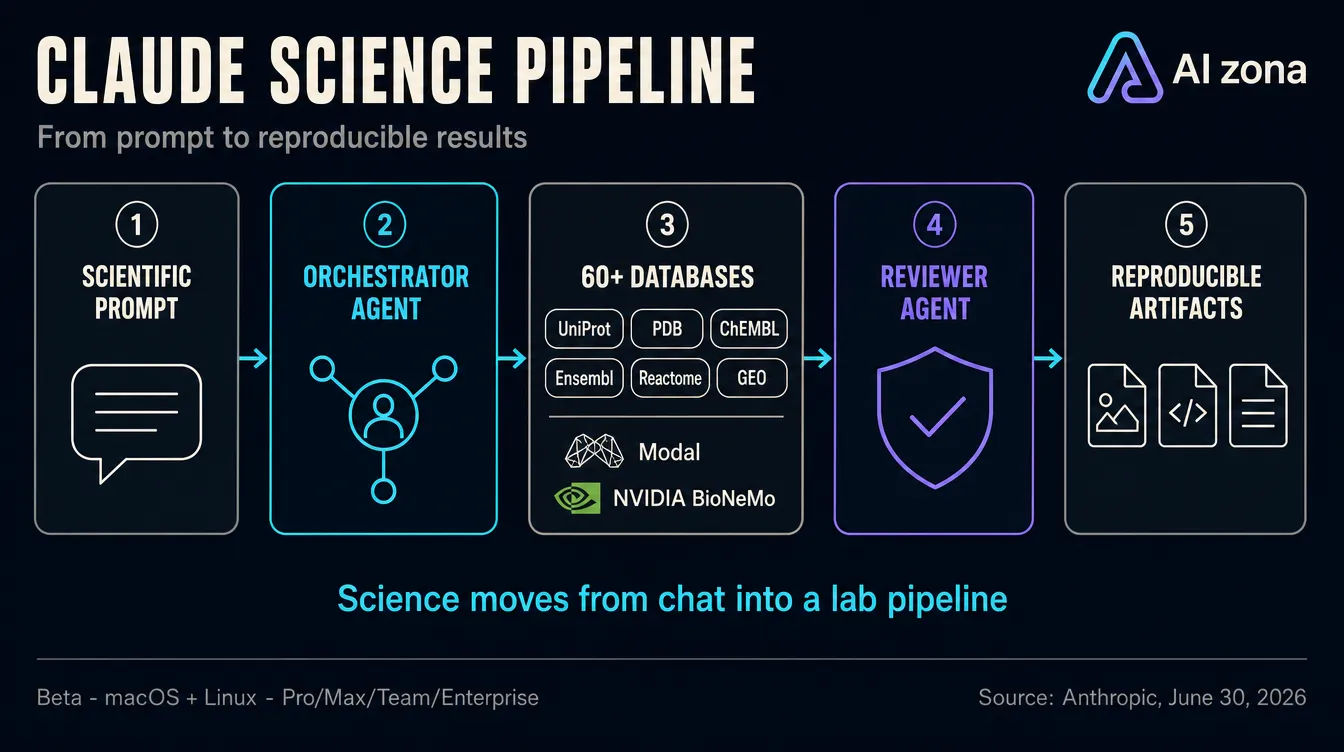
Anthropic launched Claude Science on Tuesday, June 30, 2026, in beta for Claude Pro, Max, Team and Enterprise accounts on macOS and Linux. It's not a new version of the chatbot, but a standalone application that connects 60 scientific databases, compute infrastructure and specialised skills for genomics, proteomics, structural biology and cheminformatics.
Inside is a coordinating agent with access to databases like UniProt, PDB, Ensembl, Reactome, ClinVar, ChEMBL and GEO. It runs models through the NVIDIA BioNeMo Agent Toolkit (Evo 2, Boltz-2, OpenFold3), manages compute on your laptop, an HPC cluster or through Modal, where the program gives it credits up to $2,000. It also ships with a reviewer agent that checks citations and calculations. That is a direct answer to the concern that AI in science can hallucinate exactly where it matters most.
The day before launch, Anthropic announced its own drug discovery program. Eric Kauderer-Abrams, head of life sciences at Anthropic, is running it, and the company wants to focus on neglected diseases that traditional pharma doesn't particularly chase.
The framing for the whole package came from one personnel move. On June 20, John Jumper announced on X that after nine years he is leaving Google DeepMind for Anthropic. Jumper led the AlphaFold team at DeepMind and shared the 2024 Nobel Prize in Chemistry with Demis Hassabis. Anthropic hasn't disclosed his role yet, but the timing says everything.
What you'll appreciate most about it
It saves weeks of research. In science, most of your time isn't in the experiments themselves, it's in checking whether someone already did something similar, pulling data from five different databases and reshaping it into a format your pipeline can eat. Claude Science takes that routine off your hands.
According to Anthropic, Jérôme Lecoq from the Allen Institute finished a review article using AI agents in a few months. Without them it would have taken him around two years. Stephen Francis at UCSF cut germline data analysis to a tenth of the previous time. Those aren't pretty-looking benchmarks, they're concrete savings from real labs.
The second thing Claude Science builds on is reproducibility. Most scientific AI experiments today end in a Jupyter notebook that only runs on the author's machine. Claude Science generates reproducible artifacts, meaning figures, code and manuscripts in formats you can attach to publications, and the built-in reviewer walks through citations and calculations. That helps labs where peer review is slowed most by the fact that you can't verify what the model actually did.
Who it's for
For research teams in biotech and pharma. During the launch Anthropic named partners like Novo Nordisk, Sanofi, Genmab, Schrödinger and Edison Scientific. The target audience is groups who today stitch pipelines together across multiple databases and tools by hand and are looking for a way to make that into a repeatable process.
The second group is academic labs and non-profits. Anthropic tied the launch to an AI for Science grant program: up to 50 projects get credits worth $30,000. Applications close on July 15, 2026. That opens the door for smaller teams that can barely afford a commercial pipeline.
The third group is cheminformaticians and structural biologists. Native support for 3D protein structures, genomic tracks and chemical structures means you work with results inside the app, not through screenshots in PowerPoint.
Biotech researcher
Looking for an agent that can repeat routine steps without being led through each one by hand. Claude Science promises exactly that, including reviewer checks.
- Pipeline between UniProt and PDB
- docking
- hypotheses
Biotech startup founder
Doesn't have a team for infrastructure. Claude Science is how a small team can ship reproducible results without a bioinformatics department of its own.
- Literature review
- experiment oversight
- manuscripts
Academic researcher
Through the AI for Science program, has a shot at free credits. Saves weeks on literature and prep work, which frees time for the actual experiments.
- Article reviews
- meta-analysis
- grant prep
How to use it in practice
Try the pipeline on one specific task first, not on your whole research. You'll learn Claude Science best on a task you already know cold and know how long it usually takes by hand. Whoever fires the agent at a whole project loses track of what the model actually did.
01 · Pick a sharp task
Choose one concrete scientific problem you already know the correct answer to. For example, docking a known ligand, a meta-analysis of publications, or gene expression across two tissues.
02 · Describe it in plain language
Give the agent the task in a sentence or two. The agent pulls data from the relevant databases, runs analysis through the 60 skills and dispatches compute either locally or on Modal.
03 · Read the reviewer output
The reviewer agent walks through citations, checks calculations and flags spots where it isn't sure. You decide what to keep and what to redo. That is where real human oversight begins.
An example from practice
Manifold Bio, a biotech working on tissue-targeted drug delivery, described to Anthropic a task in which they wanted to identify candidates for targeted drug transport into specific cell populations. That used to be work for a team of bioinformaticians and wet lab teams who traded Excel spreadsheets between them. With Claude Science, according to their own account, one agent runs the whole pipeline: gathers the data, applies the right models, generates candidates and hands them over for experimental validation. For a startup without its own bioinformatics team, this way of working roughly doubles the throughput, because the focus shifts away from stitching pipelines together and towards steering and reviewing the agent.
Recommended tools
Claude Science rests on one flagship app and a handful of connected tools. Pick based on which part of your scientific work you want to speed up first. If you're in structural biology, enter through NVIDIA BioNeMo. If you're wrestling with compute, go straight to Modal.
Claude Science
Anthropic
Beta app for macOS and Linux. Coordinating agent, 60 skills, reviewer and integrations for databases and compute.
Best for
Claude Pro, Max, Team, Enterprise
NVIDIA BioNeMo Agent Toolkit
NVIDIA
Suite of Evo 2, Boltz-2, OpenFold3 models for protein structures and genomics. Claude Science calls these as its skills.
Best for
For advanced bioinformaticians
Modal
Modal Labs
Serverless GPU compute. In the Claude Science program, credits up to $2,000 per project.
Best for
For labs without their own HPC
- UniProt
- PDB
- Ensembl
- Reactome
- ClinVar
- ChEMBL
- GEO
Wrap-up
Claude Science is the first product that shifts AI in science from chat into an actual laboratory pipeline. Anthropic paired it with Nobel laureate John Jumper, its own drug discovery program and an academic grant program, which turns Claude Science into a platform rather than a standalone tool.
If you work in pharma, at a biotech startup or in a research group, it makes sense to apply for the AI for Science grant by July 15 and put the beta through one real task you already know cold. The hallucination risk stays. The reviewer agent doesn't remove it, it just makes it visible to human oversight, which is the only reliable safety net for now.
Sources
- Claude Science, an AI workbench for scientists (Anthropic)
- Advancing Claude in healthcare and the life sciences (Anthropic)
- Anthropic launches AI drug discovery program, Claude Science (CNBC)
- Claude Science is Anthropic's newest flagship product (MIT Technology Review)
- Nobel laureate John Jumper is leaving DeepMind for rival Anthropic (TechCrunch)
- Anthropic releases Claude Science for researchers and pharma (STAT News)
Frequently asked questions
What people often ask
Is Claude Science worth it for me if I work in research or run a biotech startup?
In research, yes, if you work with databases like UniProt, PDB, ChEMBL or GEO and stitch pipelines together across multiple models. Claude Science takes that routine off your shoulders and checks citations and math on top. If you are more of a theorist, or work with data from a single source, the payoff will be smaller. The AI for Science grant by July 15 lets you test the project with $30,000 in credits, which is a decent runway before you start paying for it yourself.
How do I get Claude Science running and what do I need?
You need a Claude Pro, Max, Team or Enterprise account and a machine running macOS or Linux, Anthropic does not offer Claude Science on Windows yet. You download the app from Anthropic, sign in with the same credentials as Claude.ai and immediately get access to the databases and the set of 60 skills for genomics, proteomics and cheminformatics. If you need heavier compute, you connect it to Modal, where the program gives you credits up to $2,000. Your own models and pipelines plug in through standard connectors.
Is Claude Science better than ChatGPT with custom skills for science?
In depth and integration, yes. ChatGPT gives you general agents and a handful of connectors, Claude Science ships with 60 preconfigured skills specifically for biology and chemistry, native rendering of 3D protein structures and genome tracks, and, crucially, a reviewer agent that checks the outputs. ChatGPT is better if you need a general assistant across multiple domains. For a pure scientific pipeline, especially in life sciences, Claude Science is three or four steps ahead. For cheminformatics and structural biology, it is the strongest tool available today.
Doesn't AI actually degrade scientific papers with hallucinations?
The hallucination risk is real, and Anthropic admits it openly. The answer is the built-in reviewer agent, which walks through citations, checks calculations and flags spots where it isn't sure. That does not remove hallucinations, it just makes them visible to the human who ships the output further. Several scientists Anthropic works with report a tenth of the previous time on data analysis, but stress they wouldn't deploy this without human oversight. The scientific community is split: some see a huge speed-up, others warn about regulatory nuance in assay design.
What does access to 60 scientific databases mean in practice?
You don't have to pull data from UniProt, PDB, Ensembl, Reactome, ClinVar, ChEMBL, GEO and other sources by hand, reshape it into formats your pipeline can read, and juggle authorization. Claude Science ships with connectors to 60 databases pre-wired, the coordinating agent fetches data on its own when it needs it. That saves weeks of work mostly where experiments hinge on comparing data from five or six different sources. For labs without their own bioinformatics team, this is the biggest gain, because otherwise they would need a person who just maintains data flows.
Keep going
Related articles
More guides from the same area, topics and tools.

OpenAI's Astra solved ten open math problems. For 2,000 dollars in API tokens
OpenAI announced a new model family called Astra on August 2, 2026. An internal version cracked ten mathematical problems that had been stuck for a decade or longer, and published the proofs as machine-verifiable Lean 4 certificates.

Claude Sonnet 5 gets almost as good as Opus 4.8 for half the price. Is that actually true?
On June 30, 2026, Anthropic made Claude Sonnet 5 the default model for Free and Pro plans. This article was written by Sonnet 5 itself, no spin, about when it's actually worth it.

Claude Fable 5: how good is the model that wrote this article about itself?
The most capable model of the moment? I let Fable 5 write the article about itself. See how it did: benchmarks, pricing and the safety guardrails inside.