Kimi K3: 2.8 trillion parameters for free, but your home PC will not run it
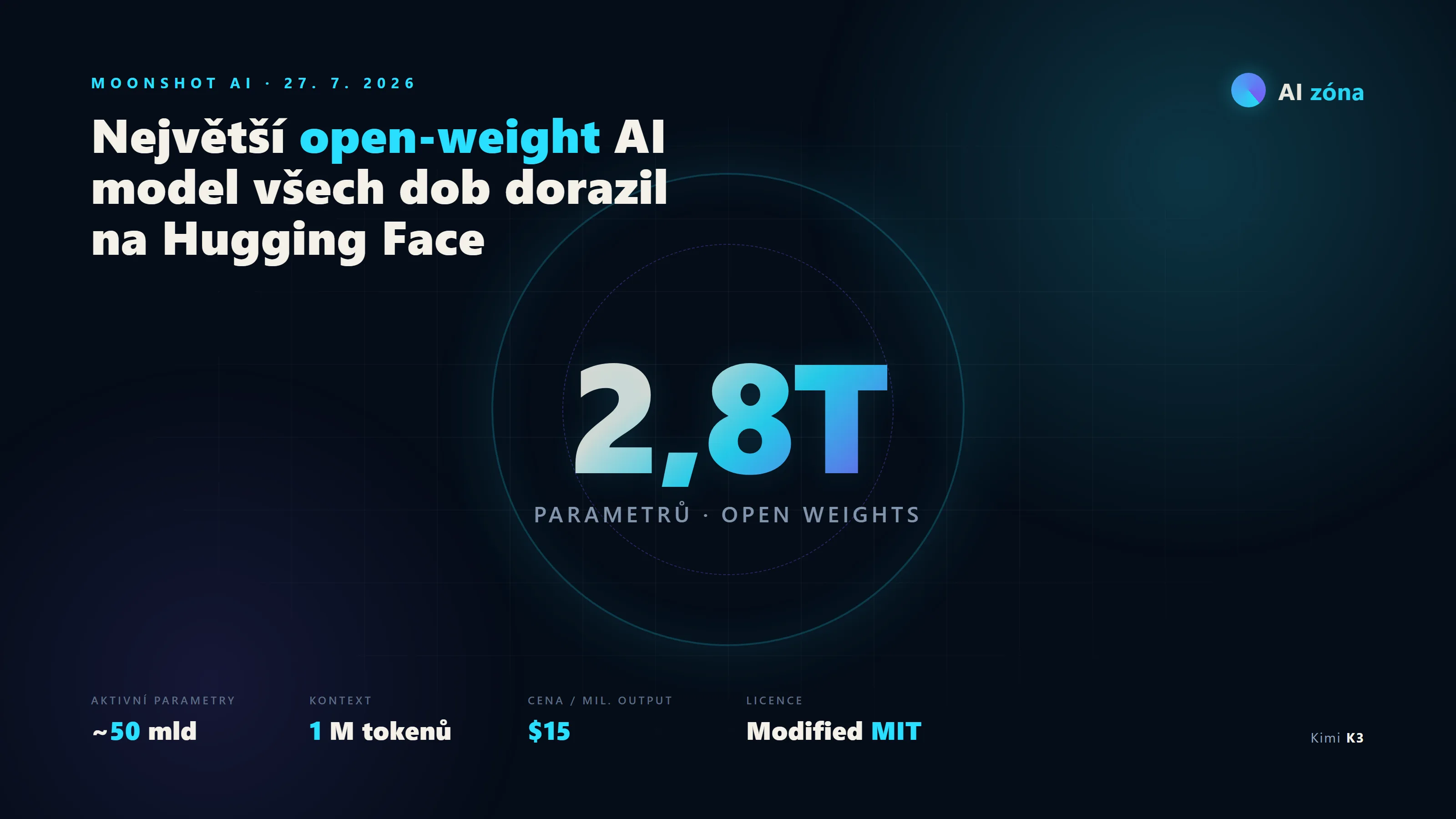
Moonshot AI released Kimi K3 on July 27, 2026, the largest open-weight model in history. It has 2.8 trillion parameters, an MIT-modified license and, through a hosting cloud, costs roughly a third of Fable 5. Running it at home is a no-go.
News analysis
Kimi K3 + Together AI
China's Moonshot AI just did what analysts had penciled in for a year from now. Kimi K3 with 2.8 trillion parameters landed at Claude Fable 5 tier, only it is open-weight. Whoever owns the hardware can download it, run it locally and pay nobody. Whoever does not, which is probably you, will grab it through hosting for a third of frontier-model pricing.
What Moonshot released
Moonshot AI unveiled Kimi K3 at the World AI Conference in Shanghai on July 16, 2026. The model first ran only through its own API and hosting partners; the full weights landed on Hugging Face on Sunday, July 27 under a modified MIT license. The model has 2.8 trillion parameters, but thanks to the Mixture of Experts architecture only 16 of 896 experts fire per token, about 50 billion active parameters. Compute-wise it runs more like a mid-size model than a 2.8T monster.
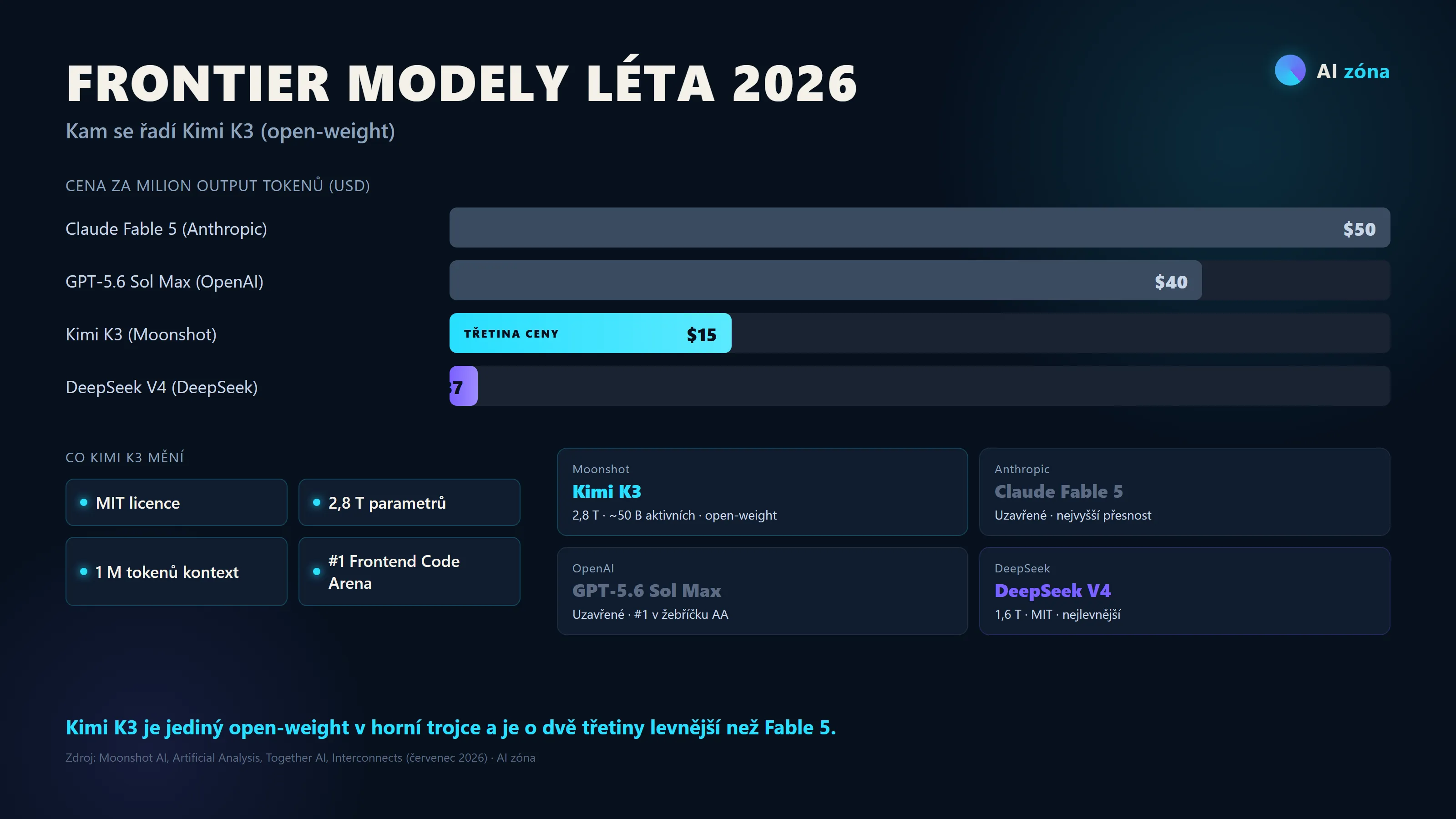
On top of that, Moonshot added two architectural novelties, Kimi Delta Attention and Attention Residuals, giving it a claimed 2.5× scaling efficiency over the previous K2 generation. The context window is set at 1 million tokens, enough for a full code repository or a longer document corpus. Benchmarks back it up: K3 finished #2 in the Vals AI leaderboard and #3 in the Artificial Analysis Intelligence Index (behind Fable 5 and GPT-5.6 Sol Max), and it took first place in the Frontend Code Arena. Moonshot's own API sells at 15 dollars per million output tokens, roughly a third of Fable 5.
What K3 actually changes beyond the headlines
The largest open-weight model ever sounds like a marketing line, but it really moves two things at once. The price for frontier-tier quality dropped, because Moonshot is pushing Together AI, Modal and others to host the model cheaper than Anthropic's Fable 5. The second is data control. Once you deploy K3 to your own data center, your prompts never leave it. For compliance-heavy sectors it is the first real alternative to the closed US models without a quality tradeoff.
Kimi K3 also disproves the claim that Chinese AI labs live off distillation from American models. Kimi Delta Attention and Attention Residuals are original architectural changes, not copies of transformer blocks from OpenAI papers. Analysts had expected a Chinese Fable-tier model no earlier than spring 2027; K3 arrived half a year sooner. That raises the pressure on Washington to rethink export controls, because blocking gets harder when a frontier model streams for free from Hugging Face.
Who this actually makes sense for
Not for everyone who uses ChatGPT or Claude today. Kimi K3 through hosting is a tool for four specific profiles. The rest will save nothing on it and will only add one more vendor to worry about.
Dev team with large API bills
A team burning through more than a billion tokens per month on Claude Fable 5. Moving to K3 via Together or Modal saves two-thirds of the cost, and coding quality stays comparable or better. Fastest ROI when replatforming the stack.
- Agent migrations
- code review
- code generation
Compliance-heavy startup
A company that cannot send data outside its own data center, or at least outside European jurisdiction. K3 hosted through Modal in the EU region, or self-hosted at a major provider, offers the first open-weight route to Fable-tier quality without data leakage.
- Banking
- healthcare
- GDPR-sensitive data
Small firm looking for a Claude alternative
A marketing team using Claude Sonnet or Opus that no longer wants to be locked into one vendor. K3 through OpenRouter plugs into the same workflow; switching between models is a matter of changing one string.
- Content
- document analysis
- agent assistant
Researcher or lab
Anyone who needs the weights to fine-tune on their own domain, or to keep experiments reproducible without hoping OpenAI does not change the model tomorrow. K3 is MIT-licensed, both commercial use and modification are allowed.
- Fine-tuning
- reproducible research
- papers
How to give K3 a try in one evening
The easiest path leads through Together AI, which hosts the model from launch day. You sign up at together.ai, the first five dollars of credit are free, that covers about 300 thousand output tokens, roughly a few dozen longer prompts or a whole night of agentic work. You generate the API key in Settings, the endpoint is OpenAI-compatible, so it works with libraries like openai, litellm, openrouter or langchain without code changes.
For a coding workflow, the OpenRouter route is worth it: it forwards K3 straight to clients like Cursor, Cline, Aider or Continue. In Cursor you switch the model to moonshotai/kimi-k3, drop in the OpenRouter API key and the agent runs. The bill for an hour of pair-coding sits around one to two dollars, roughly at Fable 5 rates, but with the difference that K3 is first in the Frontend Code Arena.
Example from practice
A ten-person marketing agency uses Cursor and Claude Sonnet for landing page builds, personalization pipelines and internal analytics scripts. Monthly API spend around 800 dollars. Switching Cursor to Kimi K3 through OpenRouter dropped the bill to 280 dollars, and nobody on the team noticed a quality difference. They deliberated for four hours, the switch itself took ten minutes plus a week of live testing. The saved 520 dollars per month now stays on the credit card, not in Anthropic's pocket.
Where to reach K3
Four ways to run K3 without touching hardware. Ordered from easiest to most involved.
- Together AI
- Modal
- OpenRouter
- Moonshot API
Together AI is the default pick for a fast start, standard pay-as-you-go and European latency through AWS Frankfurt. Modal is interesting when you need more control over the environment or want to combine inference with your own Python code. OpenRouter is the bridge to agentic clients. Moonshot's own API offers the lowest price, but paying a Chinese company is administratively the hardest option in Europe, and data technically passes through Chinese infrastructure.
Bottom line
Kimi K3 is the most interesting open-weight release of 2026. Frontier quality, MIT license, price at a third of Fable 5. Not for everyone using Claude today, but for anyone who pushes serious token volume or needs the weights for compliance, this is the summer's best pick. Start with a Together AI account, plug it into Cursor via OpenRouter and run it for a week alongside Fable 5. The price difference hits you immediately; the quality difference only shows up where it truly matters.
Sources
- Moonshot AI, Kimi K3 model card on Hugging Face, July 2026.
- Nathan Lambert, Interconnects: Kimi K3, the open-weights escalation, July 22, 2026.
- VentureBeat: China's Moonshot AI releases Kimi K3, the largest open-source model ever, July 16, 2026.
- Fortune: Moonshot's Kimi K3 pushes Chinese AI into Fable-level territory, July 16, 2026.
- TECHi: Kimi K3 open weights arrive July 27. The catch is 1.4TB, July 2026.
- Together AI: Kimi K3 on Together model catalog, July 2026.
Frequently asked questions
What people often ask
Is Kimi K3 worth it if I already use Claude or ChatGPT?
If you deal with coding, agentic workflows or long contexts and do not want to pay the Fable 5 tariff, Kimi K3 through Together AI makes sense. The cost per million output tokens is roughly a third of Fable 5. For regular content and chat you will not feel the difference, Claude or ChatGPT still cover you well. Consider K3 mainly when you push more than a billion tokens per month, or when compliance forces you to keep the option of moving to your own infrastructure open.
How do I try Kimi K3 without owning a data center?
The fastest route is Together AI or Modal, both host the model from launch day. You sign up, get an API key and call it through the standard OpenAI-compatible interface. Registration takes five minutes and the first few dollars of credit usually come free. Moonshot has its own pay-as-you-go API, but paying a Chinese company is more paperwork in Europe. Through OpenRouter, Kimi K3 plugs directly into Cursor, Cline or any other agentic client, and you use it in the same workflow as Claude.
Kimi K3 versus Claude Fable 5: what is the main difference?
Kimi K3 is open-weight, you can host it yourself if you have the hardware, or through a cloud. Fable 5 is closed, no weights, only API. In benchmarks K3 sits just below Fable 5, but in coding it ranks higher. The price of Kimi K3 through hosting is roughly a third of Fable 5. Fable 5 wins on precision in complex agentic tasks and on depth of reasoning. If a solid open alternative is enough and you care mainly about cost and vendor independence, K3 is the better pick.
Is it safe to send company data through a Chinese model?
Through Moonshot's own hosting, not really, your data would pass through Chinese infrastructure. Through Together AI or Modal, the data sits with an American provider that has standard SOC 2 and European availability. The safest option is self-hosting, where nobody outside your data center sees the weights or the prompts. That is exactly why Moonshot open-sourced the weights. For sensitive data, pick Together, Modal or your own infrastructure, not Moonshot's API directly.
How much hardware do I need to run K3 at home or in a small company?
Realistically at home, you cannot. At native 16-bit precision the model needs roughly 5.6 TB of fast memory. In the leaner MXFP4 4-bit mode it still needs 1.4 TB. The minimum is about eight 192 GB cards (typically NVIDIA Blackwell or AMD MI400) on a single node, or eighteen 80 GB cards. That is hardware worth tens of millions of dollars, run only by data centers or major clouds. For a small company, the only practical route is hosting through Together or Modal, where you pay per token with no hardware investment.
Keep going
Related articles
More guides from the same area, topics and tools.

China is betting 2 trillion yuan on AI without Nvidia. Will it build its own world?
China is preparing a five-year plan worth 2 trillion yuan (~$295bn) to build a national AI grid that runs 80% on domestic Huawei chips. What does it mean for the models you use?
OpenAI's Astra solved ten open math problems. For 2,000 dollars in API tokens
OpenAI announced a new model family called Astra on August 2, 2026. An internal version cracked ten mathematical problems that had been stuck for a decade or longer, and published the proofs as machine-verifiable Lean 4 certificates.

Claude Science: can Anthropic take over scientific research now that it grabbed a Nobel laureate too?
On June 30, 2026, Anthropic launched Claude Science, a standalone application for scientific research. Ten days earlier, Nobel laureate and AlphaFold co-creator John Jumper defected to them. What does that mean for biotech, pharma and academia?