
GPT-5.6 arrives as a trio: Sol, Terra and Luna. Plus a Voice that hears you while it speaks
On Thursday, July 9, 2026, OpenAI launched GPT-5.6 globally. Instead of a single flagship, a trio: Sol for max reasoning, Terra as the default workhorse, Luna for volume. Plus a new voice generation called GPT-Live and three weeks of government brake behind it all.
News analysis
ChatGPT + OpenAI API
On Thursday, July 9, 2026, OpenAI returned to the global market with a new generation of models. It did not ship a single model with a higher number, but three at once, each with its own role. I have to admit it took me a while to get used to the new naming system, but it makes more sense than the past race for decimal points. The number now tells you the generation, the name tells you what the model is for.
Three models instead of one flagship
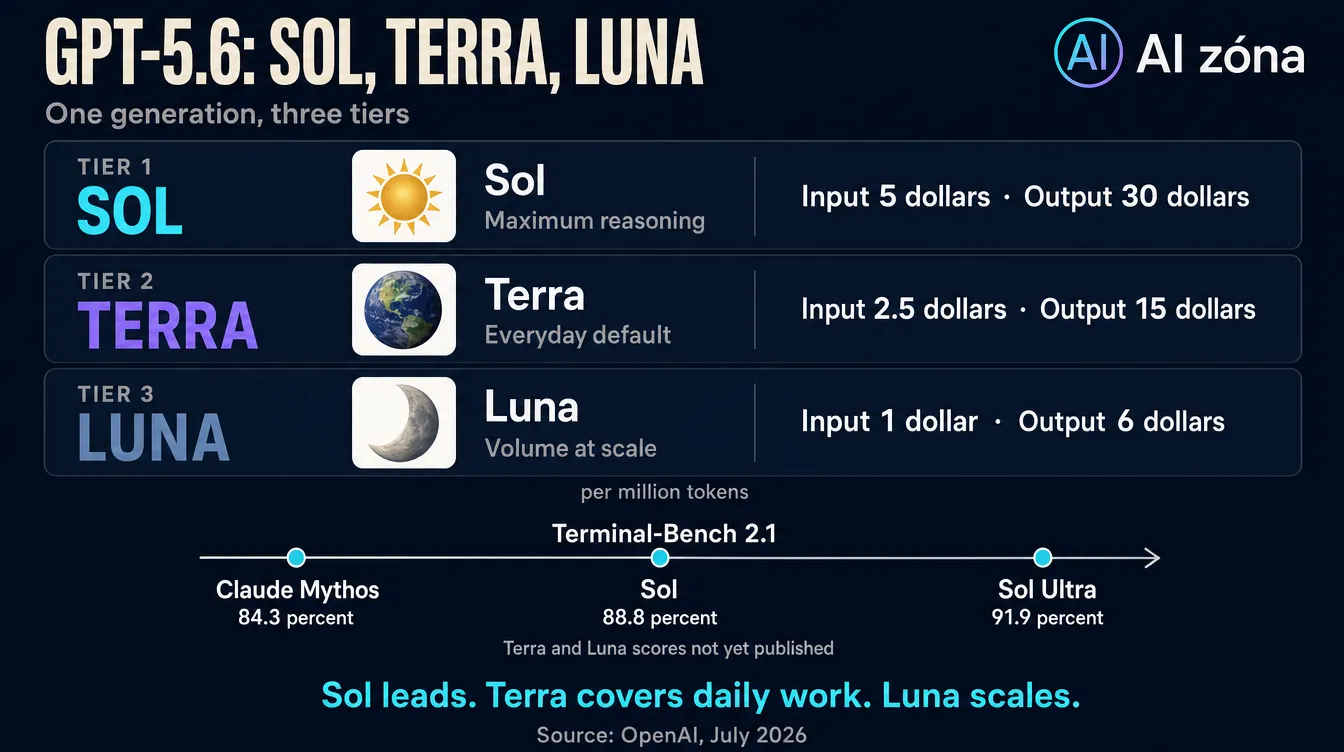
Sol is the strongest variant. OpenAI showcases it on most benchmarks in the release notes, and it is the only one that unlocks the new maximum reasoning mode and the so-called Sol Ultra for the hardest tasks. Terra is the middle class, effectively the default model for everyday work. Luna is the cheapest and fastest variant, aimed at volume and routine tasks.
The move from decimal logic (5.4, 5.5, 5.6) to a generation-plus-tier pair came because each tier now evolves at its own pace. Sol pushes capability, Luna pushes price, Terra hunts for the middle ground. When one of them improves, the whole line does not shift with it.
Part of the launch is also the new voice model GPT-Live. OpenAI shipped it a day earlier, on July 8. It replaces the older Voice Mode in ChatGPT and stands on a fully duplex architecture, which I cover in a separate section below.
Why three models and not one flagship
Saves money on large deployments. Terra offers, per OpenAI, comparable performance to the previous GPT-5.5 generation but costs half. For a company that pushes millions of requests through the API daily, this is an immediate bill cut without having to change the workflow. Luna goes further still: a million input tokens for a dollar makes it viable to deploy AI where you'd otherwise have to trim with Sol.
The second effect is architectural. When a developer has three models on hand, they can chain them. Sol on planning and decision nodes, Terra on regular work, Luna on high-volume filtering. A similar approach works today at Anthropic with Haiku and Opus, but the price ratio between Sol and Luna (five times) gives OpenAI an interesting maneuvering room.
The third reason is regulatory. When OpenAI had to pull the models back into preview for three weeks before the sharp release, it lost part of the market attention. A generation split into three separate products, however, lets it next time ship just Luna, for example, if doubts hang over the strongest Sol. Regulatory risk gets spread out.
Sol for max stakes, Luna for scale
Sol is picked by the team that cannot make a mistake. Typically developers with an agent pipeline, security analysts or researchers on structured problems. The reasoning mode and Sol Ultra open the reserve where earlier models could not handle long chains of decisions.
Terra fits most day-to-day deployments. A marketing team pushing ChatGPT into routine text and summary work, an office where AI supports project management, or a product team switching it on in Copilot will get the same feel as GPT-5.5 from Terra, but with half the invoice. That is why Terra becomes the new default.
Luna has a clear audience in companies dealing with scale. Automatic ticket classification, call center chat analysis, content tagging, extracting items from documents. When a million tokens rounds to a dollar, you can point AI at tasks that previously had to make do with an Excel and regex.
A decision path across three models
Do not start with model choice, start with the task. Picking based on paper benchmarks is an easy trap, because a benchmark never captures what you are actually missing. A working approach:
A smaller e-shop wanted to plug AI into customer chat. The test set: 200 real conversations from the last month. Sol delivered the best answer quality but was 5× more expensive than Luna, while the accuracy gap was only 4 percentage points. Terra came out as a compromise but broke down on complex complaints. Outcome: the company shipped Luna into production for first replies and a decision node in Node.js code switched it to Sol only for cases where the conversation contains the word "complaint", "refund" or "return". The AI bill dropped 78 percent compared to the original GPT-5.5 deployment, quality stayed the same.
The practical playbook has three steps. First, take a small sample of real inputs, so 50 to 200 examples of what the model will run into. Push them through Sol, Terra and Luna and grade the outputs yourself, not through another model. In the second step, calculate what each model would cost you at a realistic volume, and divide the gap by the accuracy benefit. In the third, build a decision node: when the request goes to Sol, when Terra is enough, when Luna handles it. That last route usually delivers the biggest savings.
GPT-Live: a voice that hears you while it speaks
On July 8, 2026, OpenAI shipped GPT-Live, a new generation of voice models for ChatGPT. The core difference against the current Voice Mode: the architecture is fully duplex. The model can speak and listen at the same time, which changes the dynamic of a regular conversation. You can interrupt it, it replies in your breath, adds "mhm" or "yeah" when it wants to signal it isn't blocking you. It sounds like a detail. The difference is audible in two sentences.
When GPT-Live meets a request that needs reasoning or web search, it pulls in GPT-5.5 in the background and delivers the answer when it has it. In your headset it stays one voice, but the heavier thinking runs under the hood on the stronger model.
Rollout runs globally through iOS, Android and chatgpt.com. Paid accounts (Plus, Team, Pro, Enterprise) get the full GPT-Live-1, the free tier stays on GPT-Live-1 mini. For anyone plugging voice into customer service or personal productivity, this is a concrete step. I have to admit this is the piece I enjoy most from the whole bundle, because I could not use the first Voice Mode for more than five minutes without it interrupting me with a pause after every sentence.
Recommended tools
The ecosystem around GPT-5.6 stands, for now, on three entry points. Which way you take depends on whether you want quick testing, production deployment or a voice interface.
ChatGPT with Terra
OpenAI
Terra is the default model for paid accounts from July 9. The interface stays the same, you can switch to Sol for the hardest tasks or to Luna for quick work.
Best for
Plus, Team, Pro users
OpenAI API
OpenAI
Sol enters preview globally, Terra and Luna open up progressively. Pricing Sol $5/$30, Terra $2.50/$15, Luna $1/$6 per million tokens (input/output).
Best for
Developers and companies
GPT-Live
OpenAI
Fully duplex voice model. Paid accounts get the full version, free tier GPT-Live-1 mini. Reasoning in the background is handled by GPT-5.5.
Best for
ChatGPT users, voice UX
What to take away
The Sol, Terra and Luna trio is the biggest change in OpenAI's naming logic since GPT-4. Sol claims the role of the strongest model on the market with a small but real lead over Claude Mythos on coding tasks. Terra opens a path to cut the AI bill in half without a company changing its workflow. Luna opens deployments where AI could not reach at all before.
The government pause around preview showed at the same time that launch speed is no longer only in the maker's hands. When you plan a deployment, expect more of these brakes on models with a security impact. If you run an agent on GPT-5.5 today, trying a test migration to Terra is a quick way to find out how much your bill drops.
Sources
- Previewing GPT-5.6 Sol: a next-generation model (OpenAI)
- Introducing GPT-Live (OpenAI)
- OpenAI to publicly release GPT-5.6 (CNBC)
- OpenAI unveils GPT-5.6 Sol, Terra and Luna models (VentureBeat)
- GPT-5.6 Sol, Terra, and Luna: OpenAI's Next-Gen Model Family (DataCamp)
- GPT-5.6 Pricing 2026: Sol, Terra and Luna Tiers Explained (Finout)
- OpenAI launches GPT-Live voice model series (SiliconANGLE)
Frequently asked questions
What people often ask
Is it worth moving from GPT-5.5 straight to GPT-5.6?
For everyday ChatGPT work, OpenAI will do it for you, because Terra becomes the default option for paid accounts. Over the API you are ahead of the curve if you already push GPT-5.5 into large workloads. Terra offers comparable quality for half the price, so it is effectively a cost cut without losing performance. If you handle mainly complex coding or research tasks, Sol pushes the ceiling and Sol Ultra unlocks a new maximum reasoning mode. Roll the migration in a test environment first, benchmarks are not the same as your real inputs.
How do I choose between Sol, Terra and Luna?
Based on what is expensive for your task: accuracy, or volume. Sol is picked by anyone dealing with agent pipelines, long planning, code generation with minimum errors and security analysis. Terra fits into most daily use: summarization, text drafting, developer help outside of top-tier tasks. Luna is for classification, tagging, routine customer communication and anything where latency and price matter more than depth of reasoning. In practice a mix works best. Sol on critical steps, Terra as the default, Luna on the outer shell.
Is GPT-5.6 Sol better than Claude Mythos?
On Terminal-Bench 2.1, which measures command-line work and step planning, Sol landed at 88.8 percent, Claude Mythos 5 at 84.3 percent. Sol Ultra then pushed the bar to 91.9 percent. On cyber tasks like ExploitBench, Sol delivers quality comparable to Mythos Preview, but does it with roughly one third of the output tokens. That is a decent lead, but a narrow one. On other types of tasks, mainly creative and language nuance, Anthropic still holds the front. For a corporate decision, what you test matters more than any single benchmark.
Why did the US government hold up the launch?
It reacted to the claim that the new models are better at finding software vulnerabilities. So three weeks before the sharp launch OpenAI ran preview only for a few US partners, the rest of the world waited. In its corporate communication, OpenAI writes that it treats such a restriction as an exception, not a standard. For you it mainly means one thing. The speed with which a new model reaches production is no longer controlled only by the maker but also by the regulator. For security deployments, expect more of these pauses.
How much does GPT-5.6 cost via API and when will Terra and Luna reach general availability?
Pricing starts like this: Sol is $5 per million input and $30 per million output tokens. Terra is half that, so $2.50 and $15. Luna is the cheapest: $1 input, $6 output. Sol enters preview globally, Terra and Luna open up progressively, OpenAI has not given a concrete general availability date yet. Through ChatGPT, Terra is available for paid accounts as of July 9, Luna is heading for wider rollout in the following weeks. The price gap between Sol and Luna is five times, which is decisive at larger volumes.
Keep going
Related articles
More guides from the same area, topics and tools.
OpenAI's Astra solved ten open math problems. For 2,000 dollars in API tokens
OpenAI announced a new model family called Astra on August 2, 2026. An internal version cracked ten mathematical problems that had been stuck for a decade or longer, and published the proofs as machine-verifiable Lean 4 certificates.

Claude Science: can Anthropic take over scientific research now that it grabbed a Nobel laureate too?
On June 30, 2026, Anthropic launched Claude Science, a standalone application for scientific research. Ten days earlier, Nobel laureate and AlphaFold co-creator John Jumper defected to them. What does that mean for biotech, pharma and academia?
GLM 5.2: New King of UI?
Chinese open-source model GLM 5.2 builds apps, games and components from a single prompt in ways that leave Claude Opus 4.8 behind. Is this the new leader in UI generation?