Codex agents will run inside a company's own cloud. Why is OpenAI buying Ona?
OpenAI announced on June 11 that it is buying the German company Ona (formerly Gitpod). Codex agents will run for hours directly inside a customer's VPC, with audit logs and access control. What it changes for companies, banks and developers.
News analysis
OpenAI Codex + Ona
What is new
On June 11, 2026 OpenAI announced it is buying the German startup Ona, previously known as Gitpod. The acquisition is signed and only regulatory approval is missing, which as of August 2026 is still running. The 79-person team around CEO Johannes Landgraf moves under the Codex group once the transaction goes through. Nobody published a price. Bloomberg and analysts at Crunchbase estimate four to five hundred million dollars.
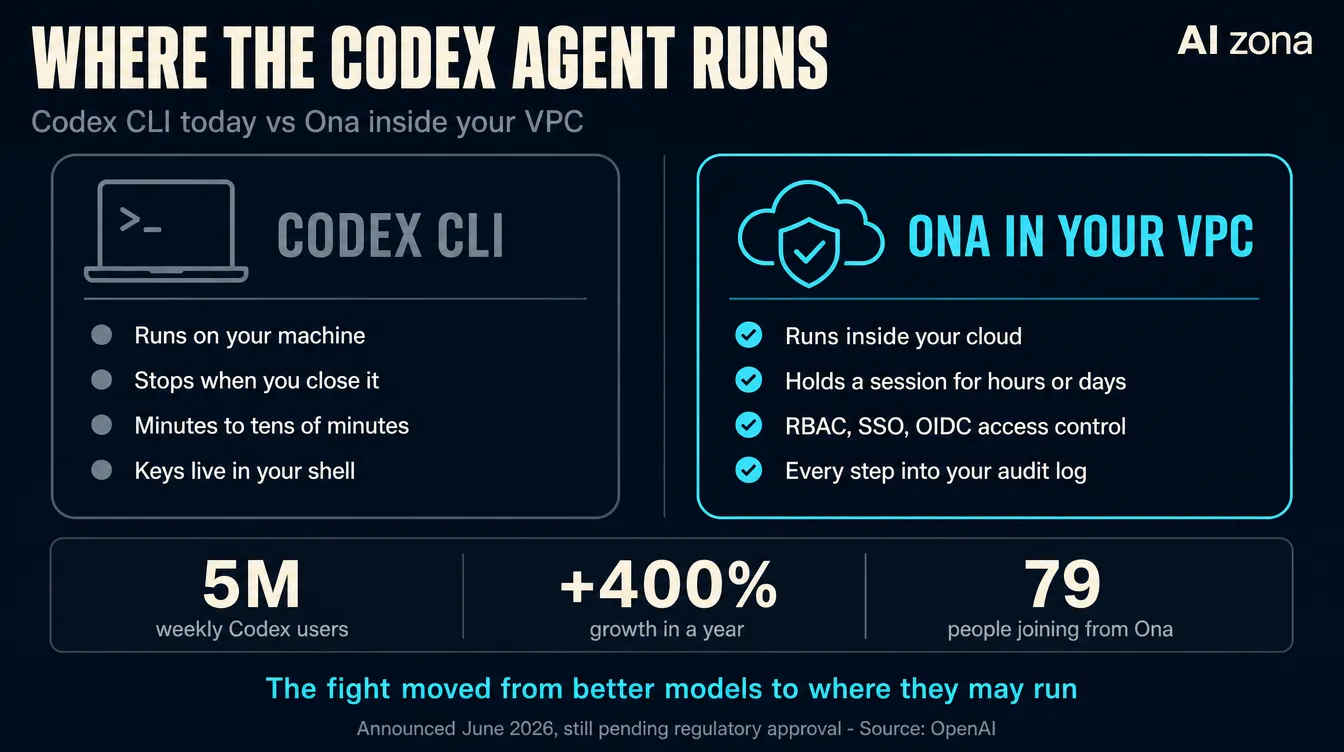
For OpenAI, Ona is a strategic shortcut. Rather than spending months building its own cloud environment for long-running agents, it buys a finished product already used by American banks, European pharmaceutical companies and Asian sovereign wealth funds. Concretely it gets three things: a persistent sandboxed cloud environment for agents, an automation layer for multi-step work, and an enterprise security layer (role-based access, SSO, OIDC, audit logs, deployment into the customer's VPC).
Anthropic reacted within hours. It raised Claude Code limits by fifty percent and sent a clear signal that this segment will be fought over hard. For you that means two things. Coding agents will get cheaper and will handle longer tasks.
- Codex CLI
- Codex Cloud
- VS Code Codex extension
- Enterprise VPC deploy
What you will appreciate most
Data stays home. A Codex agent can read internal code, go through a database or write to a ticket without any of it leaving the company perimeter. For a regulated industry that is often the precondition without which AI could not be deployed at all. In practice it means legal can finally green-light a pilot.
Ona gives Codex four layers of control that were missing:
Location
Permissions
Credentials
Audit
Agents last longer. Codex CLI so far worked only while you kept the terminal open. Ona holds a session for hours or days. The agent finishes migrating a thousand files, works through a hundred pull requests or monitors a production log overnight. Without you.
The third thing shows up on the invoice. The acquisition signals that OpenAI will fight for the coding agent segment on price as well as capability, and Anthropic has already responded. For you that means your next payments for Codex or Claude Code will likely be lower than today, or you will get more for the same price.
Who this is for
The acquisition targets enterprise, but different types of users will feel the impact differently. Some will see a blocker disappear that held them up for a long time. Others will wait a few months until the new capabilities reach public plans.
Developer at a large company
- Code review
- Refactoring
- Migrations
- Dependency audit
SaaS founder
- Background jobs
- Customer ops
- Long migrations
Freelancer / consultant
- Multiple clients in parallel
- Separated access
Marketer / non-technical
- Content automation
- Reports
- Data pipeline
Rule of thumb: if you have been trying Codex and it worked for you, do nothing for now. If you could not deploy it because of compliance, it is time to reopen the discussion with IT and legal.
How to use it in practice
Publicly available Codex still works the same. Changes will appear gradually after the acquisition closes, starting with enterprise customers. You can prepare now, though, so you are not scrambling to build oversight and processes later.
01 · Inventory
02 · Risks
03 · Pilot
Where it pays to stay cautious, even when it looks tempting. Persistent agents running inside a VPC demand the same processes as any other internal application. Monitoring, alerting, an incident plan, separation of production and test. If you do not have that for regular services today, do not start with agents. The risk that an agent makes an unforeseen production change overnight is real. An audit log documents the situation, it does not stop it.
Technically it pays off already today to:
- clarify who on the team will operate the agent (who approves actions, who receives alerts),
- introduce a naming convention for permissions and keys so they can be revoked easily,
- try Codex CLI on a task you repeatedly handle manually and write a post-mortem from it,
- agree with vendor management on who owns the OpenAI contract after the acquisition closes.
Example from practice
A mid-sized Czech insurer wanted to use Codex to audit dependencies in an internal Java repository. The audit was done manually once a quarter, took a week and often missed edge branches. Compliance rejected Codex because the repository contained code comments referencing client data. Ona changes the situation. The agent can run inside the insurer's VPC, read the repository, generate a report into an internal Jira ticket, and nothing ever leaves the company infrastructure. The audit log flows straight into the corporate SIEM. The insurer now runs the same task every two weeks instead of quarterly.
Recommended tools
If you want to start evaluating whether enterprise Codex will pay off for you once the acquisition closes, three layers of tooling can be combined. A local client, a team cloud, and an alternative for comparison.
- Codex CLI is the fastest way to try a Codex agent without deploying into the company cloud. It suits single-user tasks and pilots.
- Codex Cloud (web) is today's shape of long-running agents on OpenAI infrastructure. Ona's technology lands here after the acquisition closes.
- Claude Code is the competition worth benchmarking against. Anthropic already raised limits by fifty percent, so a comparative benchmark makes sense.
- Ona (standalone) still exists as a product. If you have a VPC and want an agent environment before the acquisition goes through, you can run Ona without an OpenAI contract.
The choice between Codex and Claude Code is open right now. Put both on the same task and compare the output. Price, latency and code quality will all shift over the coming months.
Summary
The Ona acquisition does not bring a new AI capability. What it changes is where a Codex agent can run and who controls it. For a small company or a freelancer almost nothing changes in the near term, apart from prices dropping and limits growing over time. For a large company in a regulated field, doors open that were closed until now. Codex agents inside an internal cloud, with audit logs, separated access and data under control.
For the AI scene it signals that the most important battle is no longer about a better model, it is about where a model may run and how a company governs it. OpenAI does not want to lose that battle to Anthropic, and it paid roughly half a billion dollars for it immediately. For you it means one thing. Coding agents will be cheaper, will last longer, and will soon reach places they were not allowed before.
Sources
- OpenAI to acquire Ona — official OpenAI announcement, June 11, 2026
- OpenAI to Acquire Cloud Platform Ona to Support AI Agents — Bloomberg, context and price estimates
- OpenAI buys Ona to help rein in AI agents — InfoWorld, technical breakdown
- Gitpod is now Ona: your AI software engineer — Ona's own rebrand announcement from Gitpod, September 2025
- Why OpenAI Bought Ona: Cloud Execution for AI Agents — analytical breakdown of OpenAI strategy
Frequently asked questions
What people often ask
What does it mean that Codex agents will run in a company's own cloud?
Instead of running on OpenAI infrastructure, Codex agents can be deployed straight into a customer's virtual private cloud. A bank, insurer or healthcare provider gets the agent inside its own perimeter. Data never leaves. Access is governed by the company IAM. Everything lands in the company audit tooling. In practice: the agent can read an internal repository, run tests and write to a ticketing system, while sensitive data never leaves an environment the company controls. For regulated industries that is often the precondition without which AI could not be deployed at all.
When will this show up in Codex? Should I wait for it?
The acquisition is announced but regulators still have to approve it. OpenAI says the Ona team joins the Codex group once the transaction closes. Public Codex CLI and the web environment keep working exactly as before. New enterprise VPC deployments will appear first for customers on the Enterprise plan. If you are just trying Codex on your own work, there is nothing to wait for. If you are handling a deployment for a company in a regulated field, it pays to start a pilot in the existing Codex environment now and watch for enterprise announcements through the end of 2026.
What is the difference between Ona and regular Codex CLI?
Codex CLI runs locally on your machine. Turn the machine off and the agent stops. It typically works in minutes to tens of minutes. Ona instead offers a persistent cloud environment where an agent can run for hours or days. It has its own memory, tools, permissions and audit log. It suits tasks like migrating a large repository, bulk refactoring across a hundred files, multi-step code research or continuous monitoring. The core difference is durability and control: Codex CLI is your desk, Ona is a workshop open to the team and audited.
How much did the acquisition cost and why did OpenAI do it now?
Nobody published a price. Analysts estimate four to five hundred million dollars based on multiples of Ona's expected 2026 revenue. The timing comes down to competitive pressure. Codex has five million weekly users, but Anthropic's Claude Code is catching up fast, especially on coding agents where Claude Fable 5 posts strong results. OpenAI does not have to spend months building a cloud environment for long-running agents when it can buy one for a fraction of a year's margin. Anthropic promptly raised Claude Code limits by fifty percent.
What was Ona before the deal and why did it rename from Gitpod?
Ona is a German startup with a team of 79. Before its September 2025 rebrand it operated as Gitpod and sold cloud development environments (CDE). After the rebrand it pivoted entirely to AI agents. The CEO and co-founder is Johannes Landgraf. Its clients include large American banks, European pharmaceutical companies and Asian sovereign wealth funds. Enterprise deployments grew thirteenfold in 2026. The defining trait: the agent runs inside infrastructure the client controls, with audit logging and separated access. That is exactly what OpenAI needed to scale Codex further into regulated industries.
Keep going
Related articles
More guides from the same area, topics and tools.

What can Gemini Spark do? Google shows what a practical AI agent looks like
At I/O 2026, Google introduced Gemini Spark, an independent AI agent that runs continuously in the cloud and works with Gmail, Docs and partners such as Canva and Instacart. It has launched only in the US so far, but it shows where every major AI company is heading.

Claude Sonnet 5 gets almost as good as Opus 4.8 for half the price. Is that actually true?
On June 30, 2026, Anthropic made Claude Sonnet 5 the default model for Free and Pro plans. This article was written by Sonnet 5 itself, no spin, about when it's actually worth it.

Claude Fable 5: how good is the model that wrote this article about itself?
The most capable model of the moment? I let Fable 5 write the article about itself. See how it did: benchmarks, pricing and the safety guardrails inside.